艺术
美容与健康
工艺
文化与历史
娱乐
环境
食品与饮料
逆向工程
科学
体育
技术
可穿戴设备


Shoe, Depth and Guard: The Saw You Carry to the Timber
The radial arm saw brought the blade to the work, but the work still had to come to the machine. A roof truss does not.
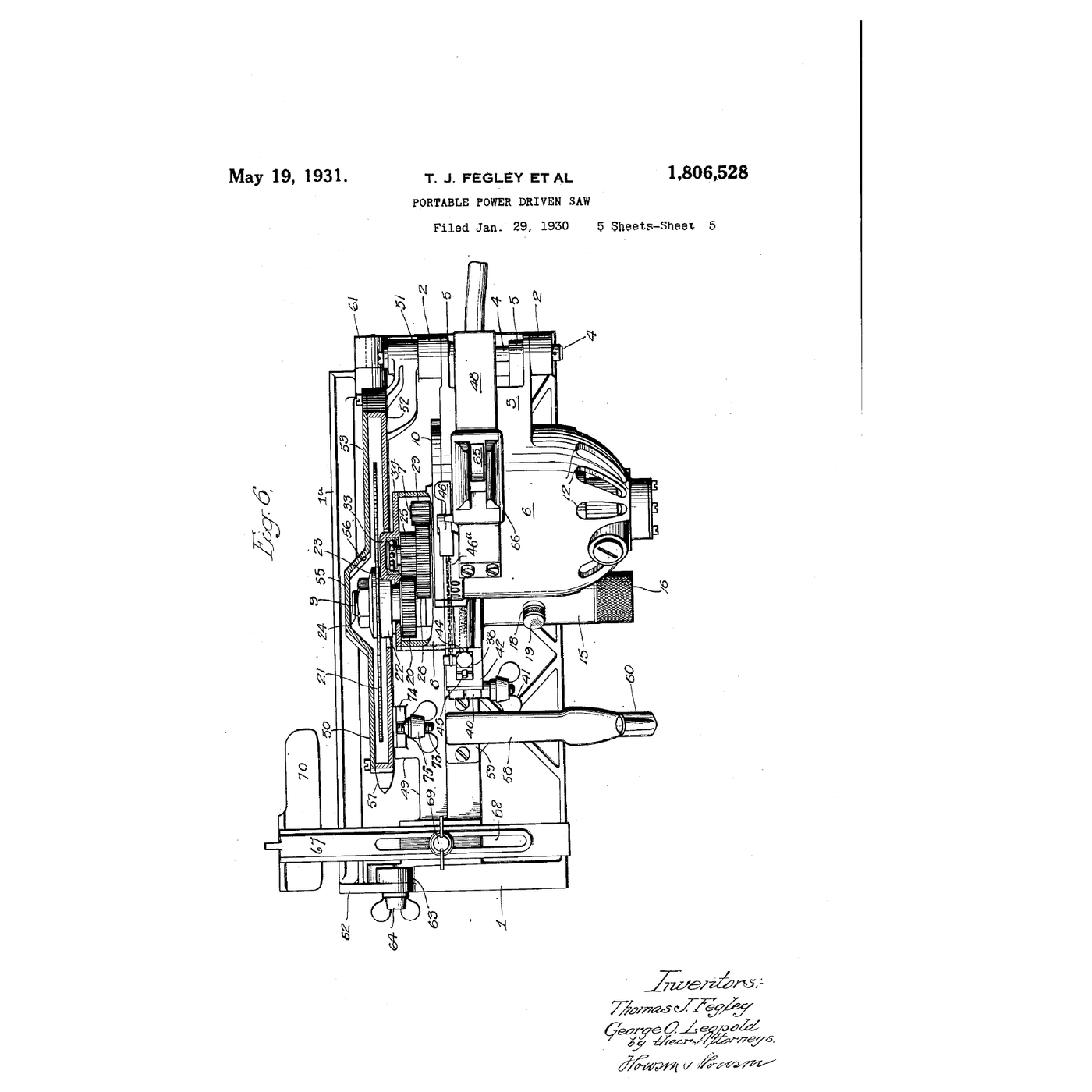
Fegley and Leopold's answer puts the motor on a frame that pivots over a flat base plate, so the whole tool rides ON the timber and the blade projects through a slot in the plate. Depth is set by pivoting the motor; the guard hangs on its own hub on the same pin and swings out of the way as the cut opens.
Three things make it work and all three are on the patent's drawings: the flat shoe that sets the reference, the pivot that sets the depth, and the guard that closes itself. This rung measures what each one is worth.
中级
About 2 hours
说明
1
1
The shoe is the reference surface, so check it is flat
The shoe is the reference surface, so check it is flat
Unplug the saw. Set the depth to zero so no blade projects, and lay the shoe on a surface you trust — a saw table, a jointed board, a piece of float glass.
Try a feeler gauge under each corner. A stamped-steel shoe that has been dropped is rarely flat, and every cut you make is referenced from it. A shoe rocking by 0.3 mm puts the same error into every cut regardless of how carefully you follow the line.
Then set the blade square to the shoe: wind the depth right down, put the combination square against the shoe and up to the blade BODY — never the teeth, which are set left and right and will read wide by the set. Check at the front of the blade and again at the back. If they differ, the arbor is not parallel to the shoe and no amount of care fixes it.
Write both checks down. Fegley's base plate is element **1** on the drawing with lugs **2** at the rear carrying the pivot — everything else hangs off that one flat surface.
所需工具:
 圆锯
圆锯 组合角尺
组合角尺 塞尺套装
塞尺套装 直尺
直尺2
2
How the depth pivot and the self-closing guard actually work
How the depth pivot and the self-closing guard actually work
The patent's mechanism reads directly off the drawing.
The motor and saw spindle sit on a **pivotal frame** attached to the base plate by a pivot pin through the rear lugs. Raising the frame lifts the blade out of the work; lowering it sets the depth. A bar pivoted to the base carries an **adjustable stop**, so a depth once found can be returned to — the same idea as a story stick.
The guard is the clever part. It has two side walls spaced far enough apart to clear the blade, and the outer wall carries a **curved enlargement with a cavity** so the guard can swallow the spindle and clamp washer when the frame is raised. It turns on a **hub 51** mounted on the same pivot pin as the motor frame — so it pivots INDEPENDENTLY of the motor. A clamp of screw stud and thumb nut locks it when wanted.
That independence is the whole safety case. The guard is pushed open by the workpiece as the cut begins and is returned by its spring as the blade leaves. It is not linked to the trigger, not timed, not electrical — it is a flap that the wood itself opens. Nothing that depends on the operator remembering can fail the way this cannot.
所需工具:
圆锯 螺丝刀套装
螺丝刀套装3
3
Cut a straight line, and find out what your kerf actually costs
Cut a straight line, and find out what your kerf actually costs
Clamp a straight batten to a board as a fence, offset from your line by the distance from the blade to the edge of the shoe. Measure that offset with the caliper rather than guessing — it differs between saws and between the two sides of the same shoe.
Set the depth so the blade projects about 5 mm below the underside of the work. Deeper is not safer: more blade in the cut means more tooth engagement, more chance of binding, and more exposed blade under the board.
Support the OFFCUT as well as the keeper. The commonest bind is a cut that closes on the blade as the two halves sag toward each other, and the saw's answer to a closing kerf is to climb back out of it toward you.
Cut, then measure the kerf with the caliper and compare it with the blade plate thickness. The difference is the set, and it is why a cut is always wider than the steel. Mark which side of the line you cut on and keep to it — the kerf has to come out of the waste, every time, or your parts come out short by one kerf each.
此步骤所需材料:
 松木板1 个
 胶合板1 个
所需工具:
圆锯 圆锯锯片
圆锯锯片 C 形夹
C 形夹 6 英寸数显卡尺组合角尺
 安全眼镜
安全眼镜 护耳器
护耳器 防尘口罩
防尘口罩4
4
Depth against bevel, and the force that opens the guard
Depth against bevel, and the force that opens the guard
正在加载 Jupyter 笔记本…
所需工具:
6 英寸数显卡尺5
5
History and context
History and context
**US 1,806,528**, Thomas J. Fegley and George O. Leopold of Philadelphia, assignors to North Bros. Manufacturing Co. Filed 29 January 1930, granted 19 May 1931, on five sheets. Long expired.
North Bros are better known for the 'Yankee' spiral ratchet screwdriver, a hand tool that turned push into rotation. Within a decade the same firm was patenting the shoe-and-guard arrangement for a saw whose power came from a motor — a small company crossing from hand tools to power tools in one generation, which is the transition this whole batch is about.
The portable circular saw did not replace the radial arm saw so much as outflank it. A machine cuts better; a portable saw goes to the timber. On a building site that is not a close contest, and the tool that goes up the ladder wins.
Rung 9 in this batch is the sibling to this one: the worm-drive saw, which solves the same problem a different way by turning the drive through 90 degrees and putting the motor in line behind the blade. Two approaches, both alive today, neither a duplicate of the other.
**Honest limits.** Depth is capped by blade diameter and cut hard by bevel, as step 4 shows. Accuracy depends entirely on a flat shoe and a straight fence. The tool cuts on the underside where you cannot see it. And a closing kerf makes it climb back toward the operator — the reason riving knives were eventually fitted, and the reason offcut support is not optional.
相关蓝图
这些蓝图共享知识——技术、材料或原理

CC0 公共领域
此蓝图以 CC0 协议发布。你可以自由复制、修改、分发和使用此作品,无需征得许可。
通过购买蓝图中的产品支持创客,他们将获得 创客佣金 (由供应商设定),或创建此蓝图的新版本并将其作为连接包含在你自己的蓝图中以分享收入。