艺术
美容与健康
工艺
文化与历史
娱乐
环境
食品与饮料
逆向工程
科学
体育
技术
可穿戴设备
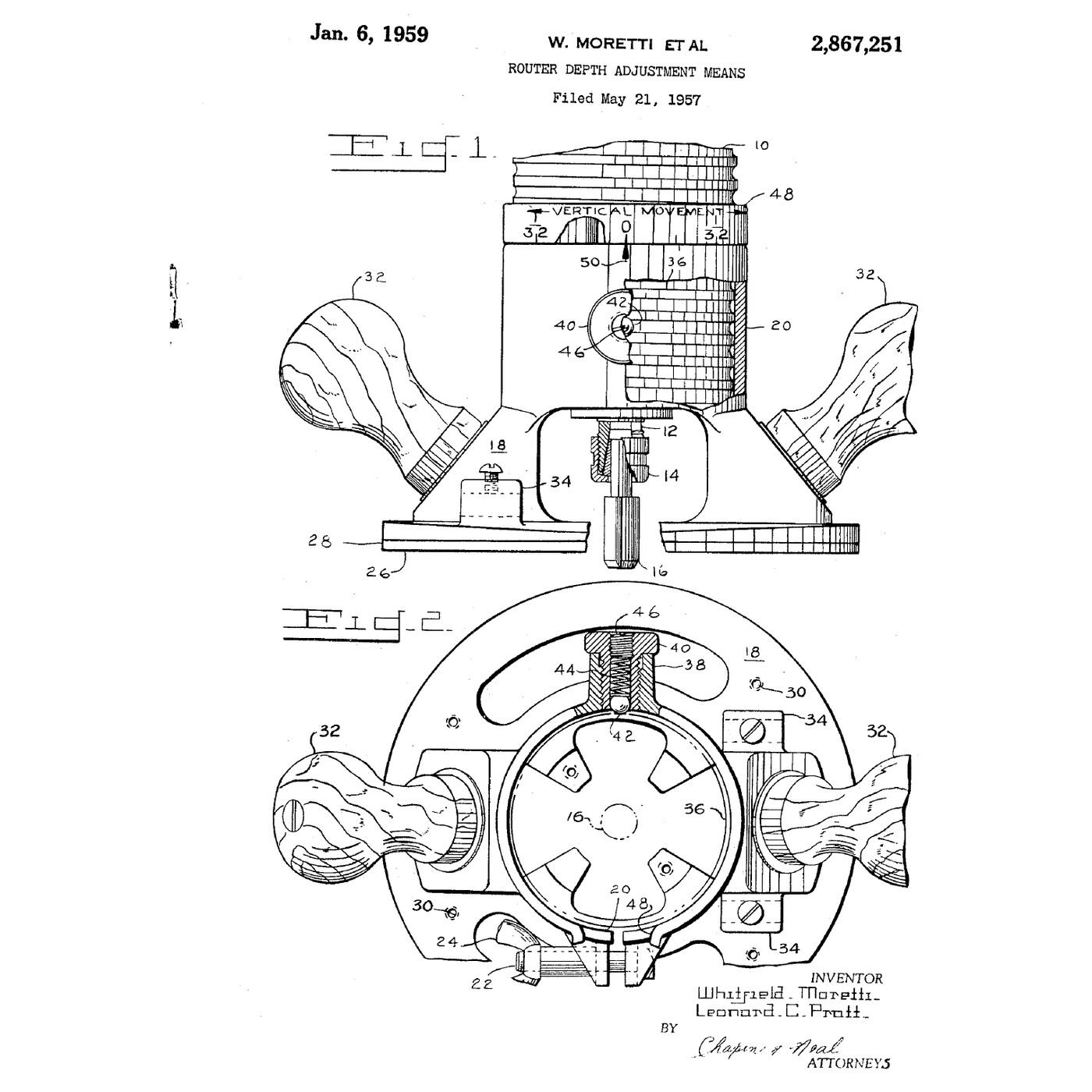


Setting a Depth You Can Trust
A router is a motor holding a spinning cutter, pointed at the work through a flat base. Everything it does well and everything it does badly comes from one number: how far the cutter sticks out below that base.
Get it wrong by half a millimetre and a rebate is loose, a hinge sits proud, a dado shows a line. So the depth adjustment is not a convenience on this tool — it IS the tool.
Moretti and Pratt's answer is elegant: one low-angle thread on the motor housing and a spring-loaded ball in the base. Rotate for fine, slide for rough, and never take anything apart to change between them.
中级
About 2 hours
说明
1
1
Find your zero, because the base is the datum
Find your zero, because the base is the datum
Unplug the router. Fit a straight cutter and stand the machine on a flat reference surface.
Wind the motor down until the cutter just touches — you want the moment the cutter stops a slip of paper sliding under it, not the moment you feel it. That is your zero, and every depth you set afterwards is measured from it.
Mark the zero on the collar. If the router has a depth rod and turret, set the rod to touch its stop at this point and lock it.
Now check something most people never do: wind down 10.00 mm by the collar and measure the actual projection with the caliper depth blade. Write both numbers down. On a worn or cheaply-made collar the two will differ, and once you know by how much you can work with the tool you have rather than the tool it claims to be.
The base is the datum for all of this, so check it is flat and that the sub-base is not proud of its screws — a countersunk screw standing 0.2 mm above the base tips the whole machine and every cut with it.
所需工具:
 木工铣
木工铣 铣刀
铣刀 6 英寸数显卡尺
 直尺
直尺 螺丝刀套装
螺丝刀套装2
2
One thread, two speeds of adjustment
One thread, two speeds of adjustment
The patent is titled 'Router depth adjustment means' and the mechanism is a single arrangement doing two jobs.
A **low-angle screw thread 36** is formed on the motor housing. The base **18** carries a **ball 42** pressed into that thread by a **spring 44**. A **wing nut 24** clamps the base to the housing when you are done.
**Fine.** With the wing nut loosened, rotate the base relative to the housing. The ball rides along the thread and the motor advances by the pitch per turn — the patent's words are that this gives 'a fine accurate adjustment of the cutter position'.
**Rough.** Push the base along the housing instead. The spring yields, the ball rides OVER the thread crests, and the motor slides to roughly where you want it. Then switch back to rotating for the last approach.
A **garter spring 48** carries a **pointer 50** around the housing, so the setting is indexed and repeatable rather than judged by eye.
The elegance is that there is no mode to select. The same ball in the same thread gives you either behaviour depending on whether you turn the base or push it, and nothing has to be released, swapped or remembered.
所需工具:
木工铣螺丝刀套装 内六角扳手组
3
3
Cut a rebate, and learn which way the router pulls
Cut a rebate, and learn which way the router pulls
Clamp a straight batten to a board as a fence. Fit a straight cutter and set 4 mm of depth.
Before switching on, decide your direction. The cutter turns clockwise seen from above, so feeding the router LEFT to RIGHT along the near edge of the work means the cutter's teeth meet the wood against your feed — the router pulls itself against the fence and stays put. Feed the other way and it climbs: the cutter grabs and runs along the work faster than you intend.
Do a short climb cut deliberately, on scrap, holding firmly, so you feel it once and never have to be told again.
Then take the same 12 mm rebate two ways: in one 12 mm pass, and in three 4 mm passes. Compare the edges. The single deep pass burns, chatters and may move the fence; the three light passes leave a surface that needs no cleaning up. Depth of cut per pass is the router's single biggest quality lever, and it costs only time.
Eye and ear protection throughout, and dust extraction if you have it — a router makes the finest dust of any tool in this batch.
此步骤所需材料:
 松木板1 个
 胶合板1 个
所需工具:
木工铣铣刀 C 形夹6 英寸数显卡尺
 安全眼镜
安全眼镜 护耳器
护耳器 防尘口罩
防尘口罩4
4
What a thread pitch is worth, and what holds the setting
What a thread pitch is worth, and what holds the setting
正在加载 Jupyter 笔记本…
所需工具:
6 英寸数显卡尺5
5
History and context
History and context
**US 2,867,251**, Whitfield Moretti and Leonard C. Pratt, assignors to the Millers Falls Company. Filed 21 May 1957, granted 6 January 1959. Long expired.
Millers Falls of Massachusetts had been making hand tools since the 1860s — braces, hand drills, mitre boxes. The `auger-and-brace` rung in this corpus is their world. By 1957 they were patenting the fine adjustment on an electric router, which is the same arc this whole batch traces: a hand-tool company following its customers into motors.
The router itself is older than this patent; what is claimed is the adjustment. That is worth noticing, because it is the pattern for most mature tools — the machine settles down and the patents move to the interface between the machine and the person setting it.
Later designs took a different route: the plunge router lets the motor drop on two posts while running, which the fixed base cannot do. Both survive, because a fixed base is more rigid and a plunge base can start a cut in the middle of a board.
**Honest limits.** The cutter is unguarded by any standard the rest of this batch would accept — the base is not a guard. A climb cut will take the tool out of your hands. Small cutters must run fast and large ones must run slow, which a single-speed router cannot do. And the dust is fine enough to need real extraction, not a bag.
相关蓝图
这些蓝图共享知识——技术、材料或原理


CC0 公共领域
此蓝图以 CC0 协议发布。你可以自由复制、修改、分发和使用此作品,无需征得许可。
通过购买蓝图中的产品支持创客,他们将获得 创客佣金 (由供应商设定),或创建此蓝图的新版本并将其作为连接包含在你自己的蓝图中以分享收入。