艺术
美容与健康
工艺
文化与历史
娱乐
环境
食品与饮料
逆向工程
科学
体育
技术
可穿戴设备

Snell's Law — Measure How Light Bends (Laser and Protractor)
A hands-on school project: shine a laser pointer into water, a glass prism and an acrylic block, measure the bending with a protractor, and discover Snell's law for yourself — the 400-year-old rule behind lenses, sparkling diamonds and fibre-optic internet. A runnable Python cell lets you check your measurements against the prediction, and a closing compendium answers the tricky questions (why thickness does not bend light more, why stacked layers cancel, and why a prism makes a rainbow).
初学者
1-2 hours
说明
1
1
The broken straw
The broken straw
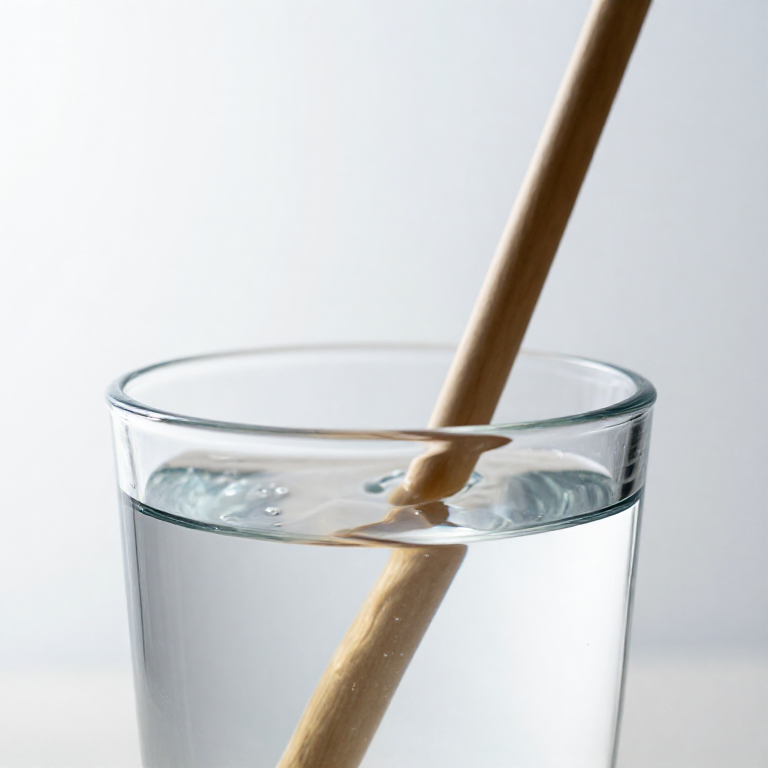
Put a straw in a glass of water and look from the side: it seems to snap at the surface. Light travels more slowly in water or glass than in air, so when it crosses the boundary at an angle it changes direction — it refracts. In this project you will measure that bending yourself with a laser and a protractor, then check your numbers against the 400-year-old law that predicts them.
2
2
The rule you are about to test
The rule you are about to test
Every material has a refractive index n, roughly how much it slows light: air 1.00, water 1.33, ordinary glass about 1.50, diamond 2.42. Snell's law says n1 times the sine of the incoming angle equals n2 times the sine of the outgoing angle, both measured from the 'normal' (the line perpendicular to the surface). The Persian scholar Ibn Sahl wrote it down around 984 AD, and Willebrord Snell rediscovered it in 1621. Keep it in mind — your measurements should obey it.
此步骤所需材料:
 纸1 张
纸1 张 石墨铅笔套装1 个
3
3
Build the bench and measure the angle
Build the bench and measure the angle
Lay a protractor flat and stand a shallow container of water (or the glass prism, or the acrylic block) with its flat face on the protractor's centre line. Mark the normal — the line straight out from the surface. Now you need a thin beam of light. Best is a handheld laser pointer aimed at the surface at a measured angle (say 30, 45 and 60 degrees to the normal). No laser? A candle or a small bright lamp placed behind a card with a narrow slit throws a beam you can trace just as well, and even a shaft of sunlight through a gap in the blinds will do. A drop of milk in the water, or a puff of chalk dust in the air, makes the beam glow so you can follow it. Mark where the beam goes inside the water, read the refracted angle off the protractor, and write down each pair of angles. Repeat for the prism and the acrylic block. SAFETY: a Class-2 laser is low power, but never look into the beam or point it at anyone's eyes; keep a candle well clear of the water and anything flammable.
此步骤所需材料:
 水1 升
水1 升 玻璃棱镜(等边)1 个
 亚克力板1 个
 带盖玻璃罐1 个
所需工具:
 激光笔
激光笔 量角器/角度尺
4
4
Check your measurements against Snell's law
Check your measurements against Snell's law
正在加载 Jupyter 笔记本…
所需工具:
 台式电脑
台式电脑5
5
Find the critical angle yourself
Find the critical angle yourself
正在加载 Jupyter 笔记本…
6
6
Compendium: the variables that trip people up
Compendium: the variables that trip people up
A few subtleties worth understanding once you have the basics. (1) It is the refractive INDEX of a material that sets how much light bends, NOT how thick the material is — a thin drop of water and a deep tank of water bend a given ray by the same angle. (2) With several PARALLEL layers, the ones in the middle cancel out: light going air -> glass -> water comes out at exactly the same angle as air -> water directly, because the glass's term appears on both sides of Snell's law. Only the FIRST and LAST materials fix the final angle. (3) So a thicker pane of glass — like the thick window of a swimming pool — does not bend light any MORE; it only shifts the whole image sideways by a few millimetres. The water beyond still bends light by its own index of 1.33. (4) The index depends slightly on colour, so a prism bends violet a touch more than red and splits white light into a rainbow — that is dispersion. (5) These same ideas explain why a pool looks shallower than it is, why lenses in glasses and cameras form images, why fibre-optic cables carry the internet by trapping light, and why a hot road shimmers with mirages as light bends through warm and cool air.
相关蓝图
这些蓝图共享知识——技术、材料或原理


CC0 公共领域
此蓝图以 CC0 协议发布。你可以自由复制、修改、分发和使用此作品,无需征得许可。
通过购买蓝图中的产品支持创客,他们将获得 创客佣金 (由供应商设定),或创建此蓝图的新版本并将其作为连接包含在你自己的蓝图中以分享收入。