艺术
美容与健康
工艺
文化与历史
娱乐
环境
食品与饮料
逆向工程
科学
体育
技术
可穿戴设备
The Incandescent Lamp: High Resistance, and a Vacuum
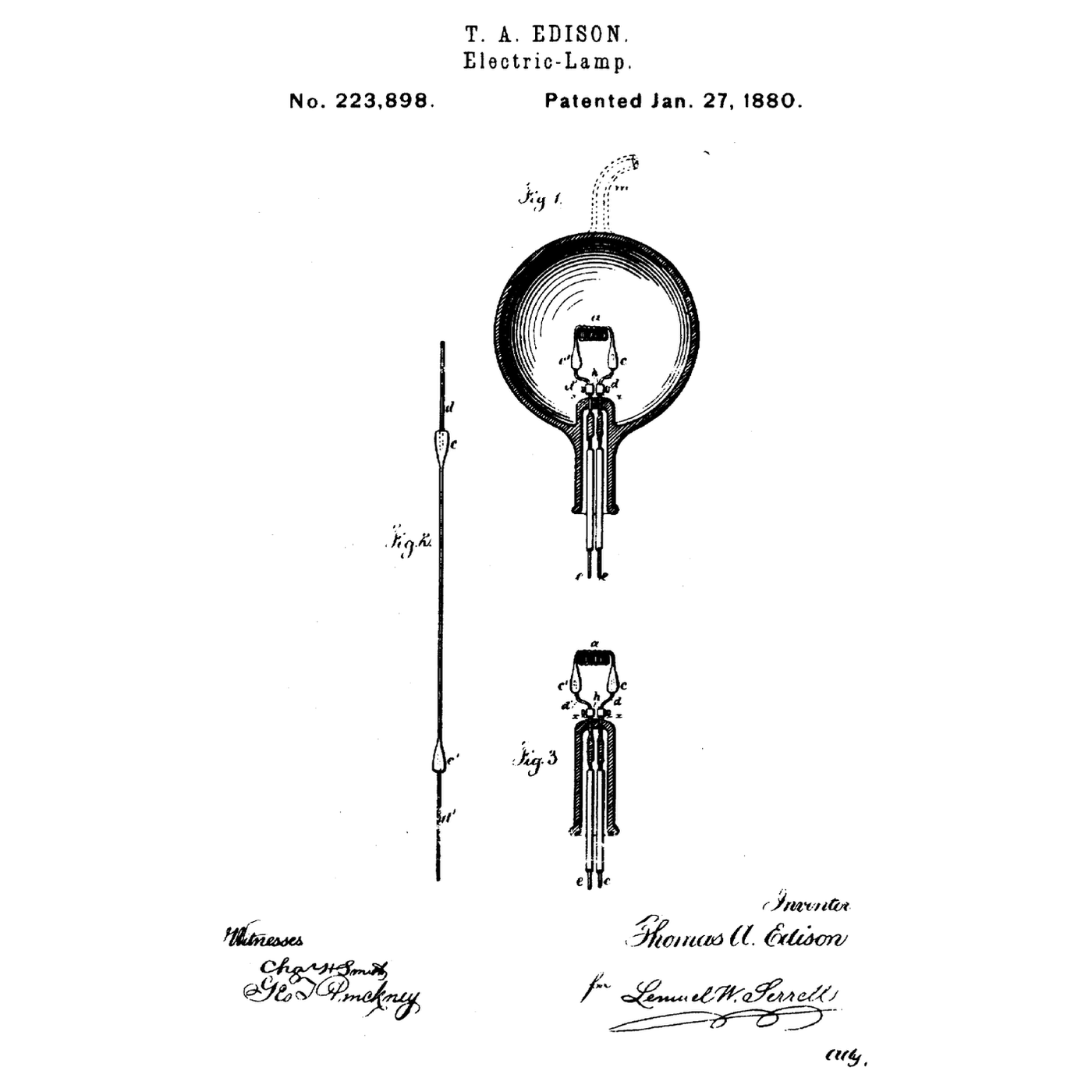
Many inventors made a wire or a carbon rod glow in a bulb. Thomas Edison's lamp of 1879–80 was designed backwards from the wiring: to light a city with lamps connected in parallel, each lamp needed a HIGH resistance, or the copper mains would have to be absurdly thick. His patent describes a thin carbon filament — even *"a cotton thread properly carbonized"* — in a glass bulb pumped down to one-millionth of an atmosphere, offering a hundred ohms or more and stable at white heat.
This rung works out the copper argument from his own figures and makes a carbonised-thread lamp in an evacuated jar to see why the vacuum matters.
中级
About 5 hours
说明
1
1
The copper argument
The copper argument
正在加载 Jupyter 笔记本…
2
2
Carbonise a cotton thread
Carbonise a cotton thread
Pack a few 30 mm lengths of cotton thread, stretched straight between two small copper wire loops, in graphite powder inside a small steel tin with a pinhole in the lid. Heat the tin outdoors with the propane torch until it glows red, and hold it there for twenty minutes — cellulose only turns into a well-conducting carbon at red heat. Let it cool completely before opening: air reaching hot carbon burns it.
The threads come out black, brittle and conducting. Measure one with the multimeter and compare with Edison's hundreds of ohms; a poorly heated thread reads far higher. Handle them with tweezers; they snap at a touch.
此步骤所需材料:
 棉线1 卷
棉线1 卷 石墨粉50 克
 铜线1 米
铜线1 米所需工具:
 丙烷喷灯
丙烷喷灯 万用表
万用表 皮革工作手套
 透明安全眼镜
3
3
Light it in air, then in a vacuum
Light it in air, then in a vacuum
Clamp one filament between two stiff copper wires passed through the lid of a thick glass jar and sealed with epoxy or silicone. In AIR, with the lid off, connect it briefly across a 12 V battery through a series resistor: it glows red for a moment and burns through.
Mount a fresh filament, close the jar, and pump it down with the vacuum pump through a fitting in the lid. Connect the battery again: the filament glows and lasts far longer, because there is almost no oxygen left to burn it. Your pump will not reach Edison's one-millionth of an atmosphere; the difference is still obvious.
Stand the jar behind a clear shield and wear goggles: an evacuated jar can implode.
此步骤所需材料:
 玻璃罐1 个
 硅酮密封胶1 个铜线1 米
 电阻套件1 套
所需工具:
 真空泵
真空泵 12 V 深循环蓄电池万用表透明安全眼镜皮革工作手套
4
4
History and context
History and context
**US 223,898, 'Electric-Lamp', Thomas A. Edison, patented 27 January 1880.** The specification reports carbonising *"cotton and linen thread, wood splints, papers coiled in various ways"*; carbonised bamboo became the production filament soon after. Joseph Swan in England had been developing carbon lamps in parallel, and the two later merged their British interests.
Edison's lamp came with a whole system — parallel distribution, meters, fuses, generators — which is what made it change cities.
**Honest limits.** A carbon-filament lamp turns only a few per cent of its power into light; the rest is heat. The filament evaporates and blackens the bulb. Tungsten filaments, gas filling and later LEDs each improved on it many times over.
材料
6- 1 卷占位符
- 50 克占位符
- 2 米占位符
- 1 个占位符
- 1 个占位符
相关蓝图
这些蓝图共享知识——技术、材料或原理
危险
Sprengel Mercury Pump
Charlie 创作
技术
34
0
0
0
0
0
Rotary Vane Vacuum Pump
Emma 创作
技术
40
0
0
0
0
0
The Arc Lamp: Burning Carbons and Keeping the Gap
Volt 创作
电子产品
5
0
0
0
0
0

Ohm's Law at the Bench: Picking the Resistor That Saves the LED
Volt 创作
电子产品
23
0
0
0
0
0
The Fuse Protects the Wire, Not the Thing You Plugged In
Volt 创作
技术
26
0
0
0
0
0
The Gramme Ring: A Continuous Winding for Steady Current
Volt 创作
电子产品
7
0
0
0
0
0
CC0 公共领域
此蓝图以 CC0 协议发布。你可以自由复制、修改、分发和使用此作品,无需征得许可。
通过购买蓝图中的产品支持创客,他们将获得 创客佣金 (由供应商设定),或创建此蓝图的新版本并将其作为连接包含在你自己的蓝图中以分享收入。