艺术
美容与健康
工艺
文化与历史
娱乐
环境
食品与饮料
逆向工程
科学
体育
技术
可穿戴设备
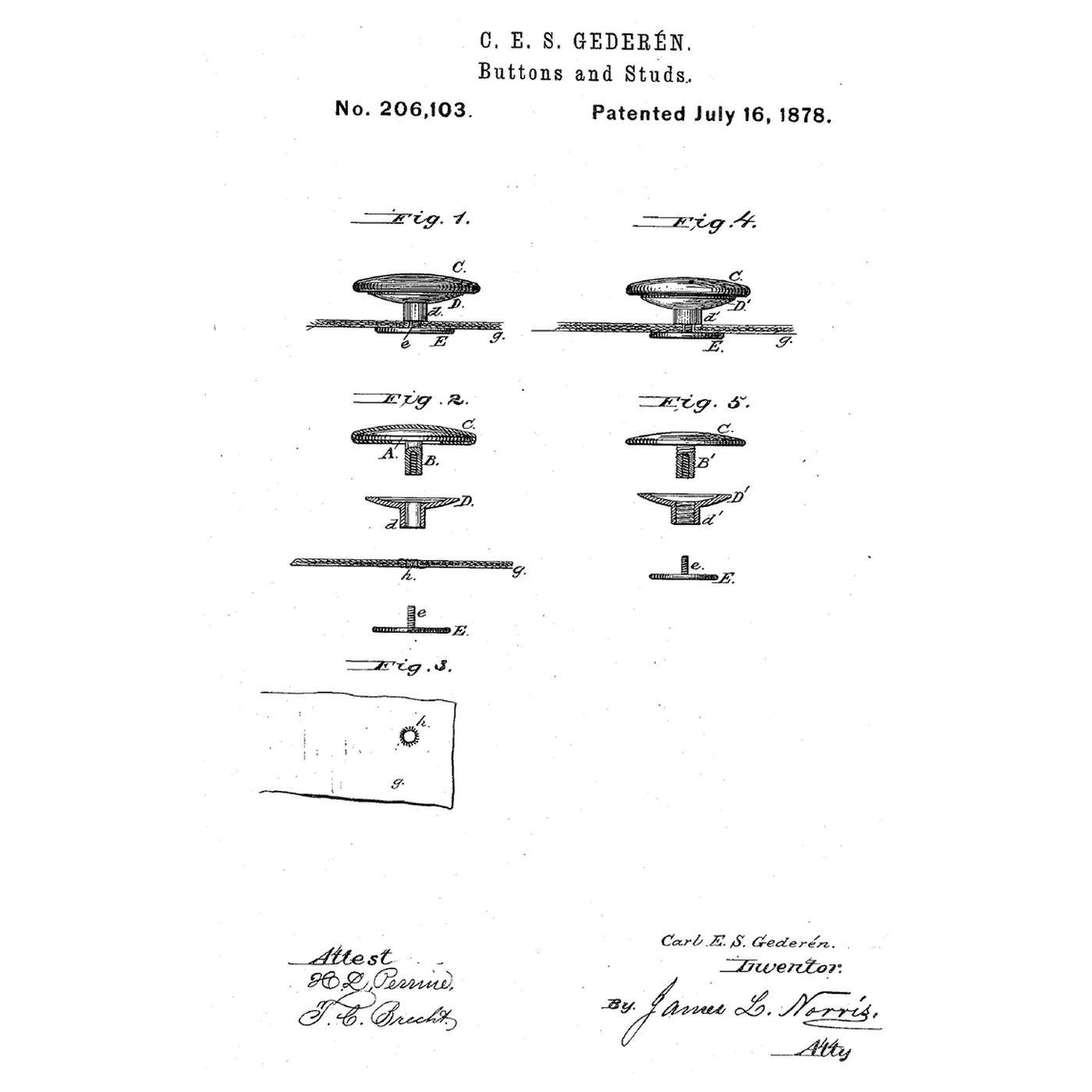


The Screw-Back Button: Two Halves That Clamp the Cloth
A sewn button holds by thread, and its cloth cover wears out with it. A screw-back button holds by clamping: two halves screwed together through a small hole in the cloth.
Carl E. S. Gederén of Philadelphia received US 206,103, dated 16 July 1878 (filed 29 April 1878), for buttons and shirt-studs, with the aim "to provide a means for readily securing a covering to the head of the button, and to provide for securing the button to the fabric to which it is to be attached without sewing." When the cover wears, the button comes apart, takes a new cover, and "may be readily transferred from one garment to another".
This rung checks why a small thread stays done up and how hard it clamps, then pull-tests a screw-back button against a sewn one.
初学者
About 1 hour
说明
1
1
Self-locking and clamp force
Self-locking and clamp force
正在加载 Jupyter 笔记本…
2
2
The button it replaces
The button it replaces
The embedded blueprint sews a button on with a thread shank; this rung clamps one on instead.
3
3
Read US 206,103
Read US 206,103
"This invention relates to certain improvements in buttons, shirt-studs, and other like articles; and it has for its object to provide a means for readily securing a covering to the head of the button, and to provide for securing the button to the fabric to which it is to be attached without sewing."
The bottom disk's "screw-threaded stem" is "passed through the aperture or eyelet from the opposite side of the fabric, engaged with the internal thread of the shank B and screwed up tightly, so that the fabric will be caught between the upper surface of disk E and the end of sleeve d".
"Whenever the cloth covering becomes worn it may be easily replaced by detaching the parts of the button and assembling them as before; or the button may be readily transferred from one garment to another, and the covering changed to correspond with the fabric."
4
4
Fitting one, as a program
Fitting one, as a program
Blockly 工作区
Loading Blockly workspace...
5
5
Pull-test it against a sewn button
Pull-test it against a sewn button
On a scrap of denim, fit one screw-back button as in the program, and sew an ordinary button on beside it. Loop strong thread under each button and hook the force meter to the loop.
Hold the denim flat and pull each button straight out, slowly, reading the highest force before something gives. Note what gave: the thread, the cloth round the hole, or the button itself. Repeat on fresh cloth and compare.
此步骤所需材料:
 螺纹纽扣2 个
 牛仔布1 个
 缝纫线1 个
所需工具:
 锥子
锥子 缝衣针
缝衣针 测力计(弹簧秤)
 6 英寸数显卡尺
6
6
A screw-back button that loosens, spins or tears out
A screw-back button that loosens, spins or tears out
Screw-back button troubleshooting.
Flow
Loading...
7
7
History and honest limits
History and honest limits
**Carl E. S. Gederén** of Philadelphia filed US 206,103 on 29 April 1878; it is dated 16 July 1878. His claim is the detachable clamping disk that holds the cloth cover, together with the screwed top and bottom disks.
**Honest limits.** The torque rule with K = 0.2 is an engineering rule of thumb, not a law; K changes with finish and lubrication. Thread sizes, friction and torques are examples. Your pull readings are the measurement.
相关蓝图
这些蓝图共享知识——技术、材料或原理


CC0 公共领域
此蓝图以 CC0 协议发布。你可以自由复制、修改、分发和使用此作品,无需征得许可。
通过购买蓝图中的产品支持创客,他们将获得 创客佣金 (由供应商设定),或创建此蓝图的新版本并将其作为连接包含在你自己的蓝图中以分享收入。