艺术
美容与健康
工艺
文化与历史
娱乐
环境
食品与饮料
逆向工程
科学
体育
技术
可穿戴设备
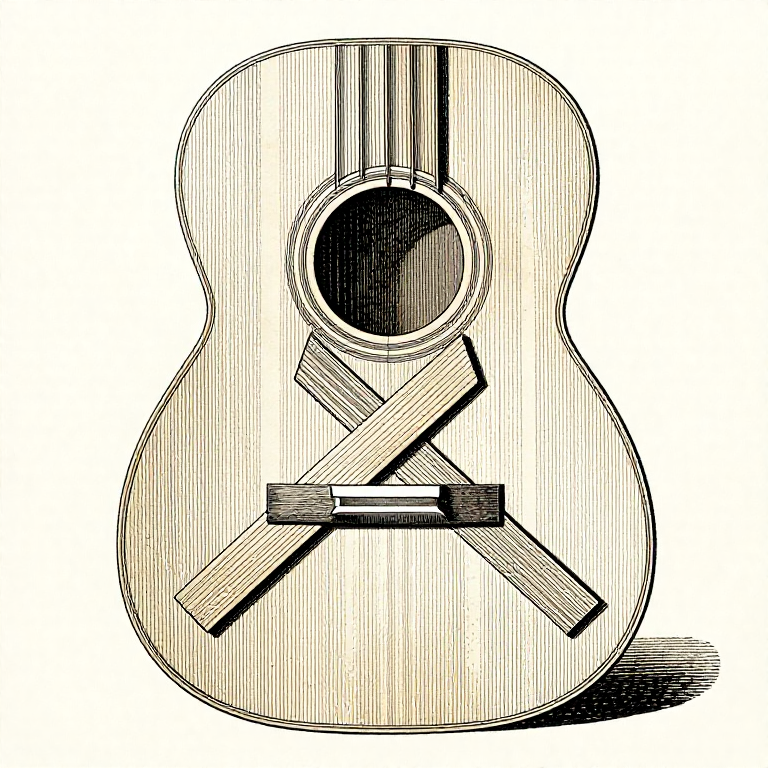


The Soundboard: A String Alone Is Almost Silent
Stretch a string between two posts in the ground and pluck it. It is almost inaudible. The string is thin, so it slices through the air instead of pushing it, and almost none of its energy becomes sound.
The soundboard is what fixes that. It is a large, light, stiff surface coupled to the string through the bridge, and it moves enough air to be heard across a room.
Everything about a soundboard is a trade between two things that pull against each other: it must be light enough to be driven by a string, and stiff enough not to be folded in half by the string's tension. This rung is about how makers resolve that, from the simplest skin over a gourd to a braced spruce top.
中级
5 hours
说明
1
1
Why a large surface is louder
Why a large surface is louder
Sound is a pressure wave, and making one means pushing a volume of air. A string 0.3 mm across displaces almost nothing: the air simply flows around it, so the pressure never builds. This is why a solid-body electric guitar is nearly silent unplugged although the string is doing exactly the same thing.
A soundboard of a few hundred square centimetres moves with the string and pushes a real volume of air. Very little energy is added — the board is louder and the note dies away faster, which is the same energy spent sooner.
That trade is a real design choice. A banjo's tight skin is loud and short; a harp's long strings on a heavy board sustain for many seconds and are quieter per note. Neither is better; they are different instruments.
Below a certain frequency a flat board becomes a poor radiator anyway, because air just slips around its edge from front to back. That is what the enclosed body and the sound hole are for, and the reason a bass instrument has to be big.
此步骤所需材料:
 云杉层压坯料1 个
 山羊皮1 个
所需工具:
 直尺
直尺2
2
Light and stiff, and why that means quartersawn spruce
Light and stiff, and why that means quartersawn spruce
The board must be driven by a very small force and must not collapse under a very large one. What matters is the stiffness per unit of mass, and wood along the grain is extraordinary at it.
**Spruce** is the classical choice across Europe and much of Asia for exactly this: stiff along the grain and very light. Cedar is slightly softer and warmer, redwood similar, paulownia is used across east Asia for the same reason.
**Quartersawn.** The board is cut so the growth rings run through its thickness rather than across its face. That gives the greatest stiffness across the width, and it also means the board moves least in width with humidity — a top that cracks in a dry winter is usually one cut the wrong way.
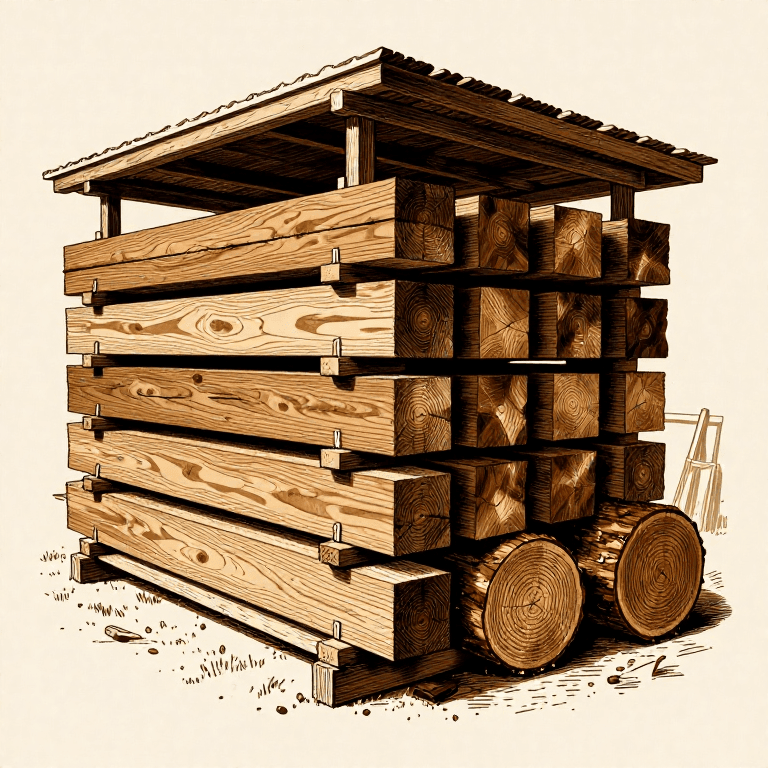
**Split, not sawn, when it can be.** A split follows the grain, so the fibres run unbroken from end to end. A sawn board crosses the grain somewhere along its length and is weaker there. This is why tonewood is riven from the billet in the traditional shops.
Thickness is not a number to copy. It is worked down by flexing the board in the hands until it feels right, because two pieces of spruce of the same thickness can differ in stiffness by half again.
此步骤所需材料:
云杉层压坯料2 个所需工具:
 6 英寸数显卡尺
 圆凿
圆凿 细砂纸直尺
细砂纸直尺3
3
Bracing: adding stiffness where it is needed and nowhere else
Bracing: adding stiffness where it is needed and nowhere else
A top thin enough to sound well is not strong enough on its own. The strings of a steel-string guitar pull with the weight of a grown adult, most of it trying to rotate the bridge and fold the top.
Bracing is the answer: thin strips of wood glued on the inside, running where the load runs. Because a brace is deep relative to its width, it adds a great deal of stiffness for very little mass — the same reason a joist is on edge and not flat.
**Across the grain first.** The top is already stiff along the grain, so the braces that matter most run across it.
**Around the sound hole.** The hole is a hole in the middle of the loaded area, and it needs framing.
**Fan, ladder or X.** A classical guitar's fan spreads the load from the bridge towards the lower bout; a steel-string's X carries a much heavier pull; a ladder is the oldest and simplest and is still right on a small light instrument.
Braces are shaved down after gluing, in the assembled box, by tapping and listening. A brace that is left square is heavier than it needs to be, and every gram of unnecessary brace is loudness thrown away.
此步骤所需材料:
云杉层压坯料2 个 兽皮胶1 个
所需工具:
 夹具
夹具 凿子套装圆凿6 英寸数显卡尺
4
4
The bridge is the only way in
The bridge is the only way in
All the energy that reaches the board goes through the bridge, so the bridge does three jobs at once and they conflict.
**It transmits.** A bridge that is too heavy damps the top and the instrument goes dull; one that is too light cannot carry the load.
**It locates.** The bridge defines one end of the sounding length, so its position sets the intonation, and it must be placed with the compensation the fret rung computes.
**It holds.** The whole tension of the strings is on it, either as a downward force (a violin's bridge, held only by that pressure) or as a shear on a glue joint (a guitar's, glued to the top).
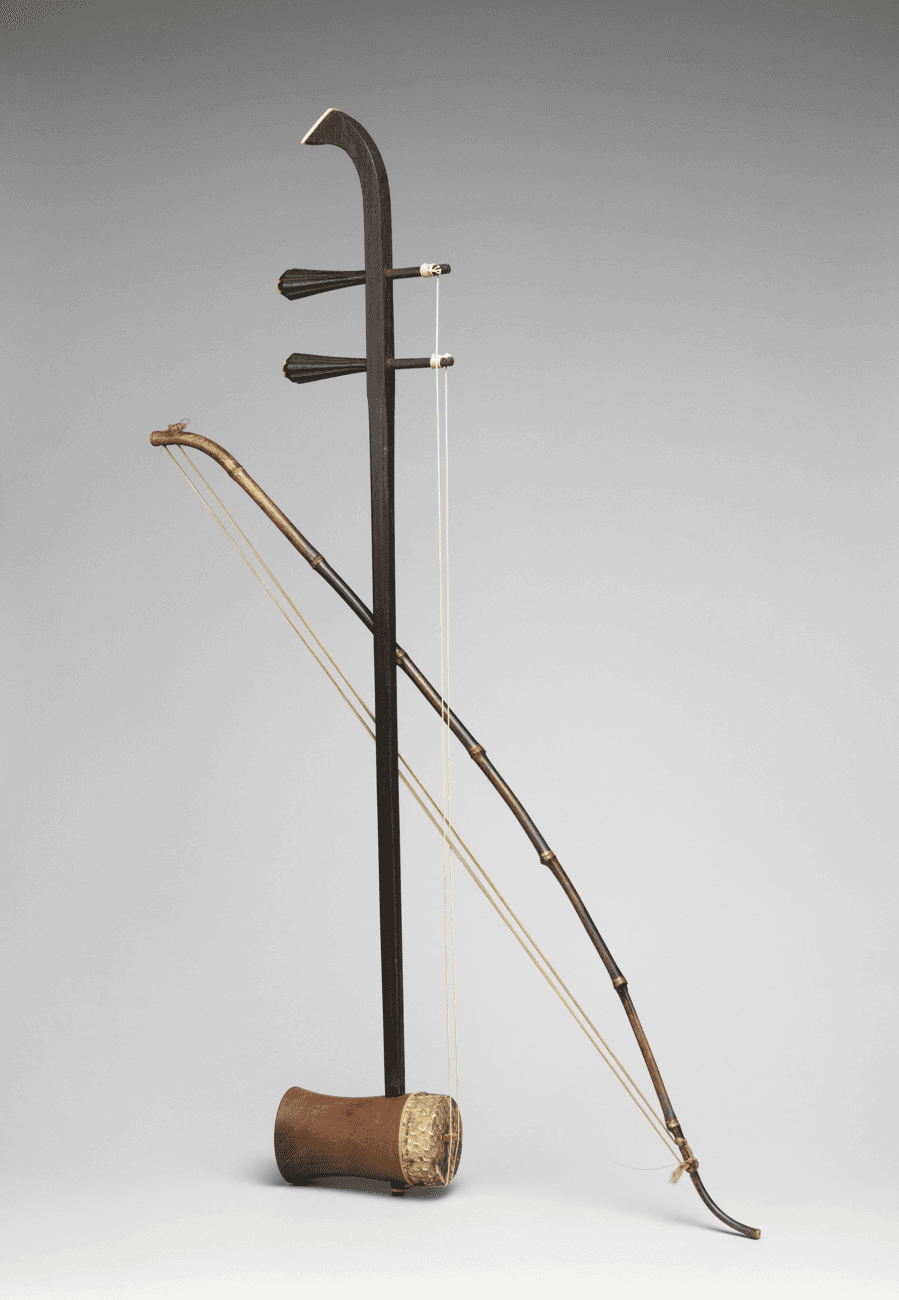
The two classic arrangements answer the same problem differently. A **pressure bridge** — violin, erhu, oud — stands free under the strings, and its position is adjustable, which is why those instruments can be intonated by moving it. A **glued bridge** — guitar, most lutes — is fixed and must be located correctly the first time.
Under a violin's bridge sits the sound post, a loose dowel wedged between the top and the back. Moving it a millimetre audibly changes the instrument, which is the clearest demonstration there is that the whole body, not just the top, is the radiator.
此步骤所需材料:
云杉层压坯料1 个兽皮胶1 个所需工具:
6 英寸数显卡尺 什锦锉套装夹具直尺
相关蓝图
这些蓝图共享知识——技术、材料或原理
CC0 公共领域
此蓝图以 CC0 协议发布。你可以自由复制、修改、分发和使用此作品,无需征得许可。
通过购买蓝图中的产品支持创客,他们将获得 创客佣金 (由供应商设定),或创建此蓝图的新版本并将其作为连接包含在你自己的蓝图中以分享收入。