艺术
美容与健康
工艺
文化与历史
娱乐
环境
食品与饮料
逆向工程
科学
体育
技术
可穿戴设备


The Two-Stroke Engine: The Piston Is the Valve
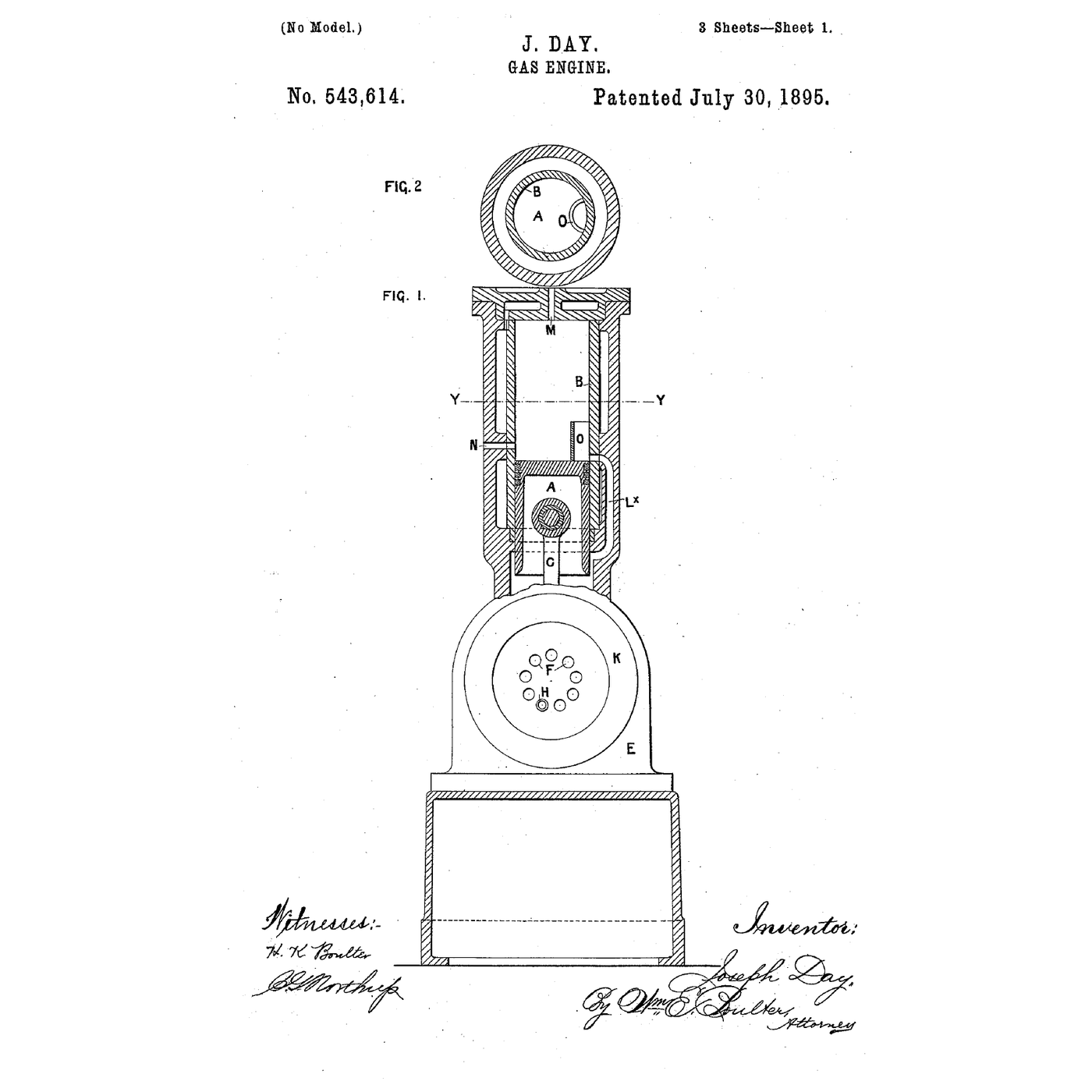
The four-stroke engine fires once every two turns and needs cams, springs and valves to breathe. Joseph Day's engine of 1891–95 fires every turn and has none of them: the piston itself opens and closes ports in the cylinder wall, and the sealed crankcase under the piston acts as a pump that pre-compresses the fresh charge.
Its own specification puts it simply: the piston *"serves as a slide-valve"*, doing away with *"eccentrics, cams, valve-rods"*. That makes it light, cheap and powerful for its size — the engine of chainsaws, mopeds and outboard motors.
This rung computes its port timing from the crank geometry and cuts the ports into a card cylinder on the slider-crank model to watch them open.
中级
About 3 hours
说明
1
1
Read Day's patent
Read Day's patent
US 543,614, 'Gas Engine', Joseph Day, patented 30 July 1895. The aim is *"a gas-engine in which eccentrics, cams, valve-rods, and other positively-actuated"* parts are done away with, *"the piston itself"* serving *"as a slide-valve"*. The explosive mixture is drawn into the crankcase chamber by the up-stroke, compressed there by the down-stroke, and delivered into the upper part of the cylinder when the piston uncovers the port; the piston also uncovers the exhaust port. Day's drawing still shows a valve admitting the charge to the crankcase — look for it.
2
2
Port timing from the geometry
Port timing from the geometry
正在加载 Jupyter 笔记本…
3
3
Cut ports and watch them open
Cut ports and watch them open
On the slider-crank model from the crank rung, wrap a card tube round the slider's path as a 'cylinder' and mark on it the piston crown's position at top dead centre. Cut an exhaust window starting 60 % of the stroke below that mark, and a transfer window starting 72 % down, on the opposite side.
Turn the crank slowly with the protractor underneath and note the angle at which the crown first uncovers each window, and when it covers it again. Compare with the notebook.
此步骤所需材料:
 纸筒1 个
纸筒1 个所需工具:
 量角器
量角器 直尺
直尺 油性记号笔
油性记号笔4
4
History and context
History and context
**US 543,614, 'Gas Engine', Joseph Day, patented 30 July 1895.** Day was an engineer in Bath, England, and had patented crankcase compression in Britain before this US patent; the two-stroke spread quickly to motorcycles and small boats.
**Honest limits.** The ports are open together, so some fresh charge escapes with the exhaust — wasteful and polluting in a carburetted engine. The crankcase carries the charge, so lubricating oil is usually mixed into the fuel and burned. The two-stroke survives where power for its weight matters more than economy.
相关蓝图
这些蓝图共享知识——技术、材料或原理

CC0 公共领域
此蓝图以 CC0 协议发布。你可以自由复制、修改、分发和使用此作品,无需征得许可。
通过购买蓝图中的产品支持创客,他们将获得 创客佣金 (由供应商设定),或创建此蓝图的新版本并将其作为连接包含在你自己的蓝图中以分享收入。