艺术
美容与健康
工艺
文化与历史
娱乐
环境
食品与饮料
逆向工程
科学
体育
技术
可穿戴设备
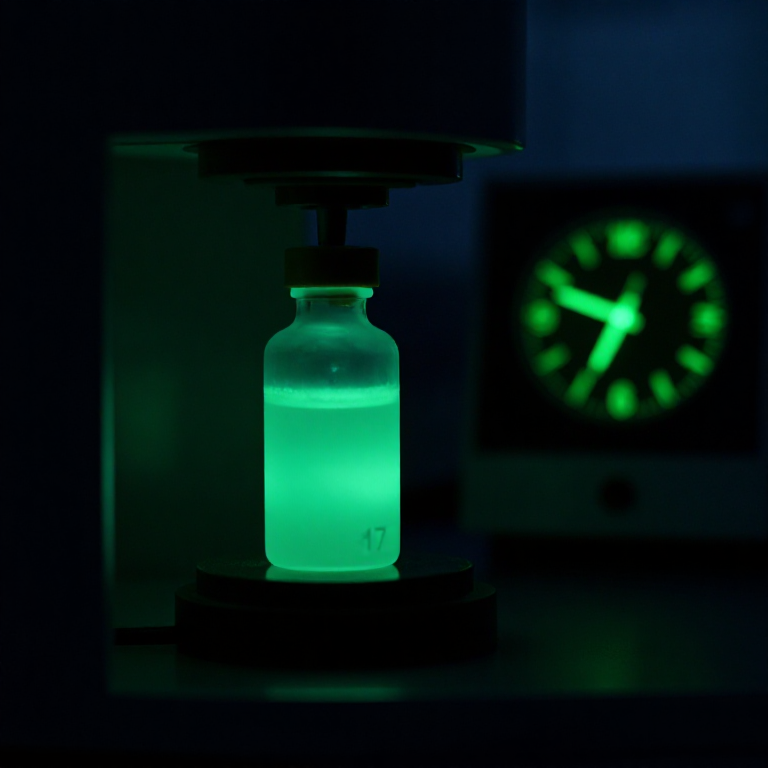

Understanding Promethium from Nuclear Fission — The Phantom Lanthanide
中级
说明
1
1
Understand Promethium's Discovery
Understand Promethium's Discovery
Jacob Marinsky, Lawrence Glendenin, and Charles Coryell isolated promethium in 1945 at Oak Ridge National Laboratory from uranium fission products using ion exchange chromatography. Element 61 had been the subject of numerous false claims since 1902. They named it promethium after Prometheus, who stole fire from the gods — symbolizing both the daring of nuclear science and the risk of misusing nuclear energy. It was the last lanthanide element to be confirmed.
2
2
Examine Why Promethium Doesn't Exist Naturally
Examine Why Promethium Doesn't Exist Naturally
Promethium is the only lanthanide with no stable isotopes. Like technetium, the Mattauch isobar rule prevents stability — neighboring stable isobars of neodymium and samarium exclude stable promethium isotopes. The longest-lived isotope, Pm-145, has a half-life of only 17.7 years. Any primordial promethium decayed away billions of years ago. Trace amounts exist in uranium ores from spontaneous fission, but at concentrations of approximately 10⁻²⁰ grams per gram of ore.
3
3
Understand Production from Reactor Fission
Understand Production from Reactor Fission
Promethium-147 (half-life 2.62 years) is produced as a fission product of uranium-235 in nuclear reactors with a fission yield of 2.6%. It is separated from other fission products by solvent extraction and ion exchange chromatography — the same technique that enabled its discovery. Annual production is measured in grams. Promethium-147 is a pure beta emitter (maximum energy 225 keV) with no accompanying gamma radiation, making it relatively safe to handle with basic shielding.
4
4
Discover Luminous Paint Applications
Discover Luminous Paint Applications
Promethium-147 replaced radium in self-luminous paint for watch dials, aircraft instruments, and emergency exit signs during the 1960s-1970s. The beta particles from Pm-147 excite a zinc sulfide phosphor to produce a green glow without the dangerous gamma radiation of radium. A promethium-powered dial produces light for about 5 years before the activity drops too low. Tritium (hydrogen-3) eventually replaced promethium for most luminous applications.
5
5
Explore Nuclear Battery Technology
Explore Nuclear Battery Technology
Promethium-147 is used in radioisotope thermoelectric generators (RTGs) and betavoltaic batteries — devices that convert radioactive decay energy directly into electricity. A Pm-147 betavoltaic cell produces microwatts of power for years without refueling or maintenance. These batteries power remote sensors, cardiac pacemakers (historically), and space probes. The absence of gamma radiation means Pm-147 batteries require minimal shielding compared to other radioisotope power sources.
6
6
Examine Thickness Gauging Applications
Examine Thickness Gauging Applications
The beta radiation from Pm-147 is used in industrial thickness gauges for measuring thin materials. The beta particles pass through the material being measured, and a detector on the other side measures the transmitted intensity — thicker material absorbs more radiation. This technique measures paper, plastic film, rubber sheet, and metal foil thickness during manufacturing with micrometer precision. The gauges operate continuously without contact, enabling real-time quality control on production lines.
7
7
Understand Promethium's Chemical Properties
Understand Promethium's Chemical Properties
Promethium behaves chemically like other trivalent lanthanides — it forms Pm³⁺ ions in solution, creates insoluble fluorides and oxalates, and exhibits the characteristic lanthanide contraction. Its ionic radius falls between neodymium and samarium, consistent with its position in the series. Promethium oxide (Pm₂O₃) and promethium chloride (PmCl₃) have been characterized. The radioactivity limits all chemistry to milligram-scale experiments in specialized hot cells.
8
8
Survey Detection in Stellar Spectra
Survey Detection in Stellar Spectra
Promethium spectral lines have been detected in the star HR 465 (a peculiar Ap star) and in the Andromeda galaxy. Like technetium in red giants, the presence of promethium in stellar atmospheres indicates active nucleosynthesis. Some chemically peculiar stars concentrate rare elements in their upper atmospheres through radiative levitation — a process where radiation pressure selectively pushes certain ions upward against gravity, creating spectral signatures far stronger than bulk abundance would predict.
9
9
Investigate Signal and Research Applications
Investigate Signal and Research Applications
Promethium-147 has been used in portable X-ray sources — the beta particles strike a target material to produce characteristic X-rays for fluorescence analysis in the field. Pm-147 heat sources have been proposed for small-scale power generation in remote locations. Research continues into promethium-doped phosphors for potential display technology. The 2023 synthesis of a promethium complex with a bound water molecule at Oak Ridge provided the first direct measurement of a promethium-oxygen bond length.
所需工具:
 精密天平
精密天平10
10
Document Findings and Scientific Significance
Document Findings and Scientific Significance
Record promethium's key data: atomic number 61, density 7.26 g/cm³, melting point 1,042°C, silvery-white metal. Promethium is the phantom of the periodic table — predicted in 1902, falsely claimed multiple times, and finally isolated from the nuclear fires of the Manhattan Project era. Its practical applications in luminous paint, nuclear batteries, and thickness gauges demonstrate that even an element with no stable existence on Earth can find its place in technology.
11
11
Half-life: what is left, and when
Half-life: what is left, and when
正在加载 Jupyter 笔记本…
已连接蓝图材料

危险
10% 归属
Extracting Neodymium-Rich Rare Earth Oxide from Monazite — The Magnet Metal That Reshaped Technology
Peter 创作
采矿
37
0
0
0
11
0

10% 归属
Understanding Samarium from Monazite — The First Rare Earth Magnet
Peter 创作
采矿
16
0
0
0
4
0

10% 归属
Understanding Praseodymium from Monazite — The Green Twin That Colors Glass
Peter 创作
采矿
17
0
0
0
3
0
10% 归属
Understanding Europium from Monazite — The Red Phosphor That Colored Television
Peter 创作
采矿
20
0
0
0
5
0

10% 归属
Understanding Lanthanum from Monazite — The Hidden Element That Bends Light
Peter 创作
采矿
19
0
0
0
8
0
相关蓝图
这些蓝图共享知识——技术、材料或原理


CC0 公共领域
此蓝图以 CC0 协议发布。你可以自由复制、修改、分发和使用此作品,无需征得许可。
通过购买蓝图中的产品支持创客,他们将获得 创客佣金 (由供应商设定),或创建此蓝图的新版本并将其作为连接包含在你自己的蓝图中以分享收入。