艺术
美容与健康
工艺
文化与历史
娱乐
环境
食品与饮料
绿色未来
逆向工程
科学
体育
技术
可穿戴设备

Understanding Thorium from Monazite — The Nuclear Fuel That Could Replace Uranium
中级
说明
1
1
Understand Thorium's Discovery
Jöns Jacob Berzelius discovered thorium in 1828 in a black mineral sent to him by Reverend Hans Morten Thrane Esmark, who found it on the island of Løvøya, Norway. Berzelius named it after Thor, the Norse god of thunder. The mineral was later named thorite (ThSiO₄). Thorium's radioactivity was discovered independently by Gerhard Carl Schmidt and Marie Curie in 1898, making it the second radioactive element identified after uranium.
2
2
Identify Thorium in Monazite Sands
Thorium occurs at 9.6 ppm in Earth's crust — three to four times more abundant than uranium. Monazite (Ce,La,Nd,Th)PO₄ contains 5-12% thorium oxide, making it the primary thorium mineral. Heavy mineral sands in India, Brazil, Australia, and the United States contain monazite as a byproduct of titanium and zirconium mining. India holds the world's largest thorium reserves — estimated at 846,000 tonnes — concentrated in beach sands along the Kerala coast.
所需工具:
Hand Lens (10x Magnification)3
3
Examine the Gas Mantle Revolution
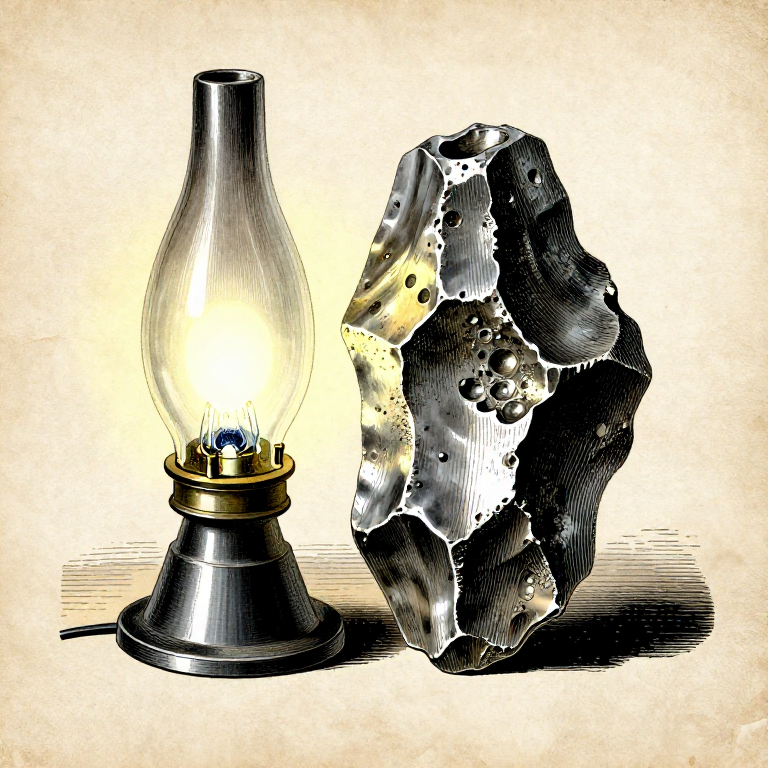
Thorium's first major application was the Welsbach gas mantle, invented by Carl Auer von Welsbach in 1891. A cotton mesh soaked in 99% thorium oxide and 1% cerium oxide produces brilliant white light when heated by a gas flame. Gas mantles illuminated the world before electric lighting became widespread. Billions were manufactured between 1890 and 1930. Thorium mantles are still used today in camping lanterns, where they produce bright light from propane or kerosene.
4
4
Understand the Thorium Fuel Cycle
Thorium-232 itself is not fissile — it cannot sustain a chain reaction. However, when bombarded with neutrons, Th-232 absorbs a neutron and transforms through protactinium-233 to uranium-233, which IS fissile. This breeding process means thorium can serve as nuclear fuel: a thorium reactor uses a small amount of fissile material (U-235 or Pu-239) to start the reaction, then breeds U-233 from thorium to sustain it indefinitely.
5
5
Compare Thorium and Uranium Nuclear Cycles
The thorium fuel cycle has several advantages over uranium: thorium is 3-4 times more abundant, the thorium cycle produces far less plutonium (reducing weapons proliferation risk), and it generates fewer long-lived radioactive waste products. Molten salt thorium reactors (MSRs) operate at atmospheric pressure — eliminating the risk of pressure-driven explosions like Fukushima. India's three-stage nuclear program plans to use thorium as its primary fuel to leverage enormous domestic reserves.
6
6
Examine Thorium's Radioactivity
Thorium-232 has a half-life of 14.05 billion years — three times the age of the Earth — making it only weakly radioactive. Its activity is 4,000 Bq per gram, compared to 12,400 Bq/g for natural uranium. Thorium decays through a chain of 10 radioactive daughters before reaching stable lead-208. The intermediate products include radium-228 and the gaseous radon-220 (thoron), which has a half-life of only 55.6 seconds — too short to accumulate like radon-222 from uranium decay.
7
7
Survey Industrial Applications
Thoriated tungsten (W-2%ThO₂) electrodes are the preferred choice for TIG welding because thorium oxide improves electron emission, arc starting, and arc stability. Thorium oxide has the highest melting point of any oxide (3,300°C) and is used in high-temperature crucibles and furnace linings. Thorium-doped glass has a high refractive index and low dispersion, making it valuable for camera lenses — Canon's legendary 50mm f/1.2 lens used thoriated glass elements.
8
8
Examine Metal Properties
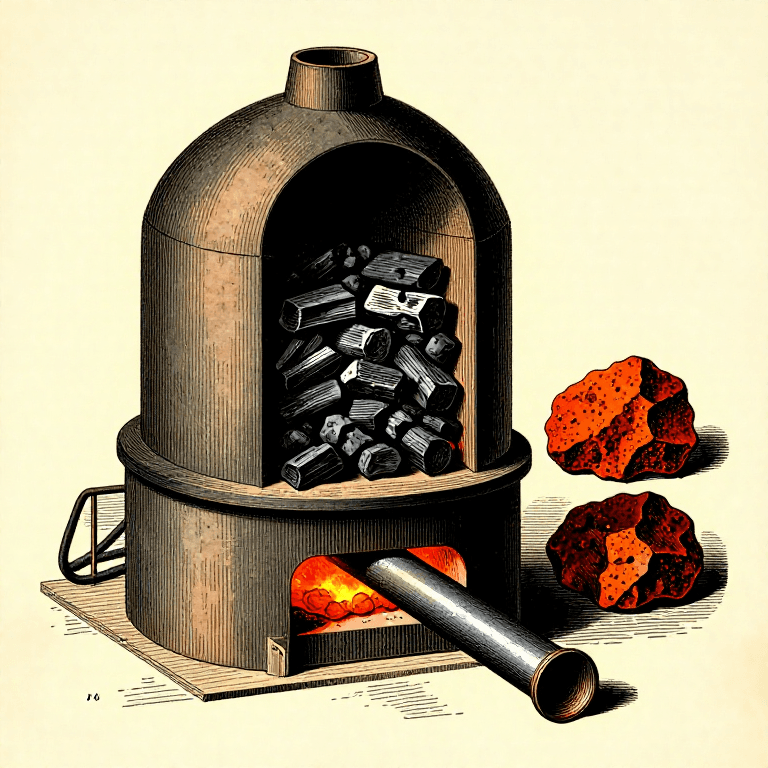
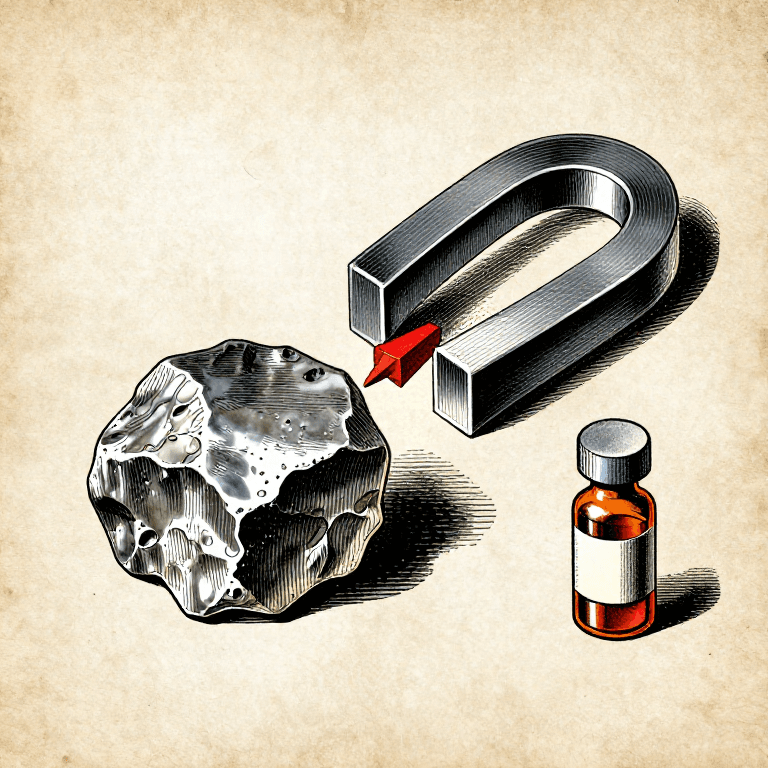
Thorium is a soft, silvery-white metal that is paramagnetic and moderately dense (11.7 g/cm³). Melting point is 1,750°C. It is relatively reactive — slowly tarnishing in air and dissolving in hydrochloric acid. Thorium is dimorphic: face-centered cubic below 1,360°C and body-centered cubic above. The metal is obtained by calcium reduction of thorium tetrafluoride (ThF₄). Thorium powder is pyrophoric and was once used in magnesium alloys for aircraft applications.
9
9
Understand Thorium Dating Methods
Uranium-thorium dating uses the decay of U-234 to Th-230 (half-life 75,380 years) to date calcium carbonate materials from 1,000 to 500,000 years old — filling the gap between radiocarbon (50,000 years) and potassium-argon (100,000+ years) dating. It is the primary method for dating cave stalagmites, coral reefs, and travertine deposits. U-Th dating of cave art at Altamira and Chauvet has revealed paintings up to 65,000 years old.
所需工具:
Precision Scale (0.01g)10
10
Document Findings and Future Energy Potential
Record thorium's key data: atomic number 90, density 11.7 g/cm³, melting point 1,750°C, soft silvery metal. Thorium represents perhaps the most promising untapped energy resource on Earth. India, China, and several startup companies are actively developing thorium molten salt reactors. If successful, thorium could provide clean energy for thousands of years using fuel far more abundant than uranium. The element named after the god of thunder may yet power civilization's future.
已连接蓝图材料
Extracting Iron from Hematite — Bloomery Smelting from Ore to Bloom作者 Peter
Understanding Gadolinium from Monazite — The MRI Contrast Agent Metal作者 Peter
Understanding Samarium from Monazite — The First Rare Earth Magnet作者 Peter
Understanding Helium from Natural Gas — The Element That Escapes Earth Forever作者 Peter
Understanding Polonium from Uranium Ore — The Deadly Discovery That Launched Nuclear Science作者 Peter
Understanding Astatine from Cyclotron Synthesis — The Rarest Naturally Occurring Element作者 Peter
Understanding Radon from Radioactive Decay — The Invisible Killer in Your Basement作者 Peter
Understanding Francium from Radioactive Decay — The Most Unstable Natural Element作者 Peter
Understanding Radium from Uranium Ore — The Glowing Element That Changed Science and Medicine作者 Peter
Understanding Actinium from Uranium Ore — The Element That Named the Actinides作者 Peter
Understanding Protactinium from Uranium Ore — The Elusive Parent of Actinium作者 Peter
CC0 公共领域
此蓝图以 CC0 协议发布。你可以自由复制、修改、分发和使用此作品,无需征得许可。
通过购买蓝图中的产品支持创客,他们将获得 创客佣金 (由供应商设定),或创建此蓝图的新版本并将其作为连接包含在你自己的蓝图中以分享收入。