艺术
美容与健康
工艺
文化与历史
娱乐
环境
食品与饮料
逆向工程
科学
体育
技术
可穿戴设备
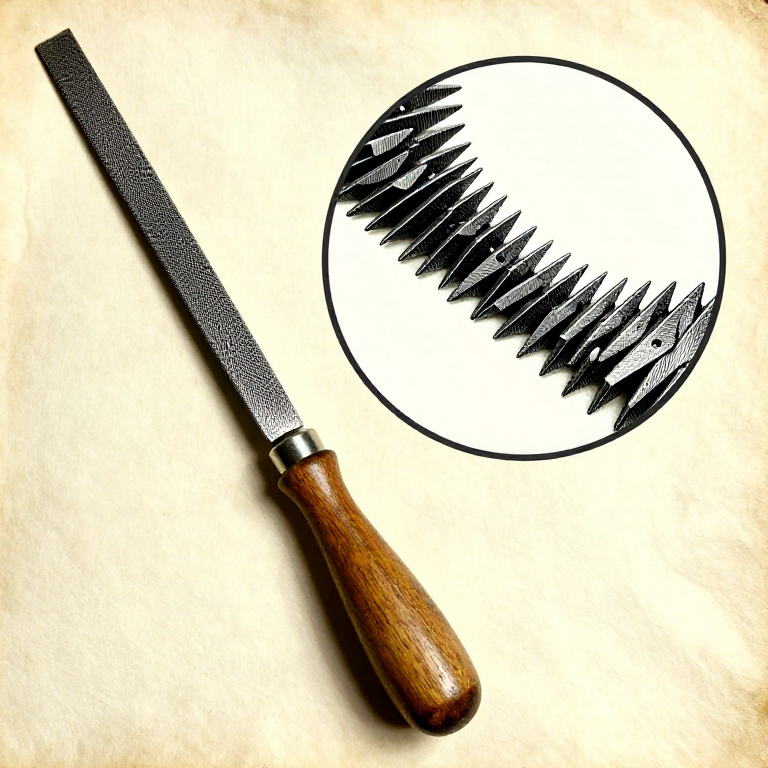


What a File Actually Is: Rows of Tiny Chisels
A file is not an abrasive. It is a hardened steel bar carrying hundreds of tiny chisels, each one cutting a chip exactly the way a plane iron does, and everything a file does well or badly follows from that.
It explains why a file only cuts on the push stroke, why dragging it back wears the teeth for nothing, why it stops cutting when the gullets fill, and why one file glides uselessly over hardened steel while another bites. None of that is true of sandpaper.
Two hundred and thirty-six blueprints on Youblob list a file among their tools and not one of them explains how to use it. This is the first of eight rungs that close that.
初学者
2 hours
说明
1
1
Look at the teeth and see the chisels
Look at the teeth and see the chisels
Put a file under a loupe with the light raking along it. Each tooth is a tiny wedge with a cutting edge across the top and an open space behind it — the gullet — where the chip goes.
The teeth all lean the same way: forward, toward the tip. That is why a file cuts on the PUSH and does nothing on the pull, and why lifting it on the return stroke costs nothing but saves the teeth. Dragging a loaded file backwards under pressure drags trapped chips across the work and scores it.
The other thing visible under the loupe is that the teeth are in rows running diagonally, not straight across. A straight row would cut a groove its own width; the diagonal makes each tooth land on fresh metal.
所需工具:
 金属锉
金属锉 放大目镜
放大目镜2
2
Single cut, double cut, and rasp
Single cut, double cut, and rasp
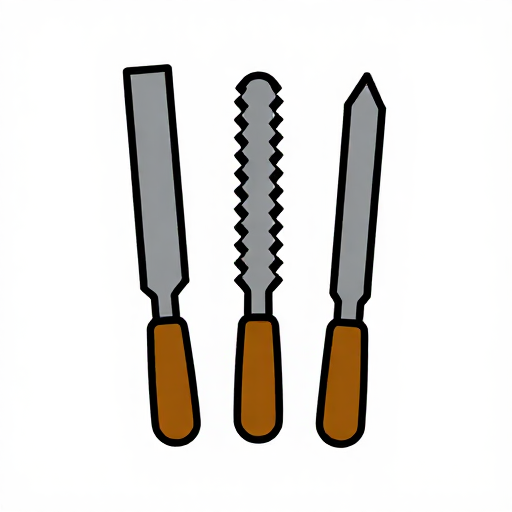
SINGLE CUT has one set of parallel diagonal rows. Each tooth is a long straight edge, it takes a wide shallow chip and leaves a smooth surface — this is what a finishing file and a saw file use.
DOUBLE CUT adds a second set of rows crossing the first, which breaks the long edges into a grid of small pointed teeth. Each takes a small deep chip, so it removes metal far faster and leaves a rougher surface. Most general-purpose hand files are double cut.
A RASP is neither: its teeth are individually raised punched points, widely spaced, with huge gaps between them. That makes it useless on metal and ideal on wood, where the chip is bulky and would instantly clog a file.
所需工具:
金属锉 细齿锉
细齿锉 粗齿锉放大目镜
3
3
Cut, grade and length — reading the name of a file
Cut, grade and length — reading the name of a file
正在加载 Jupyter 笔记本…
所需工具:
 锉刀套装
锉刀套装 计算器
计算器4
4
A file is harder than almost anything you will file
A file is harder than almost anything you will file
File teeth are hardened to around 65 HRC and left untempered, which makes them harder than nearly all working steel and also extremely brittle.
Two consequences. First, a file will cut mild steel, brass, aluminium, cast iron and most tool steel in the annealed state, but it skates uselessly on anything hardened — a hardened blade, a bearing race, a file. That is in fact the classic workshop hardness test: if a file bites, the part is soft.
Second, never use a file as a lever or a pry bar and never strike it. It will snap without bending, and it does so suddenly. Fit a handle before using one: the bare tang is a spike aimed at your palm, and it is the single commonest workshop injury with this tool.
所需工具:
金属锉 低碳钢条
低碳钢条 透明安全眼镜
相关蓝图
这些蓝图共享知识——技术、材料或原理
CC0 公共领域
此蓝图以 CC0 协议发布。你可以自由复制、修改、分发和使用此作品,无需征得许可。
通过购买蓝图中的产品支持创客,他们将获得 创客佣金 (由供应商设定),或创建此蓝图的新版本并将其作为连接包含在你自己的蓝图中以分享收入。