艺术
美容与健康
工艺
文化与历史
娱乐
环境
食品与饮料
逆向工程
科学
体育
技术
可穿戴设备
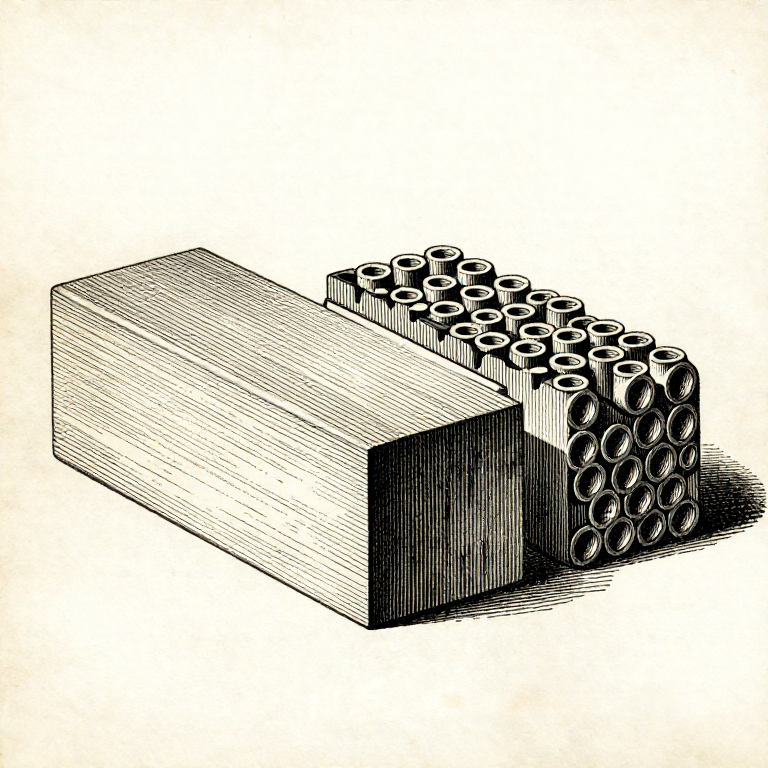


Why a Butt Joint Fails: End Grain Does Not Glue
Glue two long-grain faces together properly and the joint is stronger than the wood — break it and it tears out fibres either side. Glue two END-grain faces together and it comes apart in your hands.
The reason is the cell structure. Long grain presents cell WALLS to be bonded; end grain presents the open ends of hollow tubes, which drink the glue away from the surface and leave a starved joint over very little real contact area.
Every traditional joint in woodworking is, at bottom, a way of turning an end-grain meeting into a long-grain glue surface, a mechanical interlock, or both. Knowing that makes the whole catalogue of joints look less like tradition and more like solutions.
初学者
2 hours
说明
1
1
What end grain does to glue
What end grain does to glue
End grain wicks glue into the open tubes by capillary action. The surface is left starved, so the bond line has too little adhesive exactly where it is needed — the starvation failure the glue batch describes, produced by the timber rather than by the clamps.
The contact area is also far smaller than it looks. A long-grain surface is a field of cell walls to bond to; an end-grain surface is mostly open holes, and glue bridging a hole is not holding anything.
SIZING helps and does not cure it: brush on thinned glue, let it soak in and become tacky, then glue normally. That fills the tubes first so the real joint is not starved. It typically gets an end-grain joint to a useful fraction of long-grain strength — better than nothing, nowhere near enough to rely on.
此步骤所需材料:
 硬木块1 个
 PVA 木工胶1 个
所需工具:
 F 夹(滑动夹)
2
2
The three cures, and every joint is one of them
The three cures, and every joint is one of them
**Add long grain.** A mortise and tenon works because the tenon's cheeks are long grain glued to the mortise's long-grain walls. The end grain at the bottom of the tenon contributes nothing and is not asked to.
**Add mechanical interlock.** A dovetail resists being pulled apart by its shape alone — the glue is a bonus, which is why antique dovetailed drawers survive with the glue long since failed.
**Add a separate piece of long grain.** A dowel, a loose tenon, a biscuit, a spline. Each one crosses the joint with its own grain running the useful way, turning two end-grain faces into several long-grain glue surfaces.
此步骤所需材料:
 木榫条1 个PVA 木工胶1 个
 硬木板1 个
所需工具:
 凿子
凿子 夹背锯
夹背锯 划线规
划线规3
3
Long grain to long grain is the joint that needs nothing
Long grain to long grain is the joint that needs nothing
An edge joint — two boards glued edge to edge to make a wider panel — is long grain to long grain the whole way. Properly made it needs no dowels, no biscuits and no splines, and it will not be where the panel breaks.
Dowels and biscuits in an edge joint are for ALIGNMENT during glue-up, not strength. That is a perfectly good reason to use them, but adding them for strength is effort spent on the one part of the joint that was never going to fail.
What an edge joint does need is a straight, square, well-fitted edge and even clamping. That is the clamping-pressure rung, and it is where edge joints actually go wrong.
此步骤所需材料:
硬木板2 个PVA 木工胶1 个所需工具:
 手刨F 夹(滑动夹)
 组合角尺
组合角尺4
4
Cross-grain gluing: the mistake that waits a year
Cross-grain gluing: the mistake that waits a year
Gluing one board ACROSS another's width — a solid batten glued across a panel, a wide top glued to a wide rail — puts one piece's several millimetres of seasonal movement against the other's near zero. One of them will give.
It never fails during the build, which is what makes it so common. The glue holds perfectly, the piece looks fine for a season, and it splits in the first dry winter — by which time the cause is not obvious.
The cures are all forms of letting it slide: glue only the middle few centimetres and let the rest float, use slotted screw holes, use tabletop buttons that hook into a groove. A breadboard end does all three at once, and the last rung of this batch is that joint in detail.
此步骤所需材料:
硬木板1 个PVA 木工胶1 个所需工具:
F 夹(滑动夹)划线规相关蓝图
这些蓝图共享知识——技术、材料或原理


CC0 公共领域
此蓝图以 CC0 协议发布。你可以自由复制、修改、分发和使用此作品,无需征得许可。
通过购买蓝图中的产品支持创客,他们将获得 创客佣金 (由供应商设定),或创建此蓝图的新版本并将其作为连接包含在你自己的蓝图中以分享收入。