KUNST
SCHÖNHEIT & WELLNESS
HANDWERK
KULTUR & GESCHICHTE
UNTERHALTUNG
UMFELD
ESSEN & GETRÄNKE
REVERSE ENGINEERING
WISSENSCHAFTEN
SPORT
TECHNOLOGIE
WEARABLES
Youblob (generated from this blueprint's notebook) · CC0


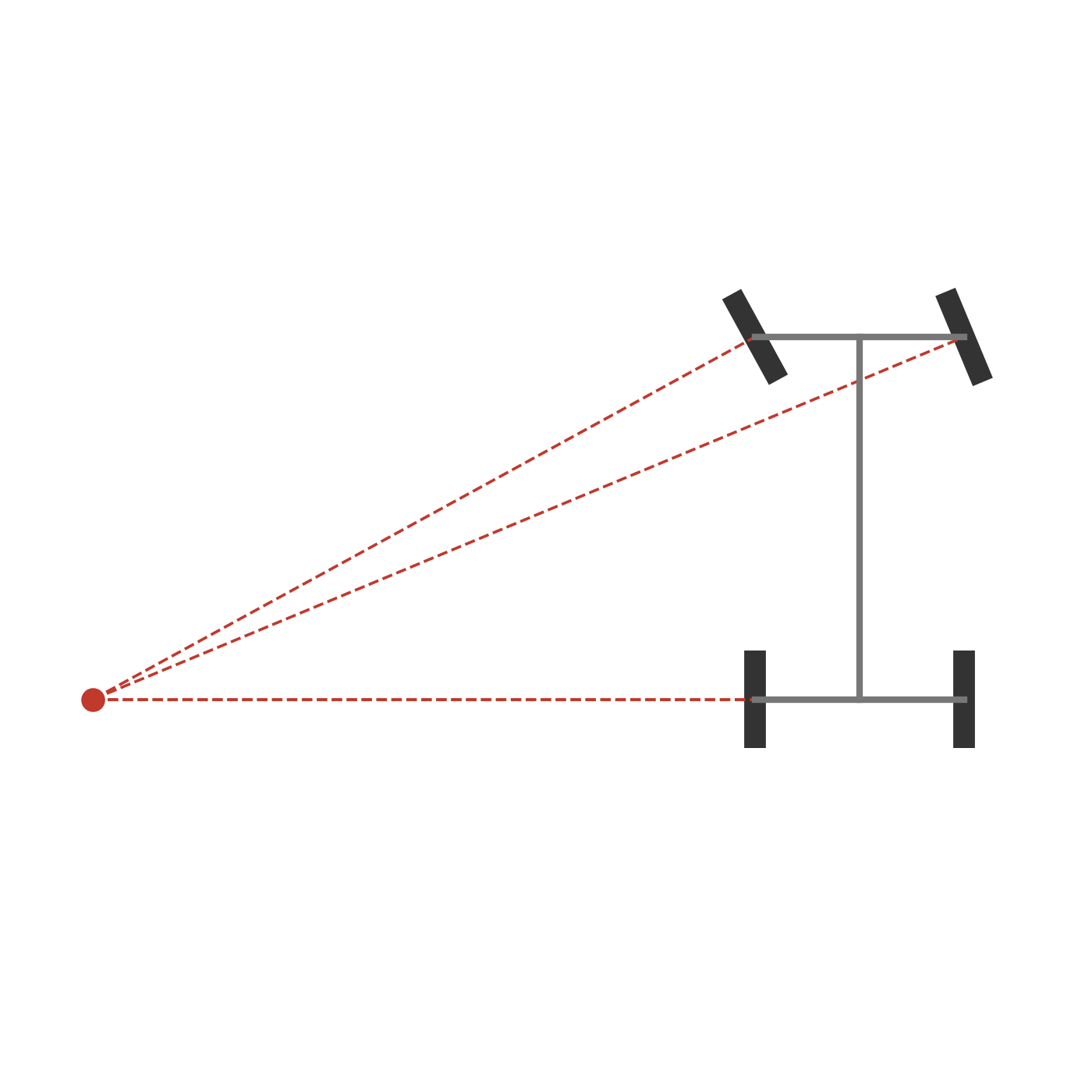
Ackermann Steering: The Inner Wheel Turns Further
A cart turns by swivelling its whole front axle on a pin — simple, but the axle sweeps under the body and the cart grows unstable. In 1816 the Munich carriage-builder Georg Lankensperger pivoted each front wheel on its own stub instead, joined them with a tie rod, and angled the steering arms so the inner wheel turns further than the outer. Rudolph Ackermann patented it in England on his behalf in 1818, and the geometry has carried Ackermann's name ever since.
Every wheel should roll round one common centre on a turn; this linkage gets very close to that without any clever mechanism at all.
This rung works out the wheel angles and checks a trapezoid linkage numerically, then builds one and measures it with a protractor.
Anfänger
About 3 hours
Anweisungen
1
1
The angles, and the linkage that makes them
The angles, and the linkage that makes them
Jupyter-Notebook wird geladen …
2
2
Build a steering model
Build a steering model
Cut a plywood 'axle beam' 300 mm long. Near each end, pivot a small plywood wheel carrier on a screw (the kingpin). Glue a steering arm to each carrier pointing backward and inward, so that the two arms, extended, meet at a point on the centre line one 'wheelbase' behind — use 520 mm for a 300 mm track, the same ratio as the notebook's car.
Join the arm ends with a tie rod of balsa strip, pinned at each end. Glue a protractor under each carrier.
Steer one wheel to 10°, 20° and 30° and read the other. Compare with the notebook's linkage column. Then make the arms parallel and repeat: both wheels now turn the same angle — the scrubbing layout.
Materialien für diesen Schritt:
 Sperrholzplatte1 Blatt
 Balsaholzplatte1 Blatt
 Maschinenschrauben6 Stück
Benötigte Werkzeuge:
 Akkubohrschrauber
 Bohrersatz
 Winkelmesser
 Lineal
3
3
History and context
History and context
**Georg Lankensperger, Munich, 1816**; patented in England in 1818 by **Rudolph Ackermann**, his agent, as a steering for carriages. No patent number is asserted here. Charles Jeantaud refined the geometry in France later in the century, and the arrangement passed to the motor car.
**Honest limits.** The linkage is exact at only a few angles. At speed, tyres run at slip angles and a car may want less than full Ackermann; racing cars often use less or even reverse it. And the geometry assumes rigid wheels rolling without slip — a fair assumption only for slow, tight turns.
Materialien
3- 1 BlattPlatzhalter
- 1 BlattPlatzhalter
- 6 StückPlatzhalter
Benötigte Werkzeuge
4- 1 vendor sell this, none ship to you yetPlatzhalter
- Platzhalter
- Platzhalter
- Platzhalter
Verwandte Blueprints
Diese Blueprints teilen Wissen — Techniken, Materialien oder Prinzipien

CC0 Gemeinfrei
Dieser Blueprint ist unter CC0 veröffentlicht. Sie dürfen dieses Werk für jeden Zweck frei kopieren, ändern, verbreiten und verwenden, ohne um Erlaubnis zu fragen.
Unterstützen Sie den Maker, indem Sie Produkte über seinen Blueprint kaufen, wo er eine Maker-Provision von Anbietern festgelegt, verdient. Oder erstellen Sie eine neue Iteration dieses Blueprints und verbinden Sie ihn in Ihrem eigenen Blueprint, um Einnahmen zu teilen.