
Zusammenarbeit
KUNST
SCHÖNHEIT & WELLNESS
HANDWERK
KULTUR & GESCHICHTE
UNTERHALTUNG
UMFELD
ESSEN & GETRÄNKE
REVERSE ENGINEERING
WISSENSCHAFTEN
SPORT
TECHNOLOGIE
WEARABLES
Ice Boat: Crossed Timbers, Skate-Edged Runners, Bicycle-Fork Steering and a Gaff Sail (Boy Mechanic, 1915)
Woody

Erstellt von

Woody

13. November 2026NO
2
0
0
0
0

Ice Boat: Crossed Timbers, Skate-Edged Runners, Bicycle-Fork Steering and a Gaff Sail (Boy Mechanic, 1915)

Robert K. Patterson's ice boat from The Boy Mechanic, Book 2 (1915): a 16 ft timber crossed by a 10-1/2 ft one and braced with wires, two front runners of band iron ground like a skate edge, and a rear steering runner clamped in a cut-down bicycle fork worked by a lever. His text and his drawing differ on the mast (about 12 ft against 14 ft); both are given.
Erfahren
About 1 week

Anweisungen

1

Text against drawing

Jupyter-Notebook wird geladen …
2

Read The Boy Mechanic, Book 2

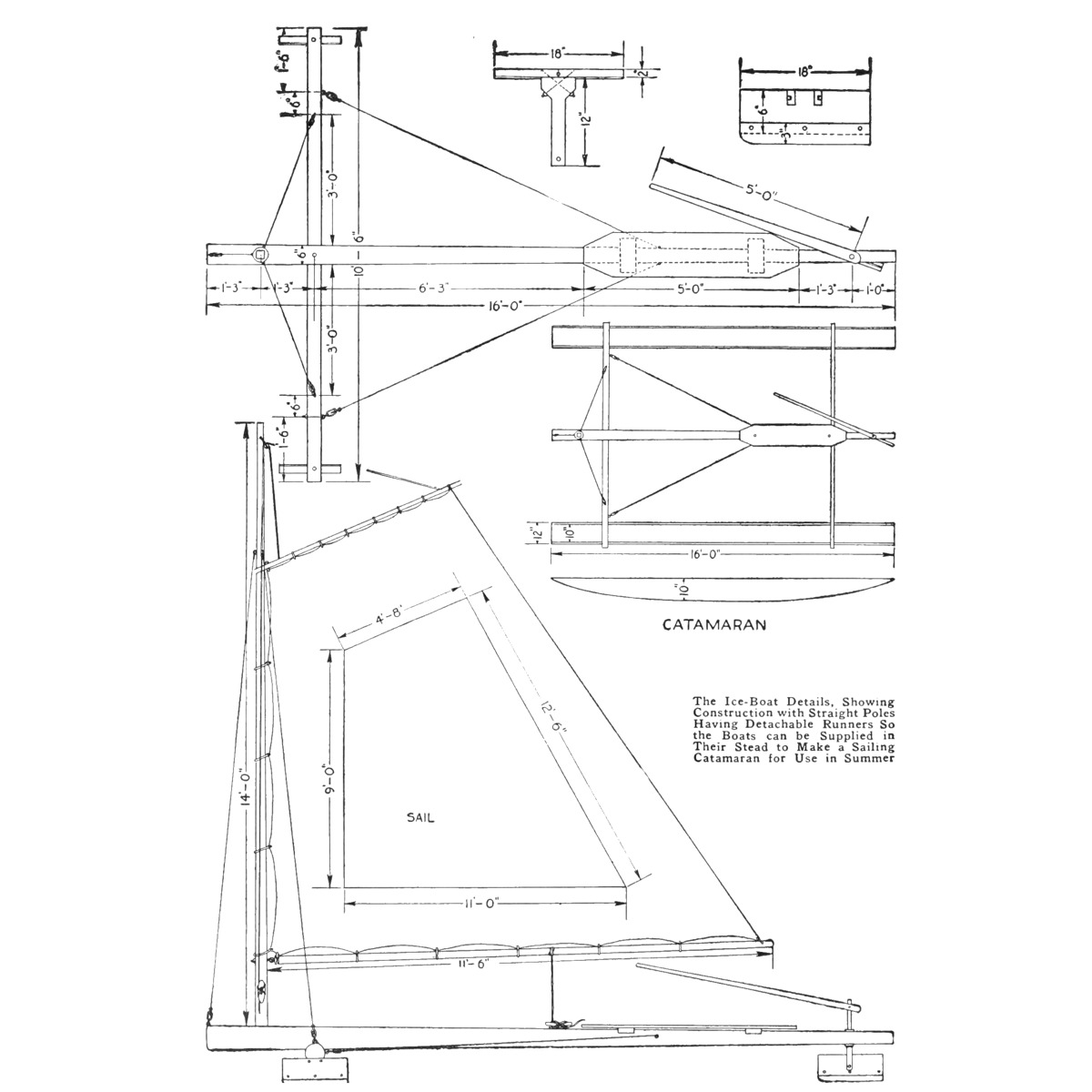
"In constructing the ice boat, use two poles, or timbers, one 16 ft. and the other 10-1/2 ft. long, crossed at a point 2-1/2 ft. from one end of the longer timber. The crossed pieces are firmly braced with wires, as shown."
3

Cross and brace the frame

Cross the 10-1/2 ft timber over the 16 ft one, 2-1/2 ft from its front end, and fasten them firmly. Brace them with wires as in the drawing: from the bow to points on the cross timber, and from the cross timber back along the long one. The drawing puts the wire points 6 in and 1 ft 6 in from each end of the cross timber.

Materialien für diesen Schritt:

HolzstangeHolzstange2 Stück
SchlossschraubeSchlossschraube1 Stück
StahldrahtStahldraht1 Stück

Benötigte Werkzeuge:

HandsägeHandsäge
Bohrwinde mit BohrerBohrwinde mit Bohrer
Bandmaß (Rollmeter)Bandmaß (Rollmeter)
BleistiftBleistift
4

Make the front runners

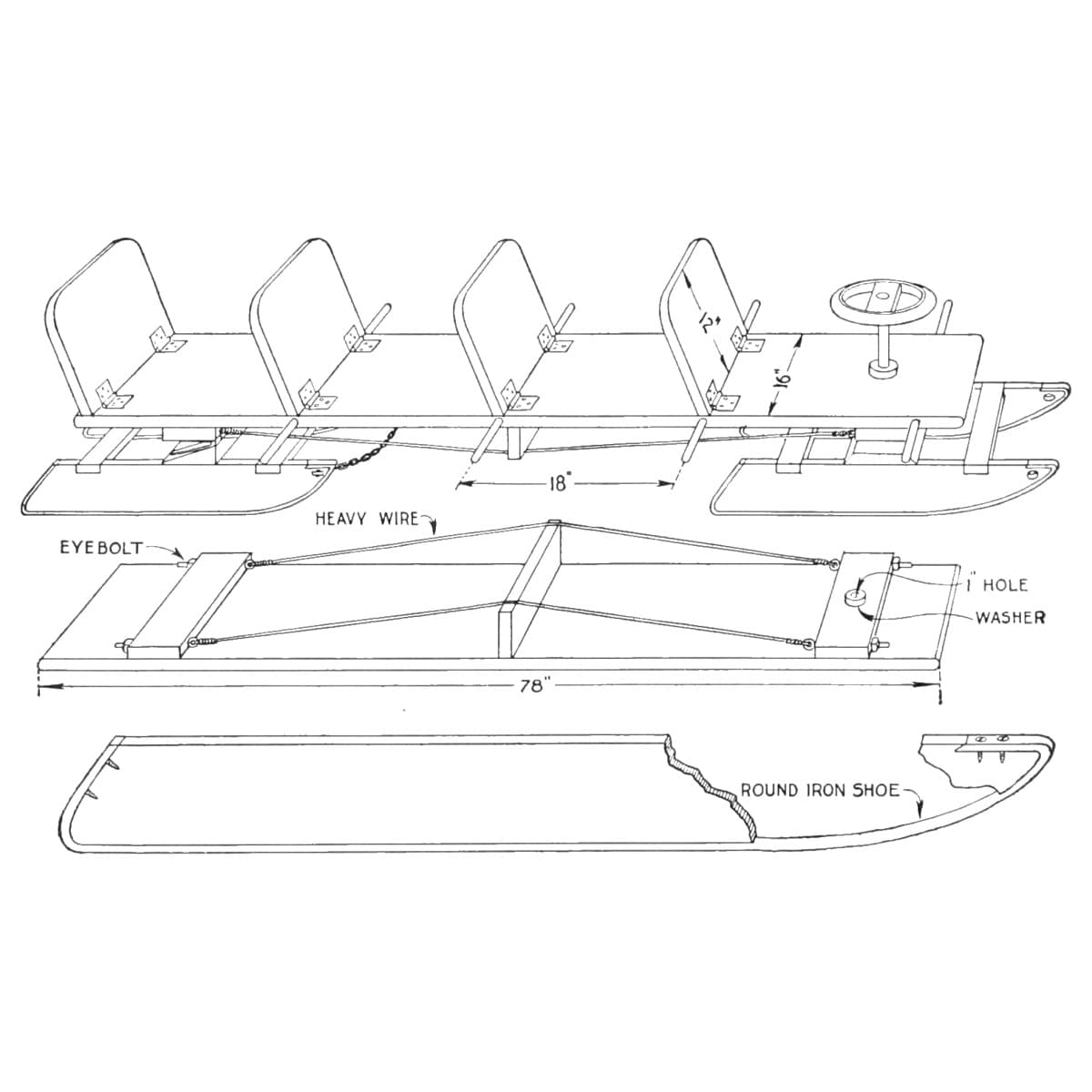
Cut two band-iron strips 18 in long, 3 in wide and 1/8 in thick; grind one edge like the edge of a skate and round the ends. Bolt each to the side of a wood piece 18 in long, 6 in wide and 2 in thick, so the ground edge projects about 1 in. With a pole frame, bolt each runner block at right angles to a 12 in piece of wood shaped as drawn, the bolts running diagonally through its shouldered part; the pole end rests on this and is bolted down. With squared timbers, fasten the runners straight to them.

Materialien für diesen Schritt:

Baustahl-FlachstahlBaustahl-Flachstahl1 Stück
HartholzbrettHartholzbrett1 Stück
SchlossschraubeSchlossschraube1 Stück

Benötigte Werkzeuge:

Bügelsäge (Metallsäge)Bügelsäge (Metallsäge)
DoppelschleiferDoppelschleifer
SchraubstockSchraubstock
HandbohrerHandbohrer
HandsägeHandsäge
5

Make the steering runner

Fasten the rear runner between two pieces of wood so its edge projects, and clamp it in a bicycle fork cut down to leave about 3 in of the blades. Bore a hole through the rear end of the long timber for the fork head. Fit a lever (5 ft on the drawing) to the top of the fork head: bore a hole through the lever end at a slight angle to fit the head, slot the end, bore across the width of the handle and put in a bolt as a clamp.

Materialien für diesen Schritt:

Baustahl-FlachstahlBaustahl-Flachstahl1 Stück
HartholzbrettHartholzbrett1 Stück
FahrradgabelFahrradgabel1 Stück
SchlossschraubeSchlossschraube1 Stück
NadelholzlatteNadelholzlatte1 Stück

Benötigte Werkzeuge:

Bügelsäge (Metallsäge)Bügelsäge (Metallsäge)
DoppelschleiferDoppelschleifer
Bohrwinde mit BohrerBohrwinde mit Bohrer
HandsägeHandsäge
StechbeitelStechbeitel
6

Step the mast and fit the seat

Cut a mortise in the long timber 15 in from the front end and set the mast in it; stay it with wires as drawn. His text says the mast should be about 12 ft; his drawing marks it 14 ft 0 in: choose one and keep the sail to suit. Fasten a board on two crosspieces mortised into the top of the long timber, as a seat for the driver (5 ft long on the drawing, ending 2 ft 3 in from the stern).

Materialien für diesen Schritt:

NadelholzlatteNadelholzlatte1 Stück
StahldrahtStahldraht1 Stück
KiefernbrettKiefernbrett1 Stück
HolzschraubenHolzschrauben1 Stück

Benötigte Werkzeuge:

HandsägeHandsäge
StechbeitelStechbeitel
HandhobelHandhobel
Bandmaß (Rollmeter)Bandmaß (Rollmeter)
7

Make and rig the sail

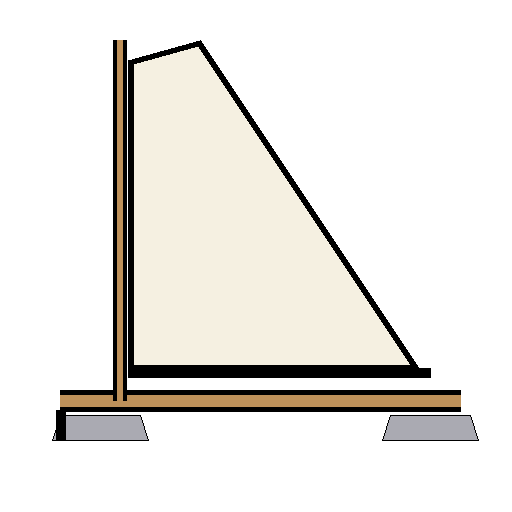
Make the sail of any good material to his drawing: luff (along the mast) 9 ft 0 in, head 4 ft 8 in, foot 11 ft 0 in, leech 12 ft 6 in. Hang the main boom, 11-1/2 ft long, and the upper spar on the mast "in the usual manner". The text also names a jib boom of about 6 ft, which the drawing does not show.

Materialien für diesen Schritt:

SegeltuchSegeltuch1 Stück
NadelholzlatteNadelholzlatte1 Stück
BaumwollseilBaumwollseil1 Stück

Benötigte Werkzeuge:

SchereSchere
HandsägeHandsäge
Bandmaß (Rollmeter)Bandmaß (Rollmeter)
8

Troubleshooting

Ice boat troubleshooting.

Flow

Loading...
9

History and honest limits

From "An Ice Boat and Catamaran" by Robert K. Patterson, in **The Boy Mechanic, Book 2**, Popular Mechanics, 1915 (Project Gutenberg 44585; checked on the archive.org scan boymechanicbook200chic2, pp. 27-28). His text and drawing differ on the mast (about 12 ft against 14 ft 0 in) and on the jib boom, which is in the text only; both are stated, not resolved. He gives no timber sections, wire size or sail cloth: those choices are ours, as are the tools and metric figures. The summer catamaran conversion is not made here.

Materialien

11

Benötigte Werkzeuge

11

Dieser Bauplan stellt her

CC0 Gemeinfrei

Dieser Blueprint ist unter CC0 veröffentlicht. Sie dürfen dieses Werk für jeden Zweck frei kopieren, ändern, verbreiten und verwenden, ohne um Erlaubnis zu fragen.

Unterstützen Sie den Maker, indem Sie Produkte über seinen Blueprint kaufen, wo er eine Maker-Provision von Anbietern festgelegt, verdient. Oder erstellen Sie eine neue Iteration dieses Blueprints und verbinden Sie ihn in Ihrem eigenen Blueprint, um Einnahmen zu teilen.

Diskussion

(0)

Anmelden um an der Diskussion teilzunehmen

Kommentare werden geladen...