


Hammering Bronze Sheet from a Cast Ingot — Raising and Planishing
Sheet bronze was the material behind Bronze Age armour, vessels, mirrors, and decorative work. Unlike casting which produces a fixed shape, sheet-working starts with a flat ingot and transforms it through repeated cycles of hammering and annealing into sheets as thin as 0.5 mm — thinner than modern cardboard.
The process exploits a fundamental property of bronze: cold-hammering compresses the crystal grains, making the metal harder and thinner with each blow. But this work-hardening also makes the bronze brittle. Before it cracks, the smith heats it to dull red (annealing), which recrystallises the grain structure and restores ductility. A single ingot may go through 10-15 anneal-hammer cycles to reach usable sheet thickness.
The finished sheet can then be cut, bent, raised into vessels, riveted, engraved, or embossed — opening the full range of Bronze Age metalcraft.
Anweisungen
Cast a flat ingot
Cast a flat ingot
Materialien für diesen Schritt:
 Kupferblech500 g
Set up the anvil stone
Set up the anvil stone
Benötigte Werkzeuge:
 Flache Steinplatte
First hammering pass — rough thinning
First hammering pass — rough thinning
Benötigte Werkzeuge:
 Schlagstein
First anneal
First anneal
Materialien für diesen Schritt:
 Holzkohle2 kg
Benötigte Werkzeuge:
 Zange mit langem Griff
Continue hammer-anneal cycles
Continue hammer-anneal cycles
Detect and prevent edge cracking
Detect and prevent edge cracking
Final thinning to usable sheet
Final thinning to usable sheet
Planish the surface
Planish the surface
Benötigte Werkzeuge:
 Glattstein
Polish (optional)
Polish (optional)
Materialien für diesen Schritt:
 Feiner Sand100 g
Materialien
3- 500 gPlatzhalter
- 2 kgPlatzhalter
- 100 gPlatzhalter
Benötigte Werkzeuge
4- Platzhalter
- Platzhalter
- Platzhalter
- Platzhalter
Materialien verbundener Blueprints
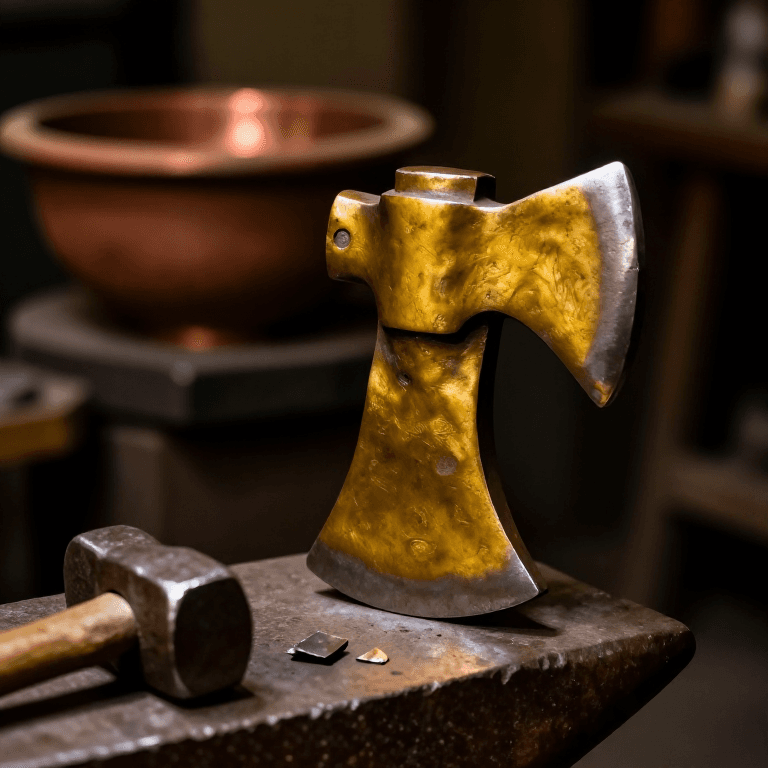
Dieser Bauplan stellt her

Verwandte Blueprints
Diese Blueprints teilen Wissen — Techniken, Materialien oder Prinzipien
CC0 Gemeinfrei
Dieser Blueprint ist unter CC0 veröffentlicht. Sie dürfen dieses Werk für jeden Zweck frei kopieren, ändern, verbreiten und verwenden, ohne um Erlaubnis zu fragen.
Unterstützen Sie den Maker, indem Sie Produkte über seinen Blueprint kaufen, wo er eine Maker-Provision von Anbietern festgelegt, verdient. Oder erstellen Sie eine neue Iteration dieses Blueprints und verbinden Sie ihn in Ihrem eigenen Blueprint, um Einnahmen zu teilen.