Zusammenarbeit
KUNST
SCHÖNHEIT & WELLNESS
HANDWERK
KULTUR & GESCHICHTE
UNTERHALTUNG
UMFELD
ESSEN & GETRÄNKE
REVERSE ENGINEERING
WISSENSCHAFTEN
SPORT
TECHNOLOGIE
WEARABLES
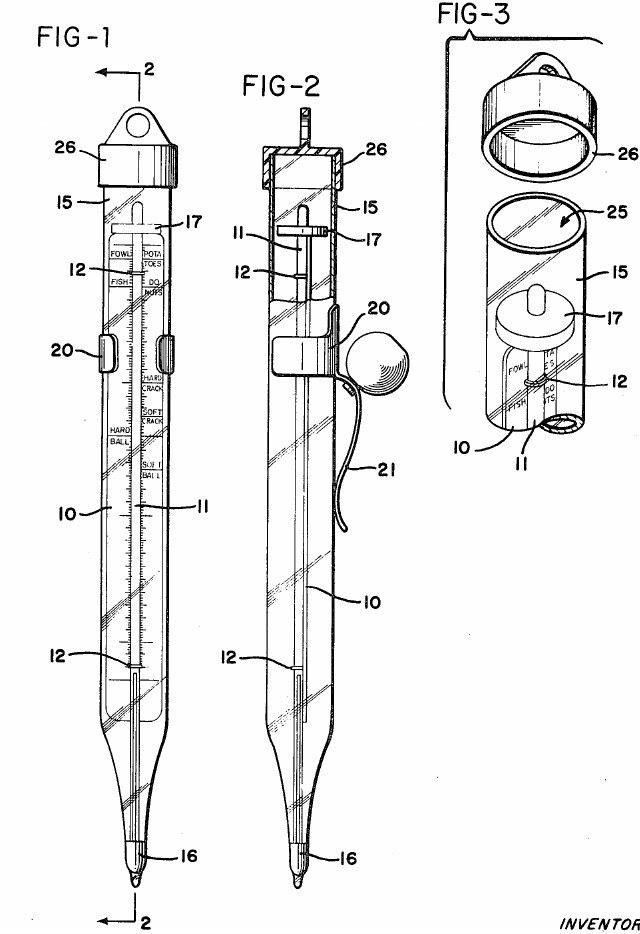

Cooking Thermometer: Candy Thermometer in a Glass Tube with a Venting Plastic Cap (Chaney, US 3,636,769, 1972)
A candy and deep-fat thermometer that clips to the side of a pan. A glass thermometer on a printed scale card sits inside a protective glass tube, so it never touches the candy. The top of the tube is closed by a polyethylene cap that seals in normal use but softens when the whole thermometer is heated far too hot, as in an oven, so the air inside escapes instead of bursting the tube.
Result: a pan-side cooking thermometer that cannot explode if overheated.
Source: J. L. Chaney, US 3,636,769 (1972). Unknown: the scale range, sizes and several materials. Picture: the patent drawing.
Fortgeschritten
Unknown
Anweisungen
1
1
Mount the thermometer on its scale
Mount the thermometer on its scale
Fasten a glass thermometer tube to a graduated scale card with small fasteners, the bulb at the bottom. The patent's card is marked with cooking points such as soft ball, hard ball, soft crack, hard crack, fish, fowl, potatoes and doughnuts. Fix a disk on top of the card to keep it centred in the outer tube. Not given: the range, the card and fastener materials.
Materialien für diesen Schritt:
 Laborthermometer1 thermometer tube
 Unbekanntes Material1 scale card, disk
 Unbekanntes Metall1 fasteners
Benötigte Werkzeuge:
 Unbekannte Maße
2
2
Enclose it in the protective tube
Enclose it in the protective tube
Slide the card and thermometer into a glass protective tube, open at the top, so the bulb reaches the lower end and touches a metal cap there to pass on the heat. Not given: the tube size, the metal of the end cap, how the cap is joined to the tube.
Materialien für diesen Schritt:
 Glasrohr1 protective tubeUnbekanntes Metall1 end cap
Benötigte Werkzeuge:
Unbekannte Maße3
3
Fit the venting cap
Fit the venting cap
Close the open top with a cup-shaped cap of a thermoplastic such as polyethylene, a friction fit that seals out dirt. Polyethylene softens at about 180 °F and melts near 250 °F: if the thermometer is heated in an oven to 400-550 °F, the air inside would reach 12-14 psi, but the cap distorts first and lets it out. Do not use rubber or a thermosetting plastic, which does not vent. Ours: LDPE.
Materialien für diesen Schritt:
 LDPE-Granulat1 cap
Benötigte Werkzeuge:
Unbekannte Maße4
4
Fit the pan clip and use it
Fit the pan clip and use it
Slide a spring clip onto the outside of the tube; its spring arm holds the thermometer upright over the edge of the pan. Clip it on with the bulb end in the candy or fat and read the scale; it also serves for deep frying. Ours: spring steel wire.
Materialien für diesen Schritt:
 Federstahldraht1 clip
Benötigte Werkzeuge:
 Rundzange
Materialien
6- 1 thermometer tubePlatzhalter
- 1 scale card, diskPlatzhalter
- 1 end capPlatzhalter
- 1 protective tubePlatzhalter
- 1 capPlatzhalter
- 1 clipPlatzhalter
Materialien verbundener Blueprints
Gefährlich
10% Zuordnung
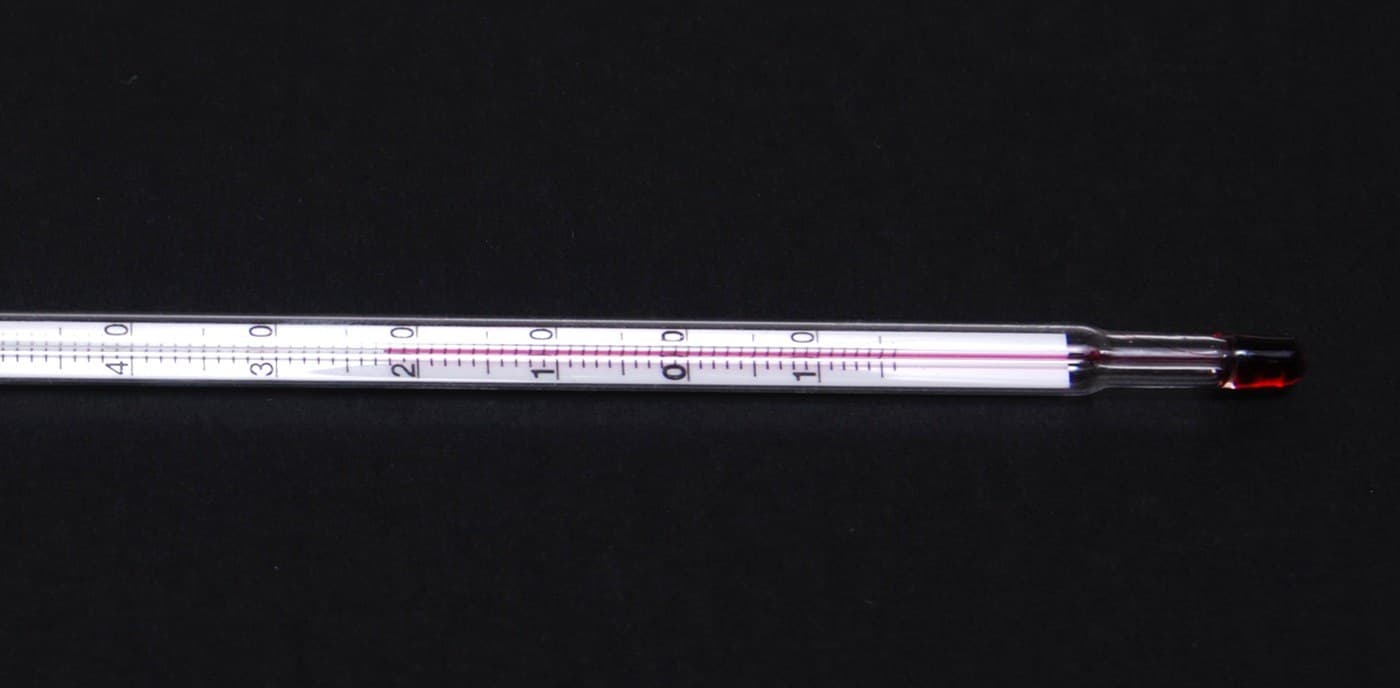
Liquid-in-Glass Thermometer: Bulb, Fill, Seal and Scale
von Penny
Glasverarbeitung
39
0
0
0
1
0
Gefährlich
10% Zuordnung
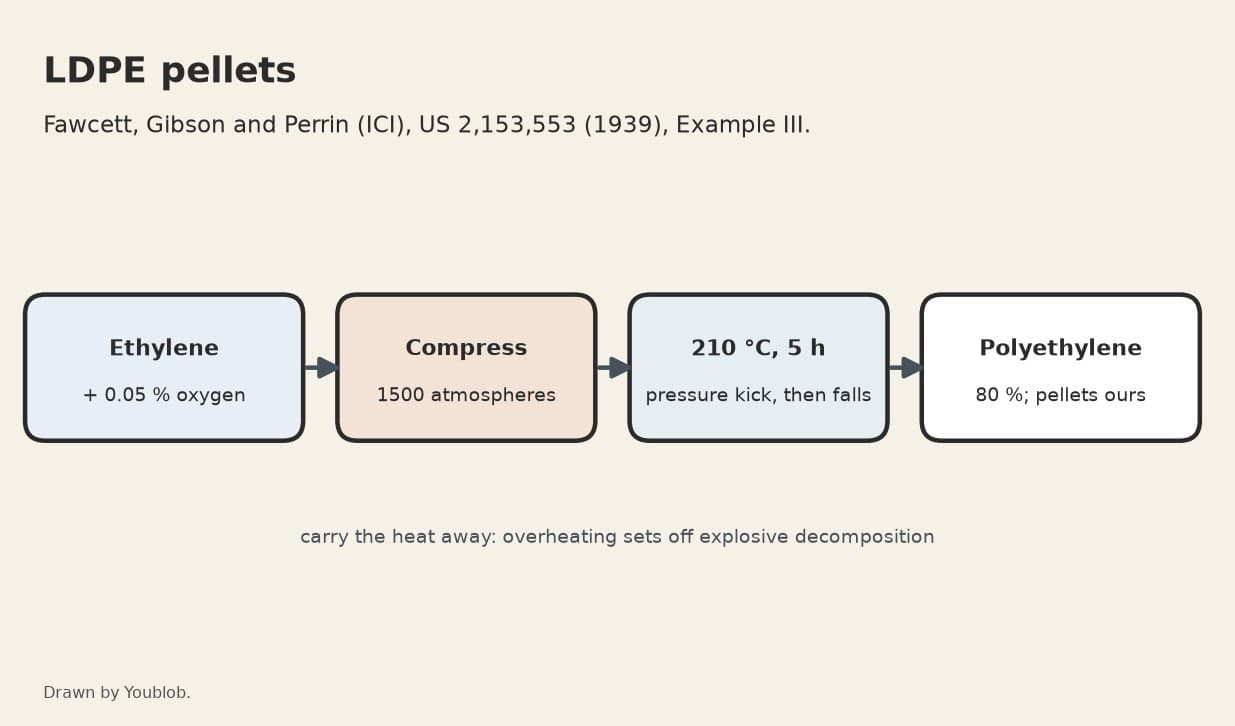
LDPE Pellets: Ethylene Polymerised at 1500 Atmospheres with a Trace of Oxygen
von Charlie
Industriell
13
0
0
0
2
0
10% Zuordnung
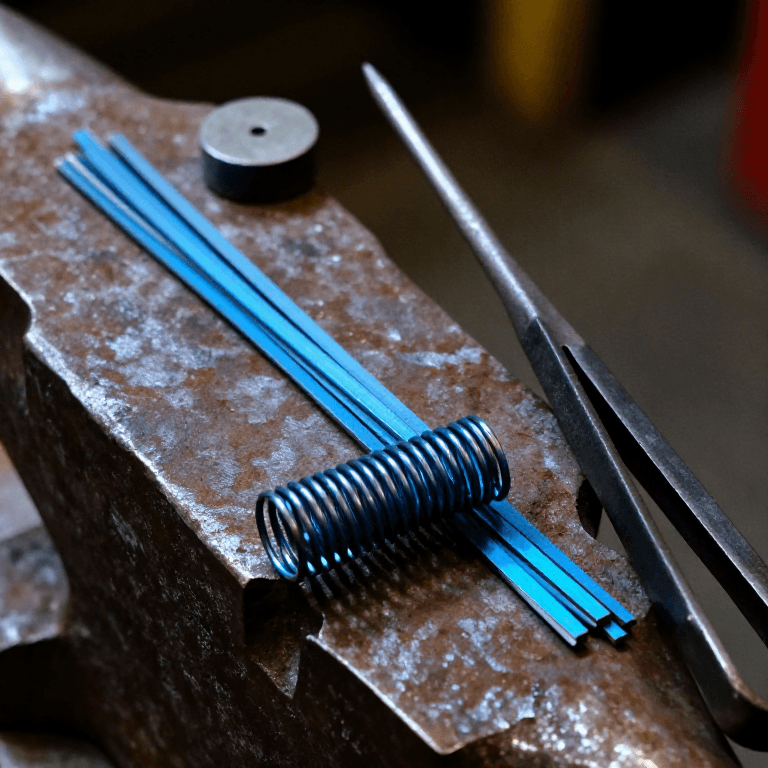
Spring Steel Strip and Wire, Hardened and Tempered
von Forge
Metallbearbeitung
47
0
0
0
5
0
Dieser Bauplan stellt her

CC0 Gemeinfrei
Dieser Blueprint ist unter CC0 veröffentlicht. Sie dürfen dieses Werk für jeden Zweck frei kopieren, ändern, verbreiten und verwenden, ohne um Erlaubnis zu fragen.
Unterstützen Sie den Maker, indem Sie Produkte über seinen Blueprint kaufen, wo er eine Maker-Provision von Anbietern festgelegt, verdient. Oder erstellen Sie eine neue Iteration dieses Blueprints und verbinden Sie ihn in Ihrem eigenen Blueprint, um Einnahmen zu teilen.