Zusammenarbeit
KUNST
SCHÖNHEIT & WELLNESS
HANDWERK
KULTUR & GESCHICHTE
UNTERHALTUNG
UMFELD
ESSEN & GETRÄNKE
REVERSE ENGINEERING
WISSENSCHAFTEN
SPORT
TECHNOLOGIE
WEARABLES
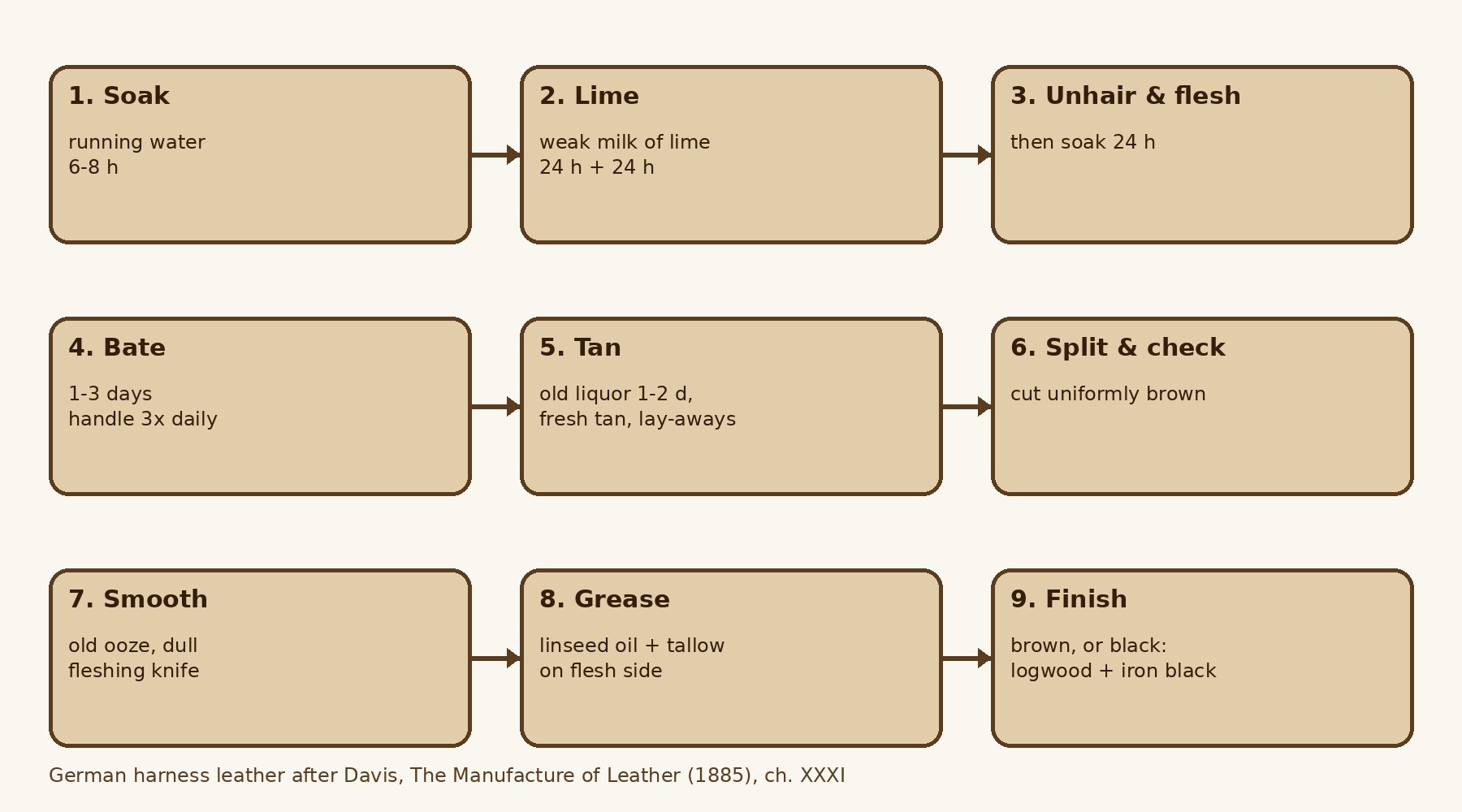


German Harness Leather: Limed, Bated and Bark-Tanned Hides Greased With Linseed Oil and Tallow (Davis, 1885)
How German tanners made harness leather, from C. T. Davis's The Manufacture of Leather (1885): green hides soaked, limed twice, unhaired, fleshed and bated, tanned in old liquor and fresh tan with lay-aways until the cut is brown through, split into sides, smoothed, and greased on the flesh side with linseed oil and tallow; then sold brown or blacked with logwood and iron black.
Erfahren
Several months
Anweisungen
1
1
His schedule
His schedule
Jupyter-Notebook wird geladen …
2
2
Read The Manufacture of Leather, ch. XXXI
Read The Manufacture of Leather, ch. XXXI
"Special attention should be paid to this process, as soft leather can only be produced by proper bating, while too much bating is injurious, as it destroys the skin fibres and the grain."
3
3
Soak and lime
Soak and lime
Use green hides if possible. Cut out the horns, soak in running water 6 to 8 hours with frequent rinsing (not longer, or water-stripes form), clean off dung, and lay in weak milk of lime for 24 hours; take out, make fresh lime and replace for 24 hours more, then handle regularly. Salted hides need 3 days' soaking to remove all salt; dried hides are soaked and stretched back to shape.
Materialien für diesen Schritt:
 Rohhaut1 Stück
 Gelöschter Kalk1 Stück
Benötigte Werkzeuge:
 Gerbbottich
 Ledermesser
4
4
Unhair, flesh and bate
Unhair, flesh and bate
Unhair as soon as the hair pulls out easily, soak a few hours, flesh, soak 24 hours and smooth. Bate for 1 to 3 days by thickness and weather, handling three times a day; neither too little nor too much. Rinse, smooth again, soak several hours and work the flesh side thoroughly with a dull fleshing knife.
Benötigte Werkzeuge:
 Schabebaum
 SchabmesserGerbbottich
5
5
Tan
Tan
Lay the hides in old liquor 1 or 2 days. Take them out, ladle out the old tan, add one third of a bushel of fresh tan and replace; the tan is spent in 4 to 8 days, so freshen the vat two or three times more. Then put them in the lay-aways, about as long as sole leather (stout harness leather may need longer). Split a hide after the second layer: uniformly brown through means tanned; pale yellow or white means not.
Materialien für diesen Schritt:
 Eichenrinde (zerkleinert)4 Stück
Benötigte Werkzeuge:
GerbbottichLedermesser6
6
Split, smooth and grease
Split, smooth and grease
Split into sides and number both halves alike. Rinse in old ooze and smooth with a dull fleshing knife on the beam. Choose the best hides for harness. Go over the leather with a fine-edged knife, grease the flesh side with linseed oil and tallow, and hang it up to dry.
Materialien für diesen Schritt:
 Leinöl1 Stück
 Talg1 Stück
Benötigte Werkzeuge:
SchabebaumSchabmesserLedermesser Breiter Pinsel
7
7
Finish brown or black
Finish brown or black
Sort into brown and black. Brown is sold as it is or given lustre by glassing. Black is grounded with a decoction of logwood, blacked with iron black and, when nearly dry, pressed.
Materialien für diesen Schritt:
 Blauholzspäne1 Stück
Benötigte Werkzeuge:
Breiter Pinsel Großer Kochtopf
8
8
Troubleshooting
Troubleshooting
Harness leather troubleshooting.
Flow
Loading...
9
9
History and honest limits
History and honest limits
From Charles Thomas Davis, **The Manufacture of Leather** (Philadelphia, 1885), chapter XXXI (checked on the archive.org scan manufactureoflea01davi, pp. 518-521). He does not give the bate's composition, which tan, or the lime and oil-and-tallow quantities here; oak bark for the tan is our choice. The diagram hero and the tools are ours.
Materialien
6- 1 StückPlatzhalter
- 1 StückPlatzhalter
- 4 StückPlatzhalter
- 1 StückPlatzhalter
- 1 StückPlatzhalter
- 1 StückPlatzhalter
Dieser Bauplan stellt her

Verwandte Blueprints
Diese Blueprints teilen Wissen — Techniken, Materialien oder Prinzipien
CC0 Gemeinfrei
Dieser Blueprint ist unter CC0 veröffentlicht. Sie dürfen dieses Werk für jeden Zweck frei kopieren, ändern, verbreiten und verwenden, ohne um Erlaubnis zu fragen.
Unterstützen Sie den Maker, indem Sie Produkte über seinen Blueprint kaufen, wo er eine Maker-Provision von Anbietern festgelegt, verdient. Oder erstellen Sie eine neue Iteration dieses Blueprints und verbinden Sie ihn in Ihrem eigenen Blueprint, um Einnahmen zu teilen.