Zusammenarbeit
KUNST
SCHÖNHEIT & WELLNESS
HANDWERK
KULTUR & GESCHICHTE
UNTERHALTUNG
UMFELD
ESSEN & GETRÄNKE
REVERSE ENGINEERING
WISSENSCHAFTEN
SPORT
TECHNOLOGIE
WEARABLES


Craftsman Leather Billfold: Two Cardboard Patterns, Silk Lining and Saddle-Stitched Waxed Silk (Boy Mechanic, 1919)
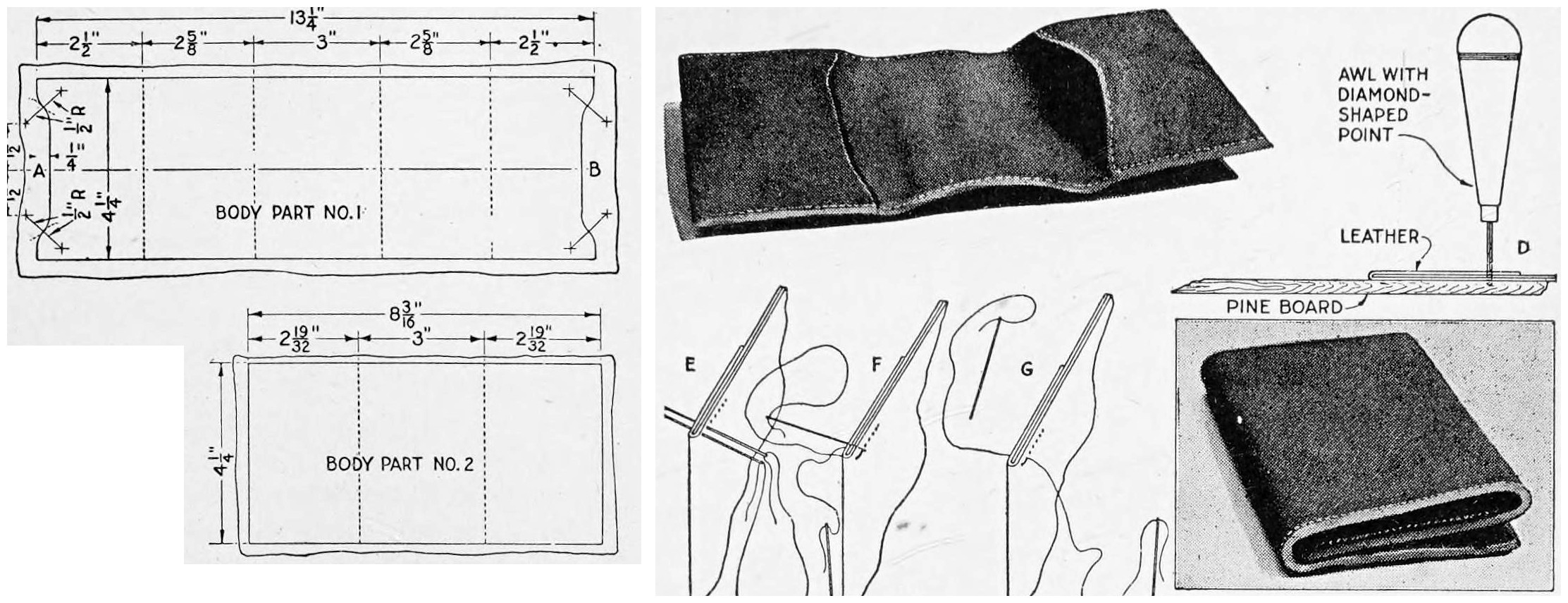
Livingston Haviland's billfold from The Boy Mechanic, Book 3 (1919): two leather body parts cut to stiff-cardboard patterns (13-1/4 and 8-3/16 by 4-1/4 in), lined with skiver or silk moire, folded into two card pockets and a money compartment, glued, and hand-sewn with heavy waxed silk 3/16 in from the edges.
Fortgeschritten
About 1 day
Anweisungen
1
1
His patterns in centimetres
His patterns in centimetres
Jupyter-Notebook wird geladen …
2
2
Read The Boy Mechanic, Book 3
Read The Boy Mechanic, Book 3
"The making of a billfold is easily within the range of an amateur in leather work, who will observe the instructions carefully." Seal, morocco, pigskin and ooze sheep are all satisfactory.
3
3
Cut the patterns and the leather
Cut the patterns and the leather
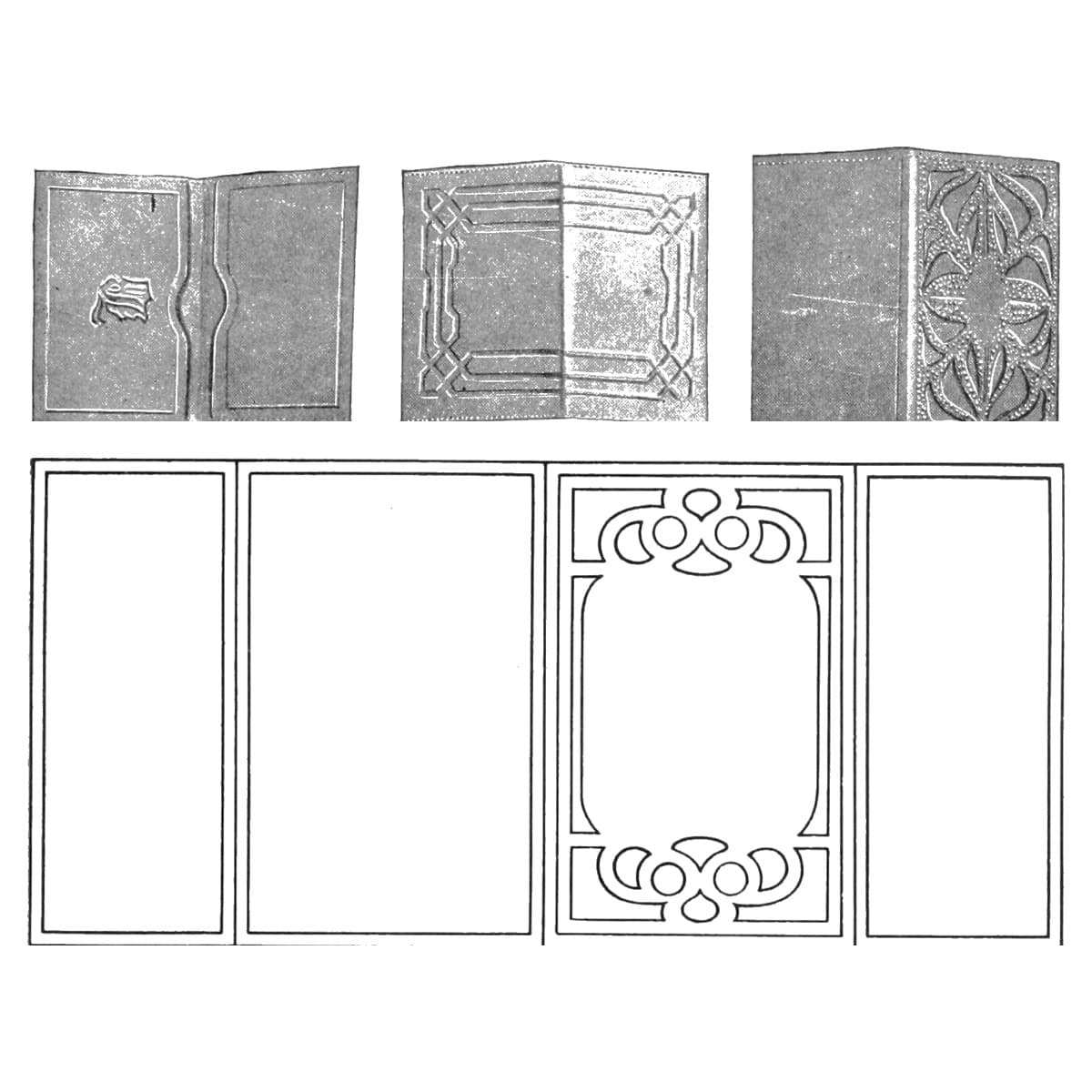
Cut two patterns of stiff cardboard (Fig. 1). Body part No. 1: 13-1/4 by 4-1/4 in, with fold lines at 2-1/2, 2-5/8, 3, 2-5/8 and 2-1/2 in, and each end (A, B) cut in with 1/2 in radius arcs, set in 1/4 in. Body part No. 2: 8-3/16 by 4-1/4 in, with fold lines at 2-19/32, 3 and 2-19/32 in. Lay each pattern on the leather and trim the leather even with it, guiding the knife with a metal straightedge, on a close-grained hardwood board or a piece of sheet zinc.
Materialien für diesen Schritt:
 Schweinsleder1 Stück
 Schablonen aus Pappe1 Stück
Benötigte Werkzeuge:
 Bleistift
 Lineal
 Haarlineal
 Bastelmesser
 Hartholzbrett
 Zinkblech
4
4
Line the parts
Line the parts
Cut linings slightly larger than the patterns. Skiver is glued all over with a good, pliable leather glue that will not crack the leather; smooth it on gently without stretching, or the leather may buckle, and dry it under a light weight. Silk moire is glued with a thin stripe round the edges only, left to overhang, and trimmed off neatly when dry.
Materialien für diesen Schritt:
 Seidenstoff1 Stück
 Lederkleber1 Stück
Benötigte Werkzeuge:
 SchereBastelmesser
5
5
Glue and fold
Glue and fold
Fold part No. 1 to form the back and the two card pockets. Apply stripes of glue as shown in Fig. 3, drop part No. 2 (the money compartment) into place, and fold the ends of No. 1 over on the dotted lines. Weight the billfold and let the glue dry.
Materialien für diesen Schritt:
Lederkleber1 StückBenötigte Werkzeuge:
 Lederpunzier- und Modellierwerkzeug
6
6
Mark and punch the stitching
Mark and punch the stitching
Draw a straight line with a blunt-point tool along the edges to be sewn, 3/16 in from them. Mark the stitch spacing for an inch on a strip of paper and transfer it along the line. Punch the holes on a pine board with a diamond-pointed awl held vertical (D); back the open ends with strips of cardboard while punching.
Benötigte Werkzeuge:
Lederpunzier- und ModellierwerkzeugLineal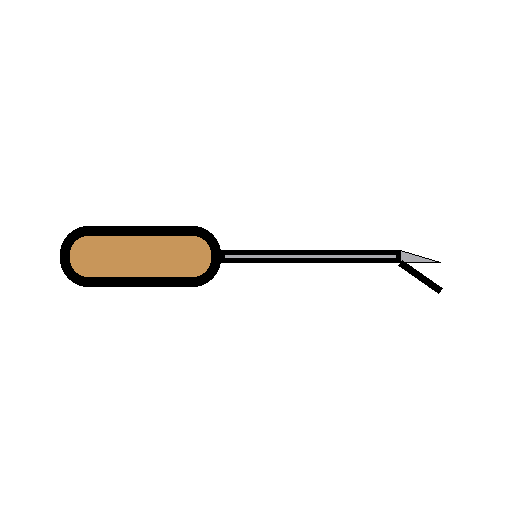 Doppelahle
 KiefernbrettSchablonen aus Pappe
7
7
Sew and finish the edges
Sew and finish the edges
Sew with heavy waxed silk matching the leather, by hand or with the work clamped between two boards. Thread a needle on each end, start both from the right side (E), pass the needle from the first hole through the second (F) and, with the needles in position (G), continue this stitch. Tie the ends neatly. Trim the edges and tool them smooth with a suitable metal tool or rod, heated moderately, applying water with the fingertip.
Materialien für diesen Schritt:
 Nähseide1 Stück
 Bienenwachs1 Stück
Benötigte Werkzeuge:
 Zwei SattlernadelnSchereBastelmesser
 Rundstahl aus Baustahl
8
8
Troubleshooting
Troubleshooting
Billfold troubleshooting.
Flow
Loading...
9
9
History and honest limits
History and honest limits
From "A Craftsman Leather Billfold" by Livingston Haviland, in **The Boy Mechanic, Book 3**, Popular Mechanics, 1919 (Project Gutenberg 71856; checked on the archive.org scan boymechanic0003unse, pp. 446-447). He does not give the number of stitches to the inch or what waxes the silk (beeswax is ours). Pigskin is one of his four leathers. The tools and metric figures are ours.
Materialien
6- 1 StückPlatzhalter
- 1 StückPlatzhalter
- 1 StückPlatzhalter
- 2 StückPlatzhalter
- 1 StückPlatzhalter
- 1 StückPlatzhalter
Benötigte Werkzeuge
13- 1 vendor sell this, none ship to you yetPlatzhalter
- Platzhalter
- Platzhalter
- Platzhalter
- Platzhalter
- Platzhalter
- Platzhalter
- Platzhalter
- Platzhalter
- Platzhalter
- Platzhalter
- Platzhalter
- Platzhalter
Dieser Bauplan stellt her
Verwandte Blueprints
Diese Blueprints teilen Wissen — Techniken, Materialien oder Prinzipien
CC0 Gemeinfrei
Dieser Blueprint ist unter CC0 veröffentlicht. Sie dürfen dieses Werk für jeden Zweck frei kopieren, ändern, verbreiten und verwenden, ohne um Erlaubnis zu fragen.
Unterstützen Sie den Maker, indem Sie Produkte über seinen Blueprint kaufen, wo er eine Maker-Provision von Anbietern festgelegt, verdient. Oder erstellen Sie eine neue Iteration dieses Blueprints und verbinden Sie ihn in Ihrem eigenen Blueprint, um Einnahmen zu teilen.