
Dyeing Yellow with Dyer's Chamomile — The Golden Flower of Mediterranean Dye Gardens
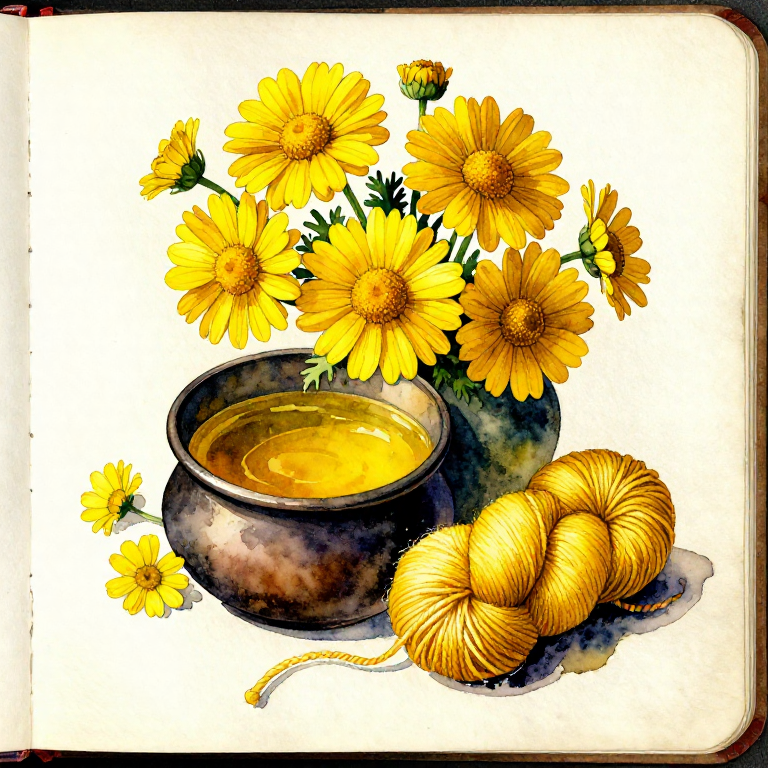
Dyer's chamomile (Anthemis tinctoria), also known as golden marguerite, is a hardy perennial native to the Mediterranean and Western Asia. Its bright golden-yellow flowers contain flavonoid pigments — primarily luteolin and apigenin — that produce a warm, clear yellow on alum-mordanted wool. Unlike common chamomile (Matricaria chamomilla), which has minimal dye value, dyer's chamomile was selected and cultivated specifically for its intense pigment content across centuries of European dye tradition.
Dyer's chamomile was grown in dedicated dye gardens throughout the ancient Mediterranean world and medieval Europe. It thrives in poor, dry soils where other crops struggle, making it a practical choice for dyers in marginal agricultural land. The plant flowers prolifically from June to September, producing masses of button-like golden flowers on wiry stems. One established plant can yield several harvests per season if flowers are picked regularly — cutting stimulates further flowering.
On alum-mordanted wool, dyer's chamomile produces a bright, warm yellow with good lightfastness — not quite as permanent as weld, but significantly better than most flower-based yellows. With iron modification, the yellow shifts to a soft olive-green. The combination of easy cultivation, generous yields, and reliable colour made dyer's chamomile one of the most practical yellow dye plants for household use in pre-industrial Europe.
Anweisungen
Weigh the dried dyer's chamomile flowers
Weigh the dried dyer's chamomile flowers
Use 100% WOF of dried dyer's chamomile flower heads. For 100 g of wool, weigh out 100 g of dried flowers. Harvest flowers when fully open and at peak golden colour — the centres should be bright yellow, not yet fading to brown. Dry the flower heads in shade on a rack for 5-7 days until they are papery and brittle. The dried flowers can be stored in paper bags for up to a year without significant loss of dye strength.
Materialien für diesen Schritt:
 Färberkamillenblüten (getrocknet)100 g
Benötigte Werkzeuge:
 Digitale Küchenwaage
Soak the flowers in warm water for one hour
Soak the flowers in warm water for one hour
Place the dried chamomile flowers in a dye pot with 4 litres of warm water and soak for at least one hour. The water will turn a pale golden-yellow within minutes. Flower-based dyes generally release colour faster than bark or heartwood dyes because the cell walls are thin and fragile. Pressing the flowers below the water surface ensures they are fully saturated and extracting evenly.
Benötigte Werkzeuge:
 Suppentopf
Simmer the flowers for 30-40 minutes
Simmer the flowers for 30-40 minutes
Bring the pot to a gentle simmer (75-85°C) and hold for 30-40 minutes. Do not boil — high temperatures diminish the brightness of flavonoid yellows. Stir occasionally. The liquid will deepen to a rich golden-yellow. The flower heads will lose their colour and turn pale as their pigment transfers to the water. A second extraction in fresh water is possible for a lighter dye bath, though the first extraction holds most of the dye.
Benötigte Werkzeuge:
 Küchenthermometer
 Rührlöffel aus Holz
Strain out the flowers
Strain out the flowers
Strain the dye liquor through a fine mesh strainer into a clean pot. Squeeze the spent flowers gently to extract all remaining liquid. Chamomile flower fragments are soft and can tangle in wool if left in the dye bath — strain thoroughly. The strained liquor is a clear, warm golden-yellow.
Benötigte Werkzeuge:
 Feinsieb
Dye alum-mordanted wool at 80°C for 45 minutes
Dye alum-mordanted wool at 80°C for 45 minutes
Pre-wet the alum-mordanted wool in lukewarm water for 15 minutes, squeeze gently, and lower it into the dye bath at room temperature. Slowly raise to 80°C over 15 minutes, then hold for 45 minutes. Turn gently every 10 minutes. The alum-luteolin complex produces a warm, bright yellow with good depth. Without mordant, the colour is much paler and less permanent. The wool will be a vivid golden-yellow when removed — brighter than goldenrod but not quite as intense as weld.
Materialien für diesen Schritt:
 Wollstrang100 g
 Alaun (Kaliumalaun)10 g
Cool, rinse, and dry
Cool, rinse, and dry
Turn off the heat and let the wool cool in the dye bath overnight. Remove, squeeze gently, and rinse in lukewarm water until the runoff is clear. The final colour is a warm, sunny yellow — cheerful and clear. Dyer's chamomile has moderate to good lightfastness — better than most flower dyes, suitable for garments and household textiles that receive moderate sunlight. Dry in shade.
Materialien
3- Platzhalter
- 100 gPlatzhalter
- Platzhalter
Benötigte Werkzeuge
5- Platzhalter
- Platzhalter
- Platzhalter
- Platzhalter
- Platzhalter
Materialien verbundener Blueprints
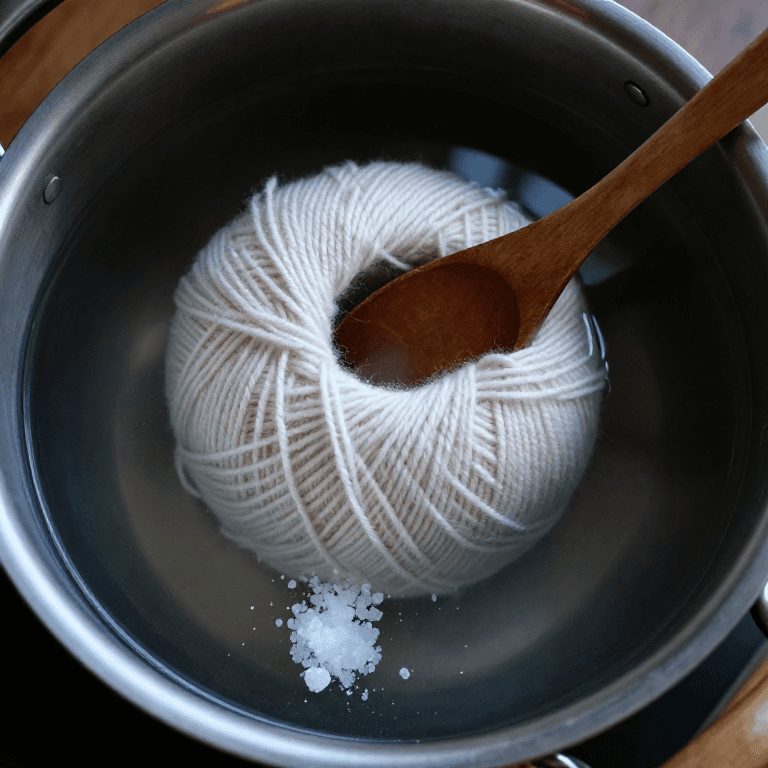
Mordanting Wool with Alum — The Foundation of Natural Dyeing
von Tex
Textil & Leder
Dyeing Yellow with Marigold — The Sacred Aztec Flower Dye
von Tex
Textil & Leder
Dyeing Yellow with Yarrow — The Ancient Wound-Herb of Every Meadow
von Tex
Textil & Leder
Verwandte Blueprints
Diese Blueprints teilen Wissen — Techniken, Materialien oder Prinzipien
Dyeing Yellow with Goldenrod — One of the Best Wild-Plant Dyes in Nature
von Tex
Textil & Leder
Iron Saddening — Darkening and Shifting Natural Dye Colours with Iron Water
von Tex
Textil & Leder
Dyeing Yellow with Dyer's Broom — The Greenweed That Made Lincoln Green
von Tex
Textil & Leder
Dyeing Orange-Gold with Dahlia — The Aztec Flower That Conquered European Gardens
von Tex
Textil & Leder
Dyeing Pale Yellow with Mullein — The Roadside Dye of Medieval Europe
von Tex
Textil & Leder
CC0 Gemeinfrei
Dieser Blueprint ist unter CC0 veröffentlicht. Sie dürfen dieses Werk für jeden Zweck frei kopieren, ändern, verbreiten und verwenden, ohne um Erlaubnis zu fragen.
Unterstützen Sie den Maker, indem Sie Produkte über seinen Blueprint kaufen, wo er eine Maker-Provision von Anbietern festgelegt, verdient. Oder erstellen Sie eine neue Iteration dieses Blueprints und verbinden Sie ihn in Ihrem eigenen Blueprint, um Einnahmen zu teilen.