KUNST
SCHÖNHEIT & WELLNESS
HANDWERK
KULTUR & GESCHICHTE
UNTERHALTUNG
UMFELD
ESSEN & GETRÄNKE
REVERSE ENGINEERING
WISSENSCHAFTEN
SPORT
TECHNOLOGIE
WEARABLES
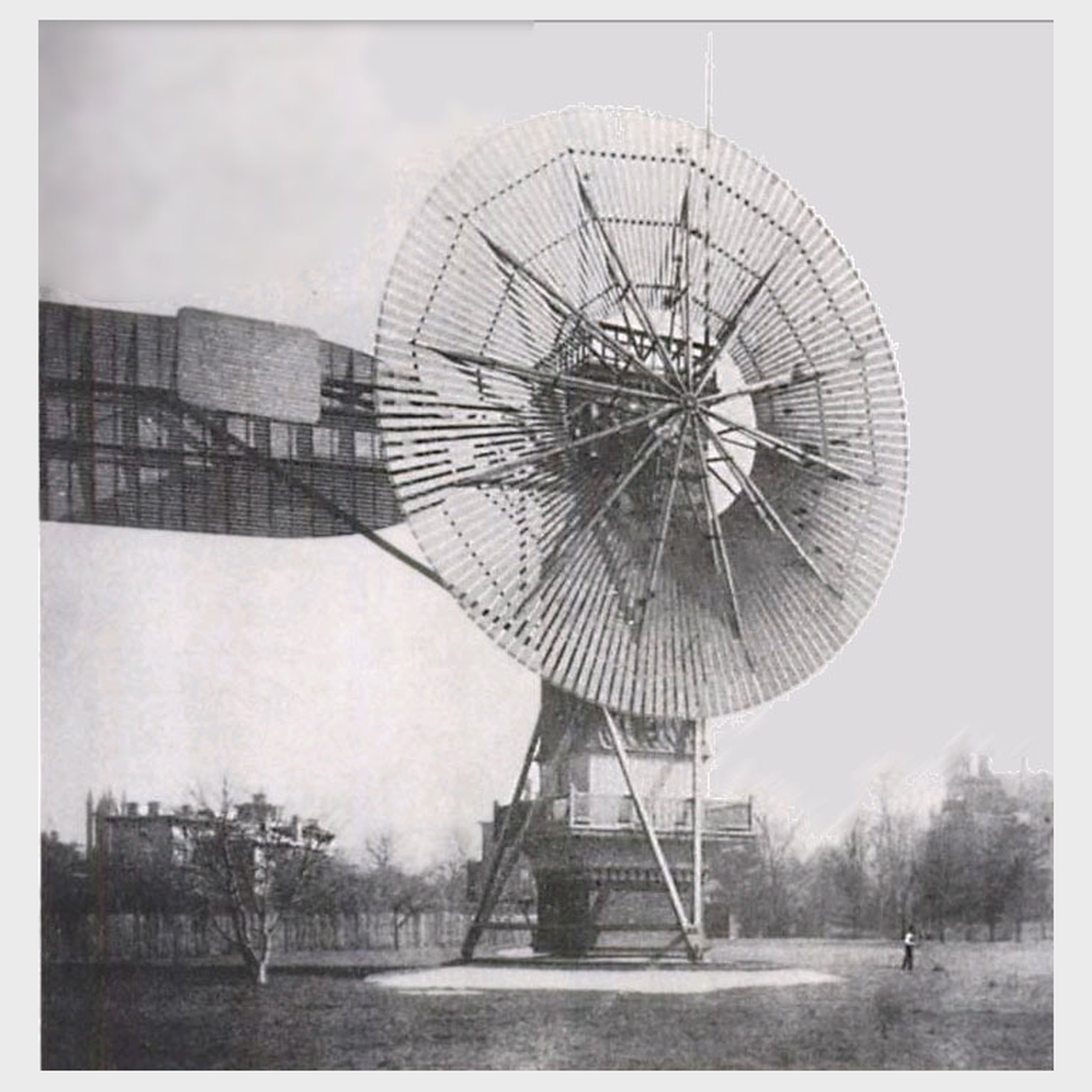


Electricity From the Wind: The Cube Law and a Rotor on a Dynamo
For a thousand years windmills ground grain and pumped water. In the winter of 1887–88 Charles F. Brush put one to a new job in the back garden of his house in Cleveland, Ohio: a 17-metre rotor of 144 cedar blades turning a dynamo that charged a cellar full of batteries — electricity from the wind.
Everything about a wind generator follows from one relation: the power in the wind goes with the cube of its speed and the square of the rotor's diameter. That is why turbines grew huge and why their sites are chosen with such care.
This rung builds a small wind generator from a hobby motor and a printed rotor, measures its power in front of a fan at several wind speeds, and checks the cube law.
Anfänger
About 4 hours
Anweisungen
1
1
The cube law
The cube law
Jupyter-Notebook wird geladen …
2
2
Build a small wind generator
Build a small wind generator
A small permanent-magnet DC motor is also a generator: turn its shaft and it makes a voltage proportional to speed.
Print a three-bladed rotor 300 mm across in PETG, with a hub that presses onto the motor shaft, each blade twisted — steep near the hub, flatter towards the tip — because the tip moves faster through the air than the root. Mount the motor on a dowel mast clamped to a plywood base, with the rotor facing the fan.
Wire the motor's terminals to a 330 Ω resistor as a load, with the multimeter across it. Add an LED in series if you want to see it light.
Materialien für diesen Schritt:
 Getriebemotor1 Stück
 PETG-Filament60 g
 Hartholzdübel1 Set
 Sperrholzplatte1 Blatt
 330-Ohm-Widerstand1 Stück
 5-mm-LED1 Stück
 Steckbrücken1 Set
Benötigte Werkzeuge:
 FDM-3D-Drucker
 Akkubohrschrauber
 Bohrersatz
 Innensechskant-Schlüsselsatz
3
3
Measure its power at three wind speeds
Measure its power at three wind speeds
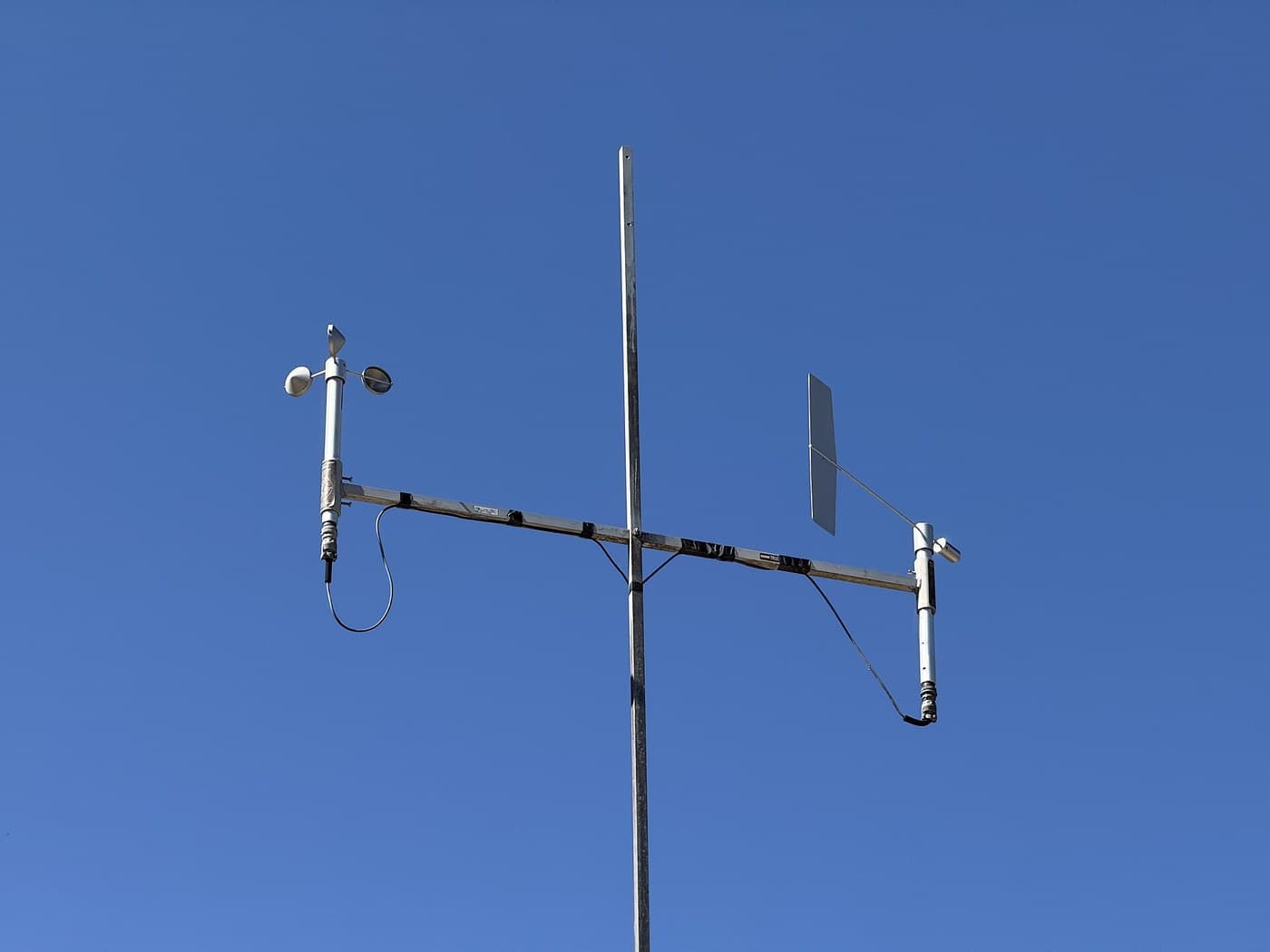
Stand the box fan 1.5 m away, facing the rotor. Measure the wind speed at the rotor with the anemometer before fitting the rotor, at each fan setting.
Fit the rotor, run the fan, and read the voltage across the resistor once it is steady. The electrical power is **V² ÷ R**. Record wind speed and power for each fan setting.
Plot power against wind speed cubed. It should be roughly a straight line — not exactly, because a small motor's own losses take a bigger share at low speed. Then divide your power by the notebook's power passing through a 0.3 m disc at the same wind speed. That ratio is your rotor's power coefficient, and the Betz rung shows the most it could ever be.
Benötigte Werkzeuge:
 Kastenventilator (stufenlos)
 Handanemometer
 Multimeter
 Bandmaß (Rollmeter)
 Digitaler Drehzahlmesser
4
4
History and context
History and context
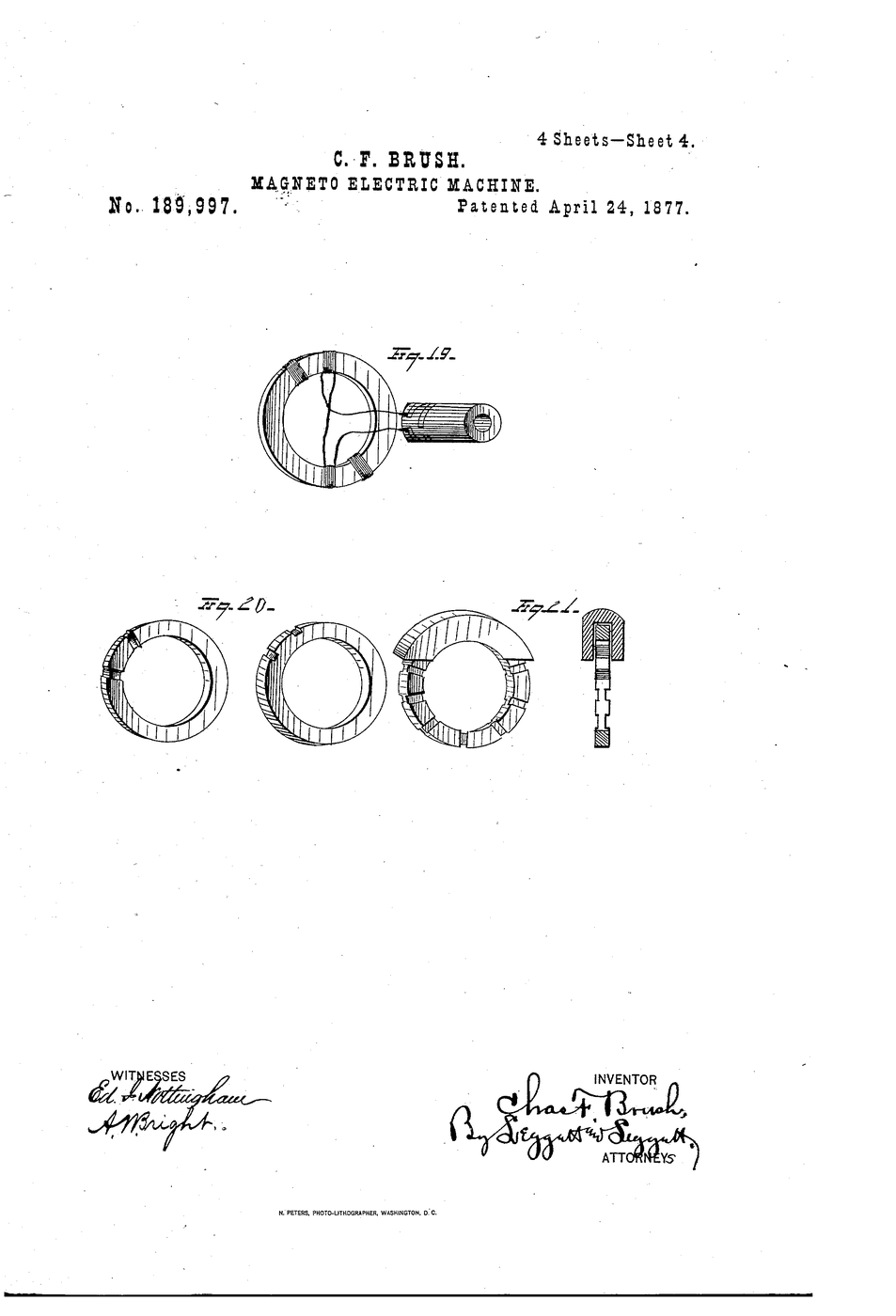
**Charles F. Brush, Cleveland, Ohio, 1887–88** — a 17 m, 144-bladed rotor on a tower about 18 m (60 ft) high driving a 12 kW dynamo through step-up gearing, charging batteries that lit his house; it ran for some twenty years. Brush had already built the arc-lighting dynamo in this catalogue. No patent number is asserted here.
In Denmark from 1891, **Poul la Cour** tested rotors in a wind tunnel of his own and found that fewer blades turning faster made better use of the wind than many slow ones — the direction every modern turbine took.
**Honest limits.** The wind stops; a wind generator needs storage or another source behind it. Its output swings with the cube of a quantity that changes by the minute. And a large rotor is a serious hazard: it must be able to stop itself in a storm, as the Halladay windmill's governor in this catalogue already could.
Materialien
7- Platzhalter
- 60 gPlatzhalter
- 1 SetPlatzhalter
- 1 BlattPlatzhalter
- 1 StückPlatzhalter
- Platzhalter
- Platzhalter
Benötigte Werkzeuge
9- Platzhalter
- 1 vendor sell this, none ship to you yetPlatzhalter
- Platzhalter
- Platzhalter
- Platzhalter
- Platzhalter
- Platzhalter
- 1 vendor sell this, none ship to you yetPlatzhalter
- Platzhalter
Verwandte Blueprints
Diese Blueprints teilen Wissen — Techniken, Materialien oder Prinzipien


CC0 Gemeinfrei
Dieser Blueprint ist unter CC0 veröffentlicht. Sie dürfen dieses Werk für jeden Zweck frei kopieren, ändern, verbreiten und verwenden, ohne um Erlaubnis zu fragen.
Unterstützen Sie den Maker, indem Sie Produkte über seinen Blueprint kaufen, wo er eine Maker-Provision von Anbietern festgelegt, verdient. Oder erstellen Sie eine neue Iteration dieses Blueprints und verbinden Sie ihn in Ihrem eigenen Blueprint, um Einnahmen zu teilen.