KUNST
SCHÖNHEIT & WELLNESS
HANDWERK
KULTUR & GESCHICHTE
UNTERHALTUNG
UMFELD
ESSEN & GETRÄNKE
REVERSE ENGINEERING
WISSENSCHAFTEN
SPORT
TECHNOLOGIE
WEARABLES
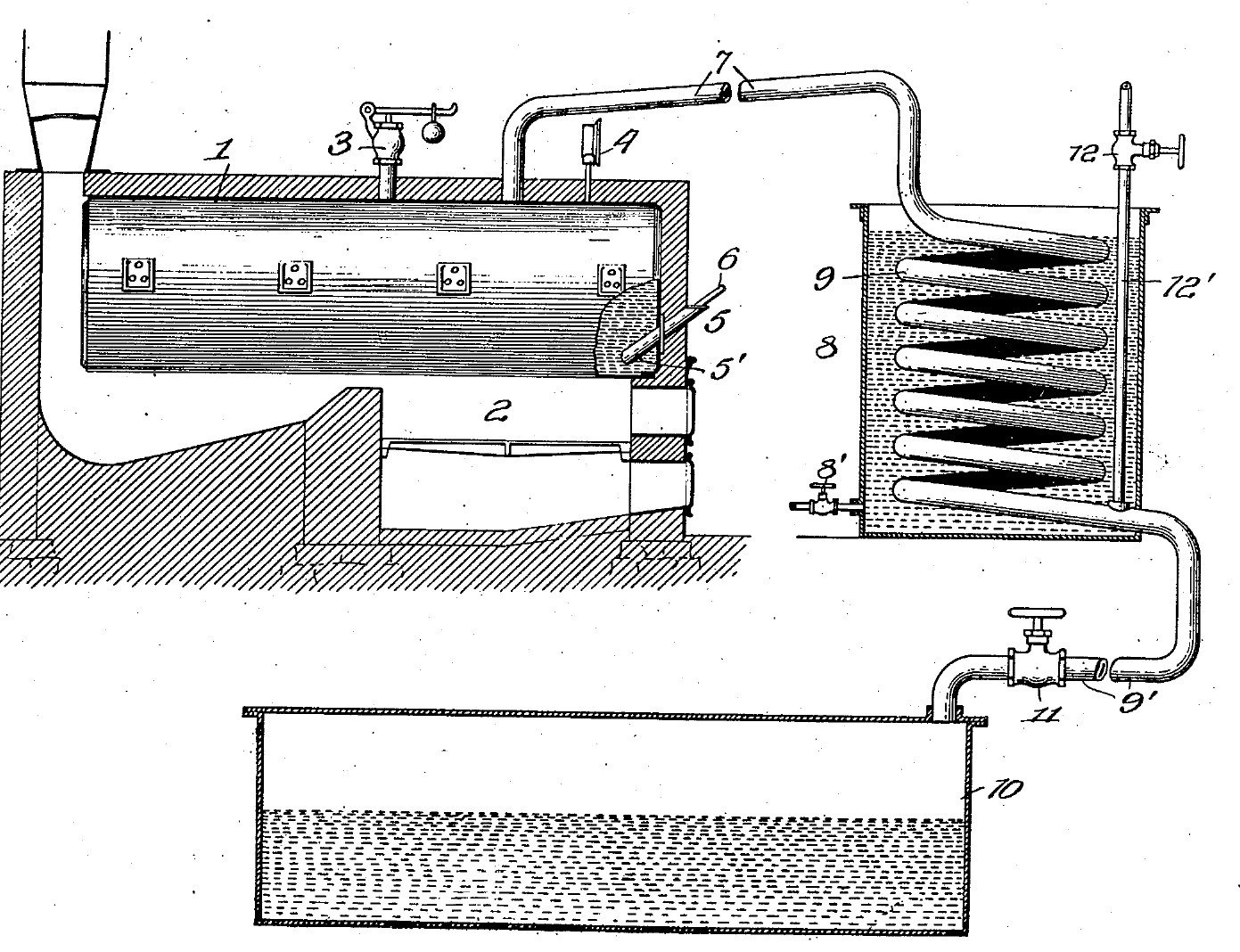


Gasoline by Pressure Cracking: Heavy Residue Distilled at 650-850 °F under 4-5 Atmospheres (Burton, US 1,049,667)
Straight distillation leaves most of a barrel of crude as heavy oil. Burton's 1913 patent turns that residue into gasoline: distil it hot while its own vapour is held at 4 to 5 atmospheres, all the way through the condenser. The heat and pressure break the heavy oil into light oil. Cracked gasoline is the first rung toward high-octane fuel.
Feed: the fuel-oil and gas-oil residue left after the light cuts, boiling at about 600 to 700 °F (claim: above 500 °F).
Source: W. M. Burton, US 1,049,667 (1913), assigned to Standard Oil (Indiana). Not given: charge size, run time, yield. Burton claims the gasoline stays in the paraffin series; that is his claim. A fired still under pressure needs a working safety valve. Picture: the patent drawing.
Experte
2 days
Anweisungen
1
1
Fill the pressure still with residue
Fill the pressure still with residue
The still is a closed, boiler-like holder over a fire chamber, with a safety valve, a pressure gauge, and a thermometer in an oil-filled tube slanting into it. Fill it with the heavy residue left after the gasoline and illuminating oils have been distilled off.
Materialien für diesen Schritt:
 Erdölrückstand1 still charge
Benötigte Werkzeuge:
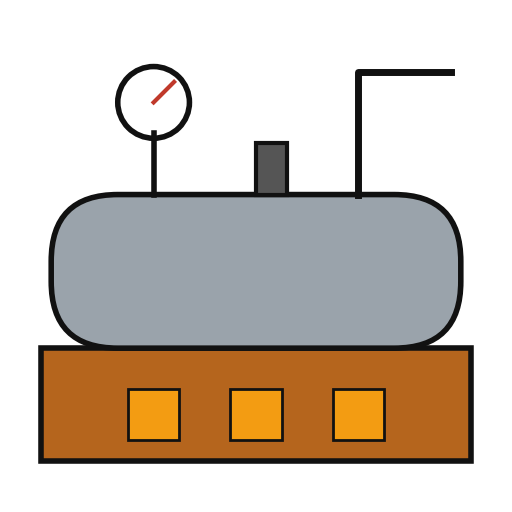 Druckdestillierblase
 Manometer
 Thermometer
2
2
Close the outlet and fire it
Close the outlet and fire it
A pipe rises from the top of the still to a water-cooled condenser coil, then runs to a receiver tank. Keep the shut-off valve after the coil closed and fire the still. The vapours build up 4 to 5 atmospheres on the liquid, and its boiling point rises from 500-600 °F to 750-800 °F.
Benötigte Werkzeuge:
Druckdestillierblase Kondensatorschlange
 WasserManometer
3
3
Distil at 650 to 850 °F under pressure
Distil at 650 to 850 °F under pressure
Distil at about 650 to 850 °F. Keep the pressure on the vapours the whole way, in the still and while they condense in the coil. The heat and pressure turn the heavy oil into low-boiling oil.
Benötigte Werkzeuge:
DruckdestillierblaseThermometerManometer4
4
Draw off the gasoline from time to time
Draw off the gasoline from time to time
Open the shut-off valve now and then to run the condensed gasoline into the receiver. Do it often enough that the coil never fills with liquid.
Benötigte Werkzeuge:
Kondensatorschlange Öltank
5
5
Let off the gas
Let off the gas
Gas that will not condense collects in the coil and blocks it. Release it from time to time through the relief valve on the pipe rising from the lower end of the coil. Burton does not say what becomes of it. Ours: collect it under pressure if it is to be used.
Benötigte Werkzeuge:
Kondensatorschlange Druckgasflasche
Materialien
1- 1 still chargePlatzhalter
Dieser Bauplan stellt her
Verwandte Blueprints
Diese Blueprints teilen Wissen — Techniken, Materialien oder Prinzipien
CC0 Gemeinfrei
Dieser Blueprint ist unter CC0 veröffentlicht. Sie dürfen dieses Werk für jeden Zweck frei kopieren, ändern, verbreiten und verwenden, ohne um Erlaubnis zu fragen.
Unterstützen Sie den Maker, indem Sie Produkte über seinen Blueprint kaufen, wo er eine Maker-Provision von Anbietern festgelegt, verdient. Oder erstellen Sie eine neue Iteration dieses Blueprints und verbinden Sie ihn in Ihrem eigenen Blueprint, um Einnahmen zu teilen.