KUNST
SCHÖNHEIT & WELLNESS
HANDWERK
KULTUR & GESCHICHTE
UNTERHALTUNG
UMFELD
ESSEN & GETRÄNKE
REVERSE ENGINEERING
WISSENSCHAFTEN
SPORT
TECHNOLOGIE
WEARABLES

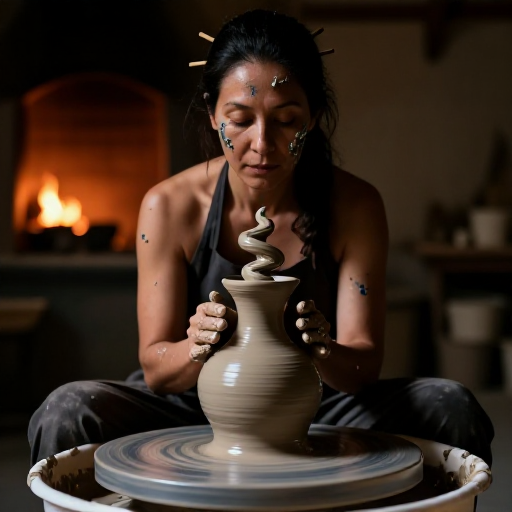

Glaze Fit: Crazing, Shivering, and the Mismatch Behind Both
A glazed pot is two materials stuck together that shrink by different amounts as they cool. If the difference is small, the glaze ends up gently squeezed and the pot is stronger for it. If it is large, something has to give.
CRAZING is the glaze cracking into a network of fine lines, because the glaze shrank MORE than the body and is being stretched. SHIVERING is the glaze flaking off in slivers, because it shrank LESS and is being crushed. They are the same problem with opposite signs.
Crazing is often left deliberately, as a decorative crackle. Shivering never is: the flakes are glass, they come off in use, and on anything that holds food that is a genuine hazard rather than a flaw.
Erfahren
3 hours
Anweisungen
1
1
Tell them apart, and know which way to move
Tell them apart, and know which way to move
CRAZING looks like a fine web of cracks across the glaze surface, often appearing days or weeks after firing as the body slowly takes up atmospheric moisture and expands. Run a finger over it and it is smooth; the cracks are in the glass, not the surface.
SHIVERING shows as sharp slivers lifting or flaking away, usually at edges, rims and handles where the glaze wraps a curve. It often appears with an audible ping as the kiln cools.
A crazed pot is not waterproof even if it looks it — liquid travels through the cracks into the porous body, which is why a crazed mug eventually smells. That is the practical reason to care beyond appearance.
Materialien für diesen Schritt:
 Klare Glasur1 Stück
 Knochentrockene Tongefäße1 Stück
Benötigte Werkzeuge:
 Brennofen
2
2
The numbers behind the mismatch
The numbers behind the mismatch
Jupyter-Notebook wird geladen …
Materialien für diesen Schritt:
Klare Glasur1 Stück Glasur1 Stück
Benötigte Werkzeuge:
 Desktop-ComputerBrennofen
3
3
Thickness and edges, before any chemistry
Thickness and edges, before any chemistry
Before changing a recipe, check the application. Glaze that is too thick shivers at edges long before a well-fitted glaze would, because an edge has glaze on two faces meeting at a corner and nothing to hold it.
Wipe glaze thinner on rims, handles and any sharp arris. Rounding sharp edges slightly while the pot is leather-hard also helps a great deal, and costs one pass with a damp sponge.
Most reported glaze-fit faults turn out to be application faults. Chemistry is the answer when the fault persists on properly applied glaze across several firings — which is the change-one-thing-at-a-time rule saving a lot of wasted effort.
Materialien für diesen Schritt:
Klare Glasur1 StückBenötigte Werkzeuge:
 Schwamm
 Modellierwerkzeug-Satz
 Digitaler Messschieber 6 Zoll
4
4
Keep test tiles, and label them
Keep test tiles, and label them
Fire test tiles of every glaze on every body you use, with one, two and three dips on the same tile, and keep them. A shelf of tiles answers questions that no amount of reading will.
Mark each tile with the glaze and body before firing — scratched into the clay, not written on with a pen that burns away. An unlabelled test tile is a pretty object of no use whatever.
Record the firing too: which kiln, what schedule, what cone it reached. A glaze is a result of a recipe AND a firing, and the same bucket in a different kiln is a different glaze.
Materialien für diesen Schritt:
Klare Glasur1 Stück Irdenware-Ton1 kg
Benötigte Werkzeuge:
Modellierwerkzeug-SatzBrennofenMaterialien
4- 4 StückPlatzhalter
- 1 StückPlatzhalter
- 1 StückPlatzhalter
- 1 kgPlatzhalter
Verwandte Blueprints
Diese Blueprints teilen Wissen — Techniken, Materialien oder Prinzipien
CC0 Gemeinfrei
Dieser Blueprint ist unter CC0 veröffentlicht. Sie dürfen dieses Werk für jeden Zweck frei kopieren, ändern, verbreiten und verwenden, ohne um Erlaubnis zu fragen.
Unterstützen Sie den Maker, indem Sie Produkte über seinen Blueprint kaufen, wo er eine Maker-Provision von Anbietern festgelegt, verdient. Oder erstellen Sie eine neue Iteration dieses Blueprints und verbinden Sie ihn in Ihrem eigenen Blueprint, um Einnahmen zu teilen.