Zusammenarbeit
KUNST
SCHÖNHEIT & WELLNESS
HANDWERK
KULTUR & GESCHICHTE
UNTERHALTUNG
UMFELD
ESSEN & GETRÄNKE
REVERSE ENGINEERING
WISSENSCHAFTEN
SPORT
TECHNOLOGIE
WEARABLES
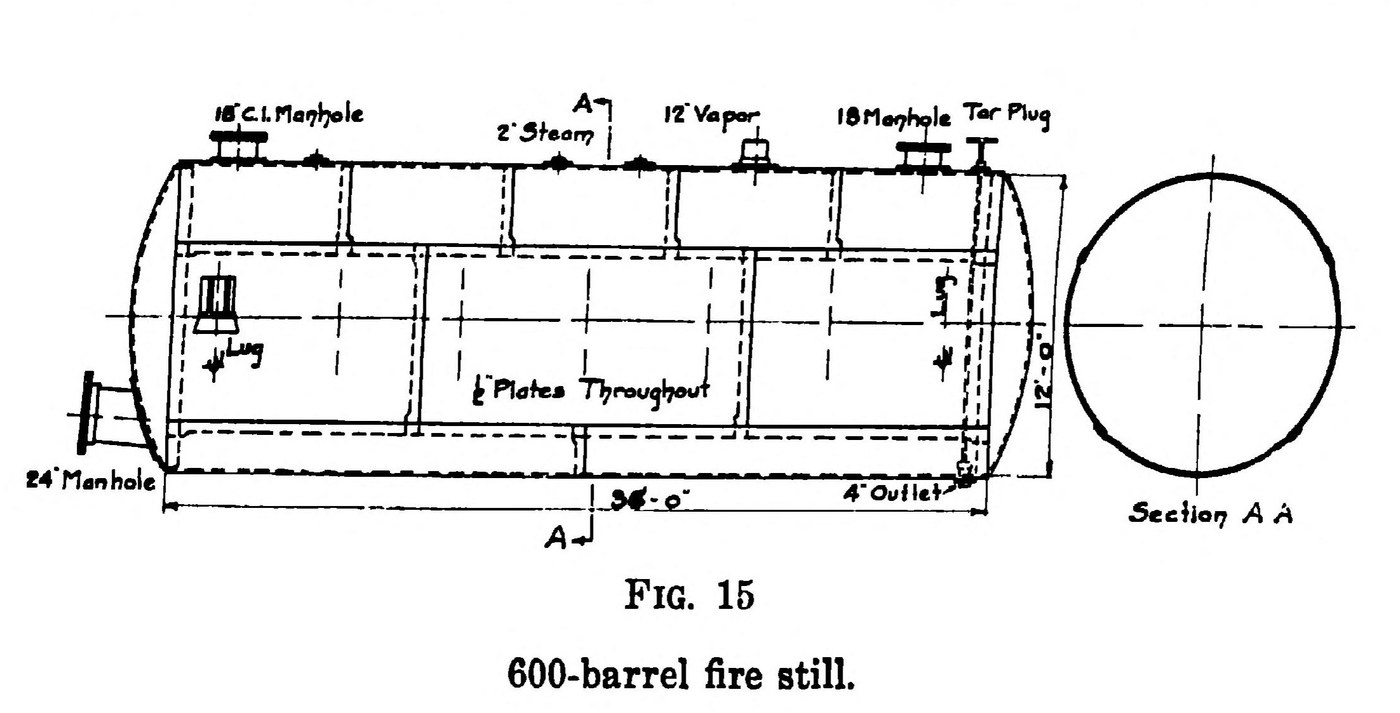


Horizontal Cylinder Still: the Riveted Fire Still (Bell, 1923)
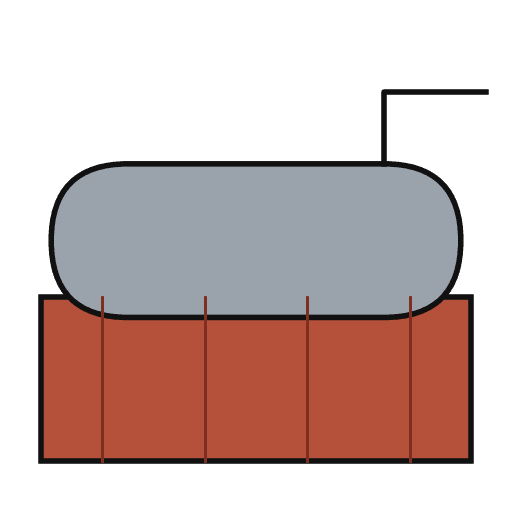
The refinery's direct-fired crude still: a long horizontal cylinder of riveted steel plate hung on lugs over a brick furnace, with a steam line, manholes, a vapour outlet to the condensers and a bottom outlet for residue.
Variable: size; the favoured length is about three times the diameter. Bell's Fig. 15 is a 600-barrel still, 12 ft across and 36 ft long, of 1/2 in plate throughout.
Source: H. S. Bell, American Petroleum Refining (1923), pp. 83-92. Picture: Fig. 15 of the book.
Experte
Unknown
Anweisungen
1
1
Size the still
Size the still
Make it about three times as long as it is wide. Batch stills take overhead about 1.5 gallons per hour per square foot of evaporating surface (two-thirds of diameter x length); continuous ones about 2.5. Give the vapour outlet at least 0.17 sq in per gallon of distillate per hour, placed half to two-thirds of the way from the fire end.
Benötigte Werkzeuge:
 Unbekannte Maße
2
2
Choose and roll the plates
Choose and roll the plates
Use fire-box or still-bottom steel 1/2 in thick for the bottom (5/8 in for stills run down to coke; more is not worth it). Up to 10 ft diameter, 3/8 in flange steel does for the sides and top; larger stills, 1/2 in throughout. Up to 30 ft long: bottom of two plates, sides of three, top of narrow barrel plates; longer: three, four and barrel plates 5 to 6 ft wide. Keep the caulking edges of the bottom plates away from the fire. Dish the heads to a radius equal to the diameter, in one piece up to 10 ft, otherwise seamed on the horizontal diameter, as thick as the shell or 1/16 in thicker.
Materialien für diesen Schritt:
 Baustahlplatte1 shell, heads
Benötigte Werkzeuge:
 Blechbiegewalzen
 Stanzpresse
3
3
Rivet and caulk
Rivet and caulk
Double-rivet all seams except at flanges and openings, with 3/4 in rivets even in the bottom, so holes can later be reamed to 7/8 or 1 in for repairs. Bevel and caulk the plates inside and out.
Materialien für diesen Schritt:
 Stahlnieten1 3/4 in
Benötigte Werkzeuge:
 Niethammer
4
4
Fit openings and steam line
Fit openings and steam line
Fit (Fig. 15) a 24 in manhole in the front head, 18 in manholes on top, a 12 in vapour outlet, a 2 in steam line, a tar plug and a 4 in bottom outlet; caulk steel details to the shell and give cast-iron ones a caulking pad. Rivet lugs on the sides.
Materialien für diesen Schritt:
 Eisengussteile1 manhole frames, outlet castings
 Stahlrohr (dickwandig, mit Gewindeenden)1 2 in steam line
 Dampfventil1 Stück
 Absperrschieber1 4 in outlet
 Winkelstahl aus Baustahl1 lugs
Benötigte Werkzeuge:
Niethammer5
5
Set it over the furnace
Set it over the furnace
Hang the still on lugs from columns on concrete piers, lugs no more than 7 ft apart, so it is independent of the brickwork (Fig. 21). Set it at least 7 to 8 ft above the grates or burners, or better, put the fire box in a Dutch oven in front, for clean combustion. Batch stills expose about a third of the circumference to the fire; for continuous running raise the lugs 12 in above the centre line with a stiff tie between them and fire the full half circumference.
Materialien für diesen Schritt:
 Beton1 piers
 Schamottesteine1 furnace lining
 Ziegel1 setting
Benötigte Werkzeuge:
 Maurerkelle
Materialien
10- 1 shell, headsPlatzhalter
- 1 3/4 inPlatzhalter
- 1 manhole frames, outlet castingsPlatzhalter
- 1 2 in steam linePlatzhalter
- 1 StückPlatzhalter
- 1 4 in outletPlatzhalter
- 1 lugsPlatzhalter
- 1 piersPlatzhalter
- 1 furnace liningPlatzhalter
- 1 settingPlatzhalter
Benötigte Werkzeuge
5- Platzhalter
- Platzhalter
- Platzhalter
- Platzhalter
- Platzhalter
Materialien verbundener Blueprints
Dieser Bauplan stellt her
CC0 Gemeinfrei
Dieser Blueprint ist unter CC0 veröffentlicht. Sie dürfen dieses Werk für jeden Zweck frei kopieren, ändern, verbreiten und verwenden, ohne um Erlaubnis zu fragen.
Unterstützen Sie den Maker, indem Sie Produkte über seinen Blueprint kaufen, wo er eine Maker-Provision von Anbietern festgelegt, verdient. Oder erstellen Sie eine neue Iteration dieses Blueprints und verbinden Sie ihn in Ihrem eigenen Blueprint, um Einnahmen zu teilen.