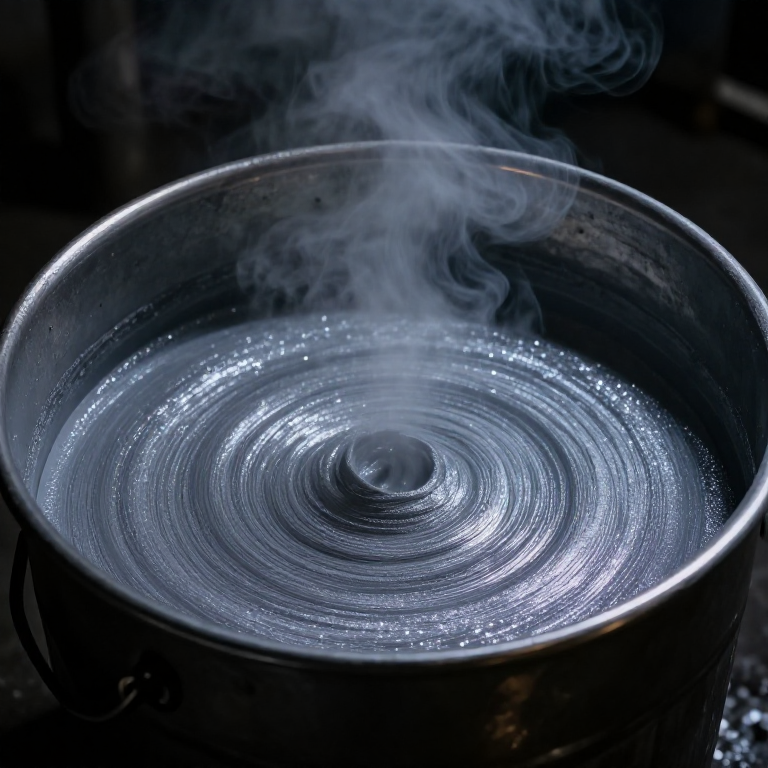


Galvanizing Iron with Zinc — A Coat That Rusts So the Iron Will Not
Iron's great weakness is rust. Left in the weather, an iron roof or bucket flakes away to nothing in a few years. In 1837 the French engineer Stanislas Sorel patented a cure that is still used on a vast scale today: dip the iron in a bath of molten zinc. The zinc bonds to the surface and shields the iron beneath, and galvanized iron suddenly lasted for decades outdoors.
The zinc protects in two ways at once. It is a barrier, sealing the iron from air and water — but more cleverly, it is a sacrifice. Zinc is more reactive than iron, so even where the coating is scratched and bare iron shows, the surrounding zinc corrodes first and spares the iron. The coating gives up itself to save the metal underneath.
Hot-dip galvanizing clad the Industrial Revolution's wire, nails, pipes, and the corrugated iron roofs that sheltered half the world. It is simple in principle — clean the iron, flux it, and dip it in molten zinc — but every step matters, because a missed patch of grease or rust leaves a hole in the armour.
Anweisungen
Understand galvanizing
Understand galvanizing
Degrease the iron
Degrease the iron
Materialien für diesen Schritt:
 Ätznatron (Natriumhydroxid)200 g
Pickle off the rust
Pickle off the rust
Materialien für diesen Schritt:
 Schwefelsäure2 Liter
Benötigte Werkzeuge:
 Säurebehälter
Rinse and flux
Rinse and flux
Materialien für diesen Schritt:
 Zinkammoniumchlorid300 g
Dry the fluxed part
Dry the fluxed part
Melt the zinc bath
Melt the zinc bath
Materialien für diesen Schritt:
 Zinkbarren50 kg
Dip the iron
Dip the iron
Benötigte Werkzeuge:
 Tiegelzange
Hold until soaked through
Hold until soaked through
Benötigte Werkzeuge:
TiegelzangeWithdraw and drain
Withdraw and drain
Benötigte Werkzeuge:
 Tauchkorb
Cool the coating
Cool the coating
Materialien für diesen Schritt:
 Wasser20 Liter
Inspect the coat
Inspect the coat
Benötigte Werkzeuge:
 Digitaler Messschieber 6 Zoll
Understand sacrificial protection
Understand sacrificial protection
Materialien
5- Platzhalter
- 2 LiterPlatzhalter
- 300 gPlatzhalter
- 50 kgPlatzhalter
- 20 LiterPlatzhalter
Benötigte Werkzeuge
4- Platzhalter
- Platzhalter
- Platzhalter
- Platzhalter
Materialien verbundener Blueprints



Dieser Bauplan stellt her

Verwandte Blueprints
Diese Blueprints teilen Wissen — Techniken, Materialien oder Prinzipien

CC0 Gemeinfrei
Dieser Blueprint ist unter CC0 veröffentlicht. Sie dürfen dieses Werk für jeden Zweck frei kopieren, ändern, verbreiten und verwenden, ohne um Erlaubnis zu fragen.
Unterstützen Sie den Maker, indem Sie Produkte über seinen Blueprint kaufen, wo er eine Maker-Provision von Anbietern festgelegt, verdient. Oder erstellen Sie eine neue Iteration dieses Blueprints und verbinden Sie ihn in Ihrem eigenen Blueprint, um Einnahmen zu teilen.