Zusammenarbeit
KUNST
SCHÖNHEIT & WELLNESS
HANDWERK
KULTUR & GESCHICHTE
UNTERHALTUNG
UMFELD
ESSEN & GETRÄNKE
REVERSE ENGINEERING
WISSENSCHAFTEN
SPORT
TECHNOLOGIE
WEARABLES
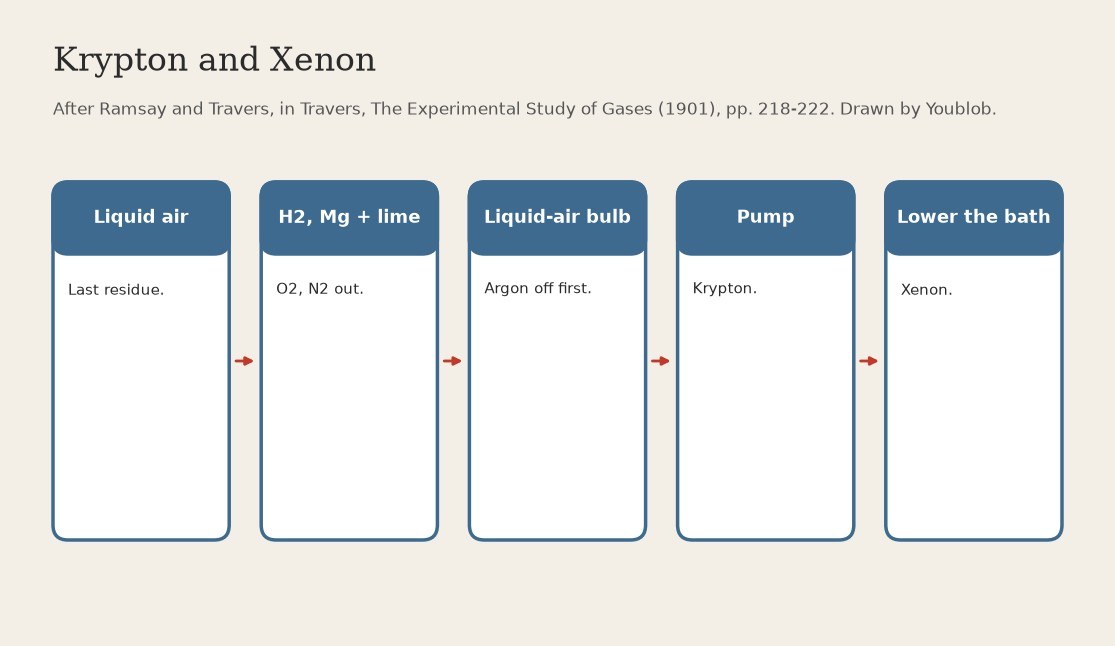


Krypton and Xenon: Liquid-Air Residues Cleaned and Fractionated at the Temperature of Liquid Air (Ramsay and Travers, 1901)
When liquid air boils away, the heavy noble gases stay in the last of it. Ramsay and Travers took that residue, stripped out the oxygen and nitrogen, and separated what was left by condensing it in liquid air and letting it boil off in fractions: argon first, then krypton, and xenon last of all.
Result: krypton and xenon gases (a litre of liquid air gives at most 0.1-0.2 cc of xenon).
Source: M. W. Travers, The Experimental Study of Gases (1901), pp. 218-222. Hydrogen is flammable; liquid air is very cold. Picture drawn by Youblob.
Erfahren
2 weeks
Anweisungen
1
1
Collect the last of the liquid air
Collect the last of the liquid air
Let liquid air evaporate quietly in a vacuum vessel. The last of it is nearly all oxygen with some nitrogen, argon, krypton and xenon; evaporate it into a gasholder. Work from much liquid air: one litre gives at best 0.1-0.2 cc of xenon.
Materialien für diesen Schritt:
 Flüssige Luft1 many litres
Benötigte Werkzeuge:
 Vakuumgefäß (Dewar)
 Gasbehälter
2
2
Strip out oxygen and nitrogen
Strip out oxygen and nitrogen
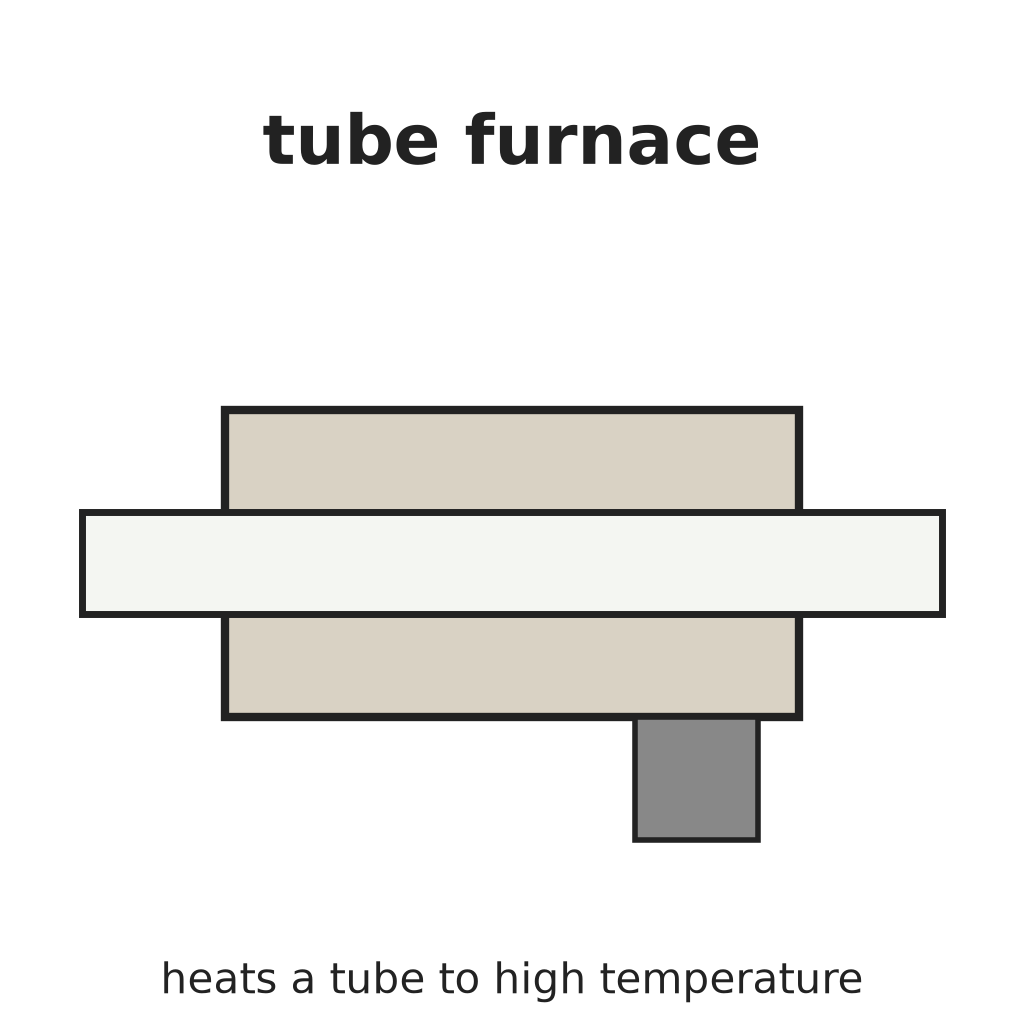
Pass the gas with hydrogen through a heated iron tube to remove the oxygen. Absorb the nitrogen with a mixture of magnesium and lime. Pass it over heated copper oxide to take out traces of carbon monoxide and hydrogen, then treat it with soda solution. Ours: a tube furnace for the heating.
Benötigte Werkzeuge:
 Wasserstoff
 Eisenrohr
 Rohrofen
 Magnesium
 Branntkalk
 Kupferoxid
 Natronlauge-LösungGasbehälter
3
3
First fractionation
First fractionation
Condense the gas in a bulb cooled by liquid air. Let the first part, mostly argon, boil off into a gasholder; collect the rest. Take the last traces off with the pump while the liquid-air vessel is lowered, so the xenon comes too. Travers got about 300 cc of heavy gas.
Benötigte Werkzeuge:
 GlasrohrFlüssige LuftVakuumgefäß (Dewar)
 VakuumpumpeGasbehälter
4
4
Refractionate
Refractionate
Condense and boil off again in six equal portions, throwing away the argon-rich first ones, and repeat, guided by the spectroscope. Let the liquid-air surface just touch the bottom of the bulb while the gas goes in, then immerse it; take every fraction off through the pump. Krypton has a vapour pressure of no more than 150 mm at this temperature; xenon hardly any.
Benötigte Werkzeuge:
GlasrohrFlüssige LuftVakuumgefäß (Dewar)Vakuumpumpe Handspektroskop
5
5
Part krypton from xenon
Part krypton from xenon
Condense the mixed gas and pump off everything that will come: that is krypton. Then lower the liquid air and collect the xenon. Repeat on each part several times, since krypton hides in the solid xenon.
Benötigte Werkzeuge:
GlasrohrFlüssige LuftVakuumgefäß (Dewar)VakuumpumpeGasbehälterMaterialien
1- 1 many litresPlatzhalter
Benötigte Werkzeuge
13- Platzhalter
- Platzhalter
- Platzhalter
- Platzhalter
- Platzhalter
- Platzhalter
- Platzhalter
- Platzhalter
- Platzhalter
- Platzhalter
- Platzhalter
- 1 vendor sell this, none ship to you yetPlatzhalter
- Platzhalter
Dieser Bauplan stellt her


Verwandte Blueprints
Diese Blueprints teilen Wissen — Techniken, Materialien oder Prinzipien

CC0 Gemeinfrei
Dieser Blueprint ist unter CC0 veröffentlicht. Sie dürfen dieses Werk für jeden Zweck frei kopieren, ändern, verbreiten und verwenden, ohne um Erlaubnis zu fragen.
Unterstützen Sie den Maker, indem Sie Produkte über seinen Blueprint kaufen, wo er eine Maker-Provision von Anbietern festgelegt, verdient. Oder erstellen Sie eine neue Iteration dieses Blueprints und verbinden Sie ihn in Ihrem eigenen Blueprint, um Einnahmen zu teilen.