

Outboard Motor
Putting an engine in a small boat used to mean rebuilding the boat. An inboard needs a bed bolted to the frames, a shaft through a hole below the waterline, a stuffing box to stop the leak, a separate rudder to steer and a fixed propeller you cannot lift out of the way. The boat becomes a motorboat permanently.
An outboard puts the engine, the shaft, the propeller and the steering into one unit that clamps to the transom. Nothing passes through the hull. The whole assembly swivels, so the propeller thrust itself does the steering and no rudder is needed, and it tilts up to clear a shoal or come ashore. When you are done you unclamp it and carry it away, and the boat is a rowing boat again.
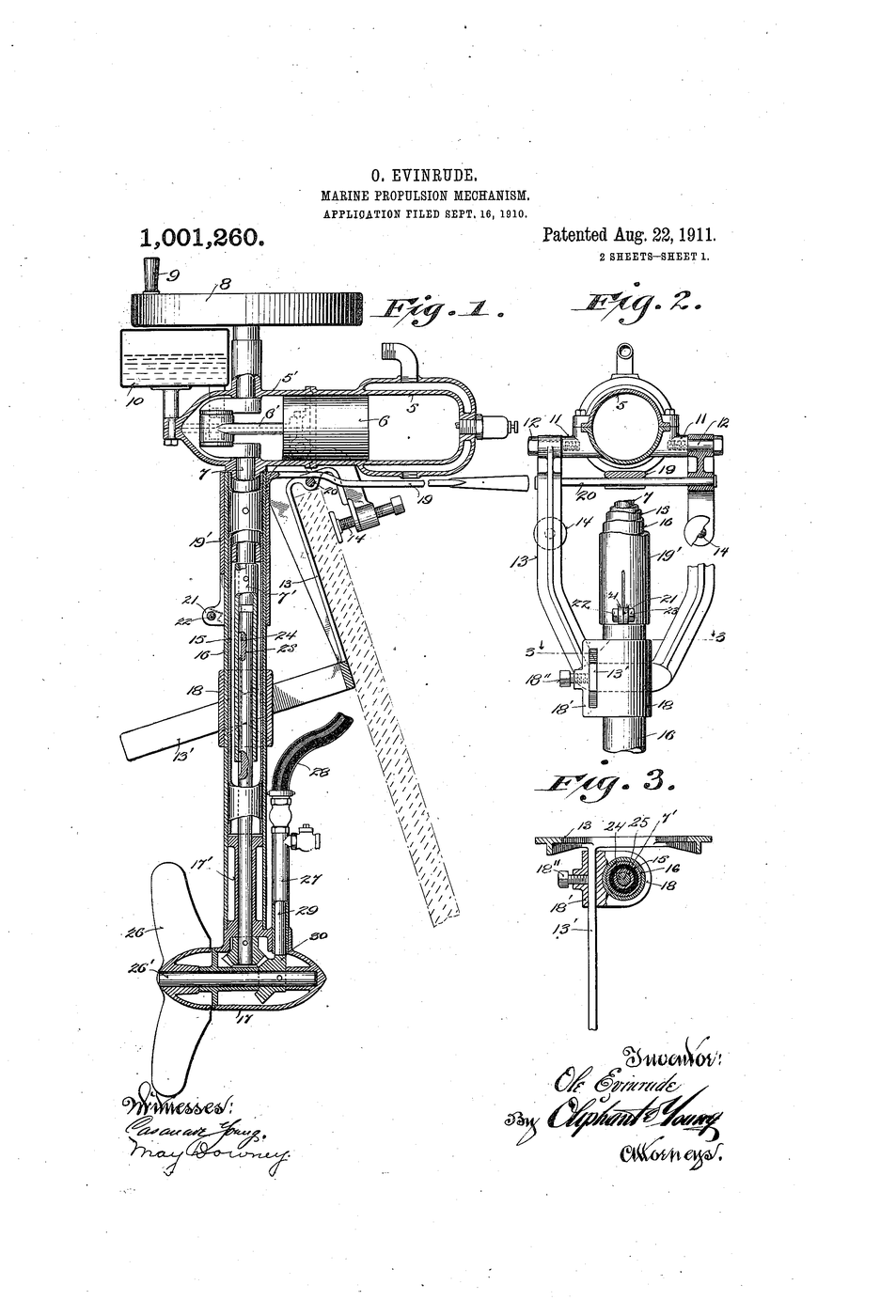
US Patent 1,001,260, "Marine propulsion mechanism", filed 16 September 1910 and granted 22 August 1911 to Ole Evinrude, assigned to the Evinrude Motor Company. The patent describes a portable unit for rowboats whose propeller can be set at various angles and depths relative to the stern or side.
Anweisungen
Read US 1,001,260 and note the two adjustments
Read US 1,001,260 and note the two adjustments
Evinrude claims a unit whose propeller can be set at various angles and various depths relative to the stern. Angle gives steering; depth gives shallow-water clearance.
Cut a test hull from plywood
Cut a test hull from plywood
Cut a flat-bottomed hull 400 mm long with a 120 mm square transom from 6 mm plywood. A simple punt shape is enough — the hull is a test bed, not the subject.
Materialien für diesen Schritt:
 Sperrholzplatte1 Blatt
Seal the hull and check it floats level
Seal the hull and check it floats level
Seal the seams and float it. Trim with ballast until it sits level — an out-of-trim hull will fake a steering result later.
Build the drive leg
Build the drive leg
Make a vertical leg from a 250 mm hardwood strip with a dowel shaft running down its length to the propeller. This is the spine of the unit.
Materialien für diesen Schritt:
 Holzdübelstange1 Stück
Carve a two-bladed propeller
Carve a two-bladed propeller
Carve a 60 mm propeller from balsa with both blades twisted to the same pitch. Unequal blades vibrate and give a false thrust reading.
Materialien für diesen Schritt:
 Balsaholzplatten1 Packung
Fit a rubber-band motor to the shaft
Fit a rubber-band motor to the shaft
Run a twisted rubber band from the top of the leg to the propeller shaft. It stores a repeatable amount of energy, which matters for comparing runs.
Build the transom clamp
Build the transom clamp
Make a wooden clamp with a screw that grips the transom. Nothing may pass through the hull — that restriction is the whole design.
Materialien für diesen Schritt:
 Holzschraube #8 x 1"4 Stück
Add a vertical swivel pin
Add a vertical swivel pin
Pin the leg to the clamp so the whole unit rotates about a vertical axis. Fit a tiller arm at the top so you can hold an angle.
Add a horizontal tilt pin
Add a horizontal tilt pin
Add a second pin allowing the leg to tilt back out of the water. Both freedoms are named in the patent and both must work.
Run straight ahead and time 3 metres
Run straight ahead and time 3 metres
Wind 40 turns, set the leg dead ahead, release. Time the run over 3 m. Repeat three times and average.
Swivel 20° and run again
Swivel 20° and run again
Same 40 turns, leg swivelled 20°. Measure the sideways displacement at 3 m. The boat turns with no rudder at all.
Plot displacement against swivel angle
Plot displacement against swivel angle
Repeat at 10°, 20°, 30° and 40°. Note that turning force keeps rising while forward speed falls — thrust is being traded, not added.
Tilt the leg and run over a shallow
Tilt the leg and run over a shallow
Lay a board in the water 30 mm below the surface. Run over it with the leg down, then tilted. Down, it strikes; tilted, it clears.
Unclamp the unit and row the hull
Unclamp the unit and row the hull
Take the whole assembly off. The hull is unmodified and undamaged — no shaft hole, no bed, no rudder. That reversibility is what sold the invention.
History & Context — second to the patent, first to the market
History & Context — second to the patent, first to the market
The patent. US 1,001,260, "Marine propulsion mechanism", filed 16 September 1910 and granted 22 August 1911 to Ole Evinrude (born in Vossestrand, Norway, emigrated as a child to Wisconsin), assigned to the Evinrude Motor Company he had founded with his wife Bess.
Evinrude did not build the first outboard motor, and the priority is not close. Cameron B. Waterman's US 851,389, "Boat-propelling device", was filed 6 December 1905 and granted 23 April 1907 — roughly five years ahead of Evinrude's filing. Waterman tested his engine in 1905 and sold detachable outboards commercially before Evinrude built his first. There were earlier attempts still, going back to electric-powered detachable units in the 1890s. What Evinrude has an unambiguous claim to is the market: launched in 1910, his company sold over a thousand units in its first year and turned the outboard from a curiosity into an ordinary object. Being second to the patent and first to the market is a common shape in this programme, and it is worth stating plainly rather than resolving in the inventor's favour.
The ice-cream story. The popular origin tale is that Evinrude rowed across a lake to fetch ice cream for Bess, that it melted on the way back, and that he resolved to motorise the boat. It is repeated everywhere, it may well have a kernel of truth, and it is not documentation. It is included here as folklore, labelled as folklore. The patent record says nothing about ice cream.
Why swivelling the whole unit is the real idea. An inboard installation separates the two jobs: the propeller makes thrust in a fixed direction and a rudder deflects the water leaving it. That works, but it needs a hole through the hull, a watertight gland around the turning shaft, a fixed shaft angle, and a second control surface. Swivelling the entire drive collapses all of that into one moving part — steering becomes thrust vectoring. It also means steering authority disappears the moment the engine stops, which is the outboard's genuine weakness and is why a drifting boat with a dead outboard cannot be steered at all. Step 12 shows the trade honestly: past about 30° you are turning hard and going nowhere.
The tilt is not a convenience feature. Small boats work in shallow water, over sandbars, and get dragged up beaches. A fixed propeller below the hull is destroyed by all three. Tilting the leg is what makes a motorised small boat survivable in the places small boats actually go, and it is why the two adjustments in step 1 belong in the same patent — an outboard that could steer but not tilt would have been an interesting failure.
Materialien
4- 1 BlattPlatzhalter
- 1 StückPlatzhalter
- 1 PackungPlatzhalter
- 4 StückPlatzhalter
Verwandte Blueprints
Diese Blueprints teilen Wissen — Techniken, Materialien oder Prinzipien

CC0 Gemeinfrei
Dieser Blueprint ist unter CC0 veröffentlicht. Sie dürfen dieses Werk für jeden Zweck frei kopieren, ändern, verbreiten und verwenden, ohne um Erlaubnis zu fragen.
Unterstützen Sie den Maker, indem Sie Produkte über seinen Blueprint kaufen, wo er eine Maker-Provision von Anbietern festgelegt, verdient. Oder erstellen Sie eine neue Iteration dieses Blueprints und verbinden Sie ihn in Ihrem eigenen Blueprint, um Einnahmen zu teilen.