Zusammenarbeit
KUNST
SCHÖNHEIT & WELLNESS
HANDWERK
KULTUR & GESCHICHTE
UNTERHALTUNG
UMFELD
ESSEN & GETRÄNKE
REVERSE ENGINEERING
WISSENSCHAFTEN
SPORT
TECHNOLOGIE
WEARABLES


Plug Gauge: Machinery Steel Case-Hardened in Charred Leather (Markham, 1908)
A plug gauge checks the size of a hole. Hardened tool steel can creep in size for months, so some makers used machinery steel and case-hardened it instead.
E. R. Markham's Tool Making (1908) packs the turned gauge in charred leather in a box, keeps it red hot in the furnace 7 or 8 hours, lets it cool, reheats it in a tube to a low red and plunges it in raw linseed oil. No tempering is needed, and the gauge does not change as it ages. Grinding and lapping are as for any plug gauge.
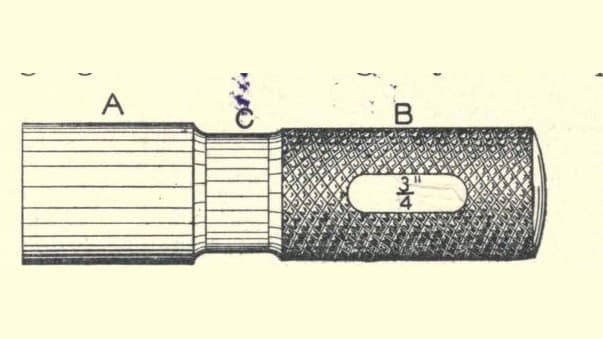
Mild steel stands for his machinery steel; the 3/4 in size is his Fig. 293.
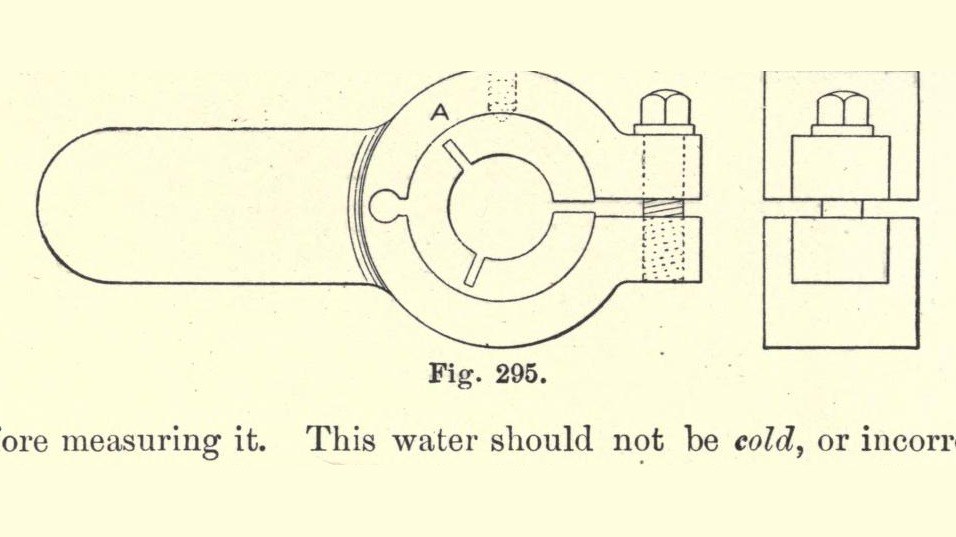
Source: E. R. Markham, Tool Making (American School of Correspondence, 1908), pp. 178-182. Picture: his Fig. 295, ring laps in a holder.
Erfahren
Two days
Anweisungen
1
1
Read Markham
Read Markham
"When it reaches a low red heat, it should be plunged in a bath of raw linseed oil. It will not be necessary to draw the temper, and the danger of alteration as it ages is done away with."
2
2
Turn, knurl and stamp
Turn, knurl and stamp
Rough out the bar, allowing enough to turn off the decarbonised skin. Turn the handle (B in Fig. 293) to size and knurl it, and turn and finish the neck (C). Mill a flat spot in the middle of the handle and stamp on it the size of the gauge and the name or mark of the part it gauges (some shops stamp on C instead). Stamp before finishing any gauging surface, as driving stamps stretches the steel. Then turn the gauging end (A) .010 to .015 in over the finished size to allow for grinding.
Materialien für diesen Schritt:
 Baustahl-Flachstange1 bar
Benötigte Werkzeuge:
 Metalldrehmaschine
 Drehmeißel
 Rändelwerkzeug
 Fräsmaschine
 Stahlschlagbuchstaben und -zahlen
 Hammer
 Mikrometer
 Schutzbrille
3
3
Pack and carburise
Pack and carburise
Pack the gauge in a box with charred leather all round it, as for pack hardening, close the box and run it in the furnace for 7 or 8 hours. Then, red hot, take the box out of the furnace and let it cool with the gauge inside. Do not quench straight from the box: Markham's second heat refines the grain, making it as compact as properly hardened tool steel.
Materialien für diesen Schritt:
 Verkohltes Leder1 packing
Benötigte Werkzeuge:
 Einsatzhärtekasten
 MuffelofenSchutzbrille
4
4
Reheat and quench in oil
Reheat and quench in oil
Heat the gauge in an ordinary fire, enclosed in a piece of tube so the fire does not touch it. When it reaches a low red heat, plunge it into a bath of raw linseed oil. The temper need not be drawn.
Benötigte Werkzeuge:
 Esse
 Rohes LeinölSchutzbrille
5
5
Grind
Grind
Grind on dead centres if you can (a worn lathe spindle copies its own error onto the work), with water running on the work to keep it cool; otherwise heat it as little as possible. Use a coarse wheel free from glaze to within .004 in of size, then a finer wheel to .001 in over. Always measure the gauge cold, since a gauge ground to size while warm will be small when it cools.
Benötigte Werkzeuge:
 RundschleifmaschineMikrometerSchutzbrille
6
6
Lap to size
Lap to size
Make a lap: a piece of cast iron with a hole bored a trifle larger than the gauge, split, and closed by a screw (Fig. 294); for much gauge work, a holder with split ring laps held by a pointed screw (Fig. 295). Lap the gauge to finished size with flour emery mixed with oil. Lapping warms it too much to caliper, so cool it in a dish of water at the temperature of the room where it will be used (about 70 F), not cold water, before each measurement.
Benötigte Werkzeuge:
 Gusseisenstab
 Schmirgelpulver
 Maschinenöl
 Becherglas
 Destilliertes Wasser
 LaborthermometerMikrometer
7
7
History and honest limits
History and honest limits
Markham notes that the creeping of hardened tool steel, put down to a rearrangement of its particles after hardening, led some manufacturers to use machinery steel for gauges. The case-hardened gauge needs no seasoning.
He calls the steel "machinery steel"; mild steel bar stands for it here. The size of the box and the furnace are not given; the 3/4 in size is his Fig. 293.
Materialien
2- 1 barPlatzhalter
- 1 packingPlatzhalter
Benötigte Werkzeuge
19- Platzhalter
- Platzhalter
- Platzhalter
- Platzhalter
- Platzhalter
- Platzhalter
- Platzhalter
- Platzhalter
- Platzhalter
- Platzhalter
- Platzhalter
- Platzhalter
- Platzhalter
- Platzhalter
- Platzhalter
- Platzhalter
- Platzhalter
- Platzhalter
- Platzhalter
Dieser Bauplan stellt her
Verwandte Blueprints
Diese Blueprints teilen Wissen — Techniken, Materialien oder Prinzipien
CC0 Gemeinfrei
Dieser Blueprint ist unter CC0 veröffentlicht. Sie dürfen dieses Werk für jeden Zweck frei kopieren, ändern, verbreiten und verwenden, ohne um Erlaubnis zu fragen.
Unterstützen Sie den Maker, indem Sie Produkte über seinen Blueprint kaufen, wo er eine Maker-Provision von Anbietern festgelegt, verdient. Oder erstellen Sie eine neue Iteration dieses Blueprints und verbinden Sie ihn in Ihrem eigenen Blueprint, um Einnahmen zu teilen.