KUNST
SCHÖNHEIT & WELLNESS
HANDWERK
KULTUR & GESCHICHTE
UNTERHALTUNG
UMFELD
ESSEN & GETRÄNKE
REVERSE ENGINEERING
WISSENSCHAFTEN
SPORT
TECHNOLOGIE
WEARABLES
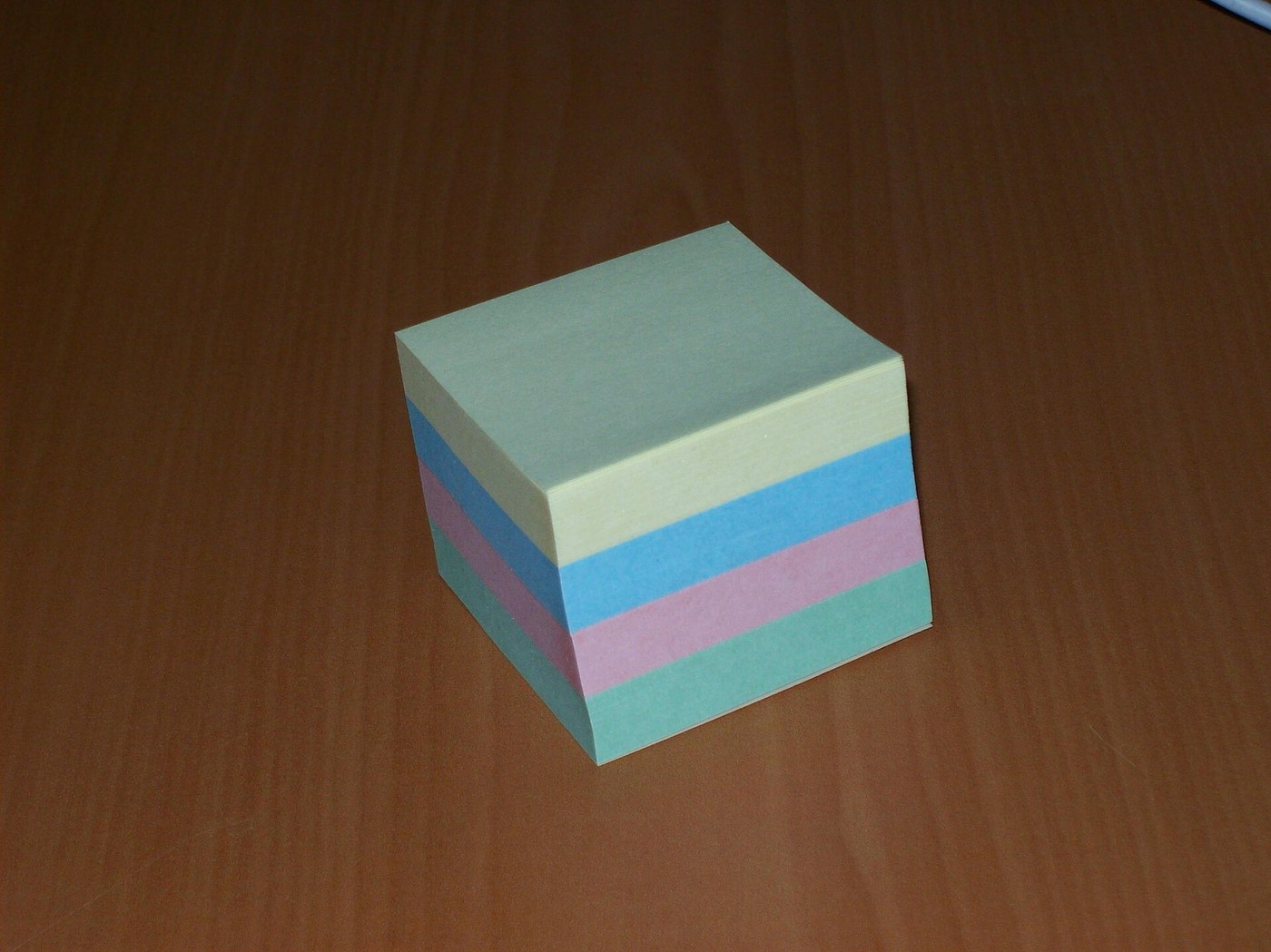


Repositionable Microsphere Adhesive
In 1968 Spencer Silver at 3M, trying to make a very strong adhesive, made the opposite: an acrylate that formed tiny tacky spheres and held only lightly. For years it had no product. In 1974 his colleague Art Fry coated it on bookmarks for his church hymnal so they would stay put without tearing the pages; the sticky note reached shops in 1980.
**US 3,691,140**, "Acrylate copolymer microspheres", Silver, filed 9. March 1970, granted 12. September 1972: "inherently tacky", elastomeric microspheres of an acrylate ester such as iso-octyl acrylate with a small share of an ionic monomer.
**You measure what makes it different from tape**: the peel force over twenty re-sticks, side by side with masking tape, and the spheres themselves under a microscope.
Anfänger
1 hour
Anweisungen
1
1
Look at the stripe
Look at the stripe
Put a sticky note's adhesive stripe under the digital microscope at high magnification. Beside it, a strip of masking tape. Capture both; measure the bead size and spacing on the note.
Benötigte Werkzeuge:
 Digitalmikroskop
 Malerkrepp
 Wiederablösbare Haftnotizen
2
2
Clean the glass
Clean the glass
Wipe a glass sheet with isopropyl alcohol and let it dry. Cut the masking tape to the same 25 mm width and 75 mm length as the note's sticky area.
Benötigte Werkzeuge:
 Glasscheibe
 Schere
 Lineal
 Küchenpapier
 Isopropylalkohol 99 %
3
3
Peel at 90 degrees
Peel at 90 degrees
Press the note and the tape onto the glass with one firm thumb stroke each. Clip a paper clip to each free end, hook the spring scale, and peel straight up, slowly. Record the steady force.
Materialien für diesen Schritt:
 Büroklammern2 Stück
Benötigte Werkzeuge:
 Federkraftmesser
4
4
Re-stick and repeat
Re-stick and repeat
Stick the same pieces down again in the same place and peel again. Record peel 1, 2, 5, 10 and 20.
Benötigte Werkzeuge:
Federkraftmesser5
5
Peel ladder and contact area
Peel ladder and contact area
Jupyter-Notebook wird geladen …
6
6
History & Context
History & Context
**What the patent specifies:** inherently tacky, elastomeric, solvent-insoluble acrylate copolymer microspheres made by suspension polymerisation with an ionic comonomer. **Modern build (derived):** a commercial sticky-note pad, tested.
The same idea now holds repositionable labels, wall graphics and removable flags. Its limits: a weak grip by design, fading tack as dust and fibre collect on the spheres, and poor hold on rough or damp surfaces.
Materialien
1- 2 StückPlatzhalter
Benötigte Werkzeuge
9- Platzhalter
- Platzhalter
- Platzhalter
- Platzhalter
- Platzhalter
- Platzhalter
- Platzhalter
- Platzhalter
- Platzhalter
Verwandte Blueprints
Diese Blueprints teilen Wissen — Techniken, Materialien oder Prinzipien


CC0 Gemeinfrei
Dieser Blueprint ist unter CC0 veröffentlicht. Sie dürfen dieses Werk für jeden Zweck frei kopieren, ändern, verbreiten und verwenden, ohne um Erlaubnis zu fragen.
Unterstützen Sie den Maker, indem Sie Produkte über seinen Blueprint kaufen, wo er eine Maker-Provision von Anbietern festgelegt, verdient. Oder erstellen Sie eine neue Iteration dieses Blueprints und verbinden Sie ihn in Ihrem eigenen Blueprint, um Einnahmen zu teilen.