KUNST
SCHÖNHEIT & WELLNESS
HANDWERK
KULTUR & GESCHICHTE
UNTERHALTUNG
UMFELD
ESSEN & GETRÄNKE
REVERSE ENGINEERING
WISSENSCHAFTEN
SPORT
TECHNOLOGIE
WEARABLES
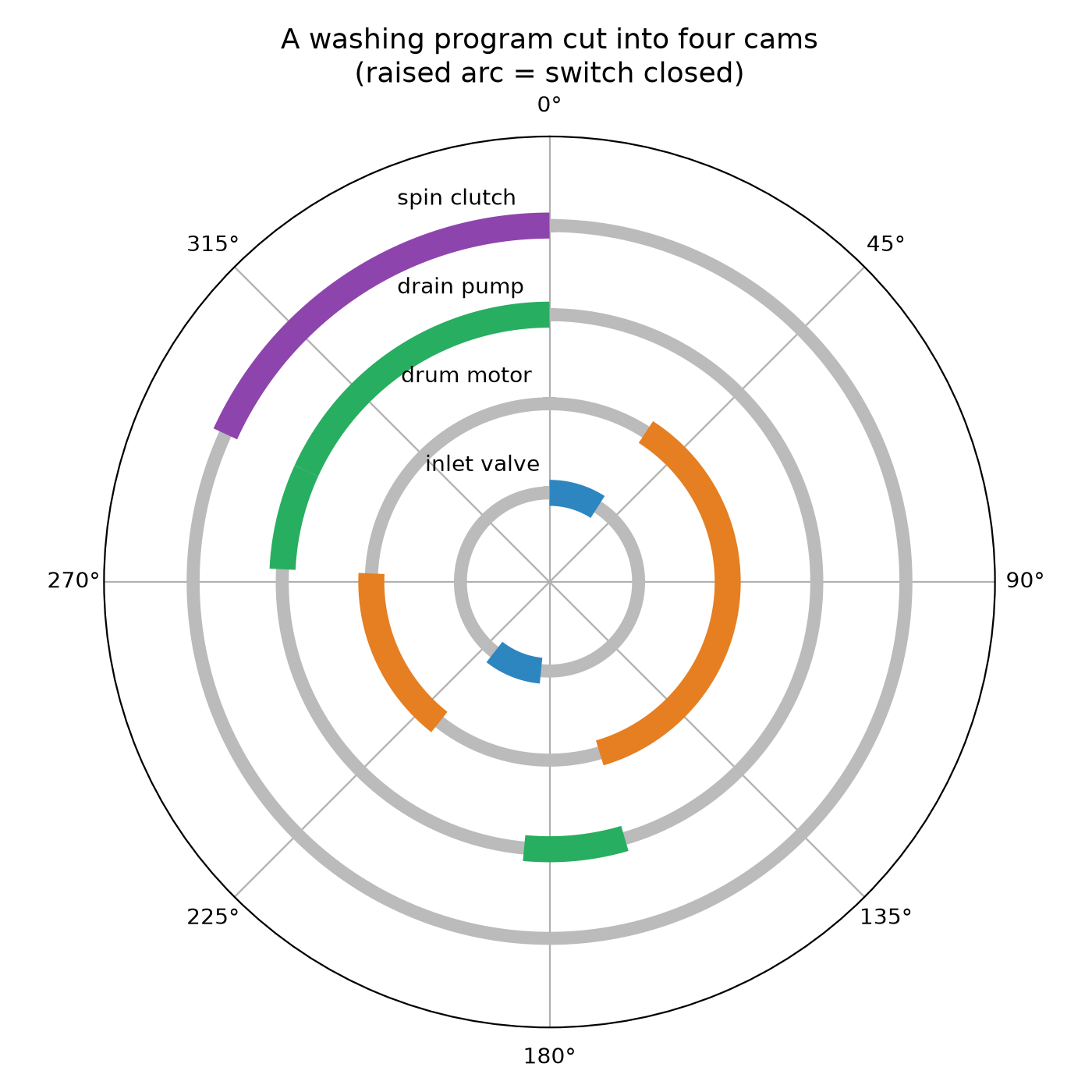
Youblob (generated from this blueprint's notebook) · CC0


The Cam Timer: A Program Cut Into Discs
Before microcontrollers, a washing machine, a dishwasher, a traffic light or an industrial process followed its sequence by turning a shaft of cam discs past a row of switches. A slow synchronous motor turns the stack once per program; each disc switches one function on while its raised arc passes; the dial on the front is simply the end of the shaft, and turning it by hand skips the program forward.
Everything about the program lives in the geometry: time is angle, and each function is an arc.
This rung turns a washing program into cam arcs, draws the cams, and builds a four-cam timer from printed discs and microswitches that switches four lamps in sequence.
Anfänger
About 4 hours
Anweisungen
1
1
From program to cam arcs
From program to cam arcs
Jupyter-Notebook wird geladen …
2
2
One turn of the cam shaft
One turn of the cam shaft
Blockly-Arbeitsbereich
Loading Blockly workspace...
3
3
How a cam moves its follower
How a cam moves its follower
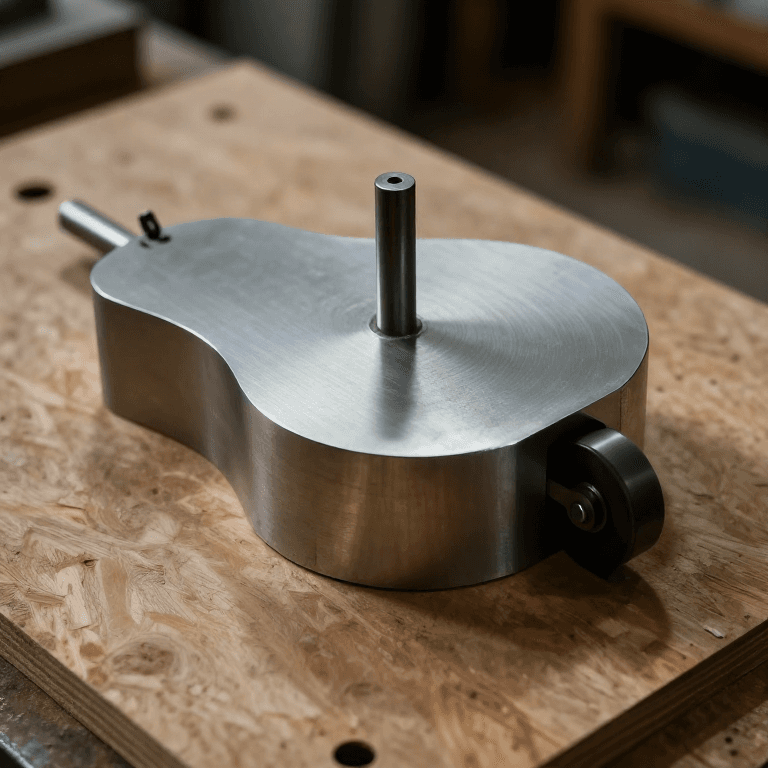
Each disc of a cam timer is a plate cam lifting a switch lever. The embedded blueprint shows how the cam's profile sets the follower's motion.
4
4
Build a four-cam timer
Build a four-cam timer
From the notebook's arcs, draw four discs 50 mm across with raised arcs 3 mm high where each function is on. Print them in PETG with a flat on their bore and stack them on an 8 mm steel shaft, with the zero marks lined up.
Turn the shaft with a slow geared DC motor — for a quick demonstration, one turn every minute or two instead of a real program's hour. Mount four lever microswitches on a plywood rail so each lever rides on one disc, and wire each through an LED and resistor from the supply.
Run it: the LEDs play the program in order. Turn the shaft by hand to jump to any step, as the dial of a washing machine does. Change one disc and the program changes.
Materialien für diesen Schritt:
 Stahl-Stangenmaterial1 Stück
 Gleichstrom-Getriebemotor1 Stück
 Mikroschalter (mit Hebel)4 Stück
 5-mm-LED4 Stück
 330-Ohm-Widerstand4 Stück
 Sperrholzplatte1 Stück
 Steckbrücken1 Stück
Benötigte Werkzeuge:
 FDM-3D-Drucker
 PETG-Filament
 Gleichstromnetzgerät
 Akkubohrschrauber
 Lötkolben
 Digitaler Messschieber 6 Zoll
5
5
A cam timer stuck on one step
A cam timer stuck on one step
Program timer faults.
Flow
Loading...
6
6
Context and honest limits
Context and honest limits
Motor-driven cam timers ran washing machines, dishwashers, traffic signals and process plants for most of the twentieth century, until microcontrollers replaced them from the 1980s onward — keeping the same sequences.
**Honest limits.** A pure cam timer knows only time: a real washing machine timer also waits for the tub to fill or drain before it moves on, using the level switch to stop the timer motor. The printed demonstration runs fast; a real timer makes one turn per program.
Materialien
7- 1 StückPlatzhalter
- Platzhalter
- 4 StückPlatzhalter
- Platzhalter
- 4 StückPlatzhalter
- 1 StückPlatzhalter
- Platzhalter
Benötigte Werkzeuge
6- Platzhalter
- Platzhalter
- Platzhalter
- 1 vendor sell this, none ship to you yetPlatzhalter
- 2 vendors sell this, none ship to you yetPlatzhalter
- Platzhalter
Dieser Bauplan stellt her
Verwandte Blueprints
Diese Blueprints teilen Wissen — Techniken, Materialien oder Prinzipien


CC0 Gemeinfrei
Dieser Blueprint ist unter CC0 veröffentlicht. Sie dürfen dieses Werk für jeden Zweck frei kopieren, ändern, verbreiten und verwenden, ohne um Erlaubnis zu fragen.
Unterstützen Sie den Maker, indem Sie Produkte über seinen Blueprint kaufen, wo er eine Maker-Provision von Anbietern festgelegt, verdient. Oder erstellen Sie eine neue Iteration dieses Blueprints und verbinden Sie ihn in Ihrem eigenen Blueprint, um Einnahmen zu teilen.