KUNST
SCHÖNHEIT & WELLNESS
HANDWERK
KULTUR & GESCHICHTE
UNTERHALTUNG
UMFELD
ESSEN & GETRÄNKE
REVERSE ENGINEERING
WISSENSCHAFTEN
SPORT
TECHNOLOGIE
WEARABLES
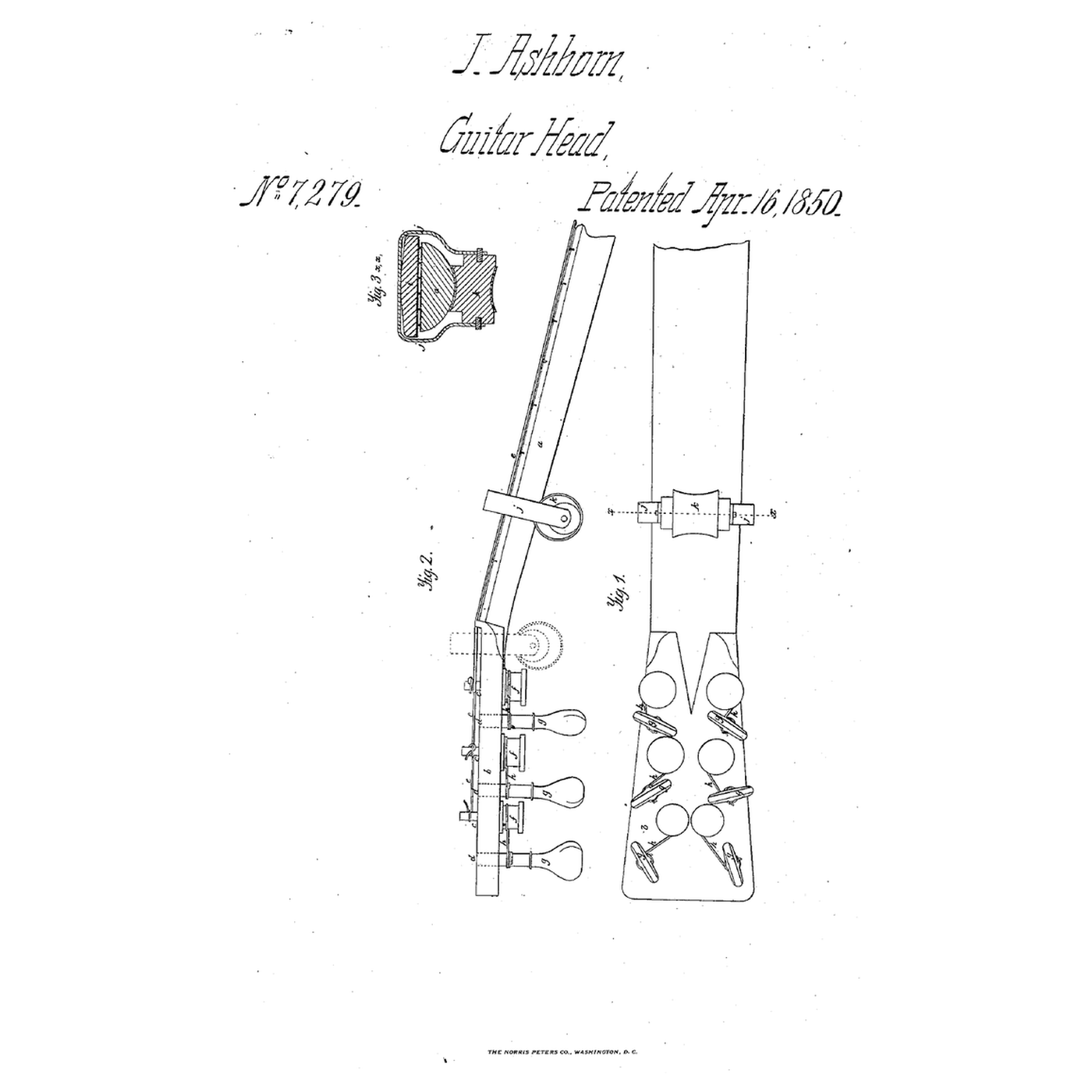


The Capo: A Movable Nut You Clamp With One Hand
A song in a key that is awkward on the guitar can be played in an easy shape if every string is raised by the same amount. A clamp across the neck at a fret does exactly that.
James Ashborn of Walcottville, Connecticut, received US 7,279, dated 16 April 1850, for improvements in the "Guitar-Head and Capo Tasto". The capo tasto — "the clamp used on the handle of a guitar to determine the vibrating length of the strings" — becomes a plate lined underneath, held by a strap round the neck and drawn tight by an eccentric roller, so it can be set on any fret "with one hand only" and pushed back onto the head when not needed. The same patent gears the tuning pegs through cords on enlarged spindles.
This rung works out what a capo does to the pitch, what it must press, and how Ashborn's pegs geared the tuning.
Anfänger
About 2 hours
Anweisungen
1
1
Semitones, clamp force and peg gearing
Semitones, clamp force and peg gearing
Jupyter-Notebook wird geladen …
2
2
Why each fret is a twelfth root of two
Why each fret is a twelfth root of two
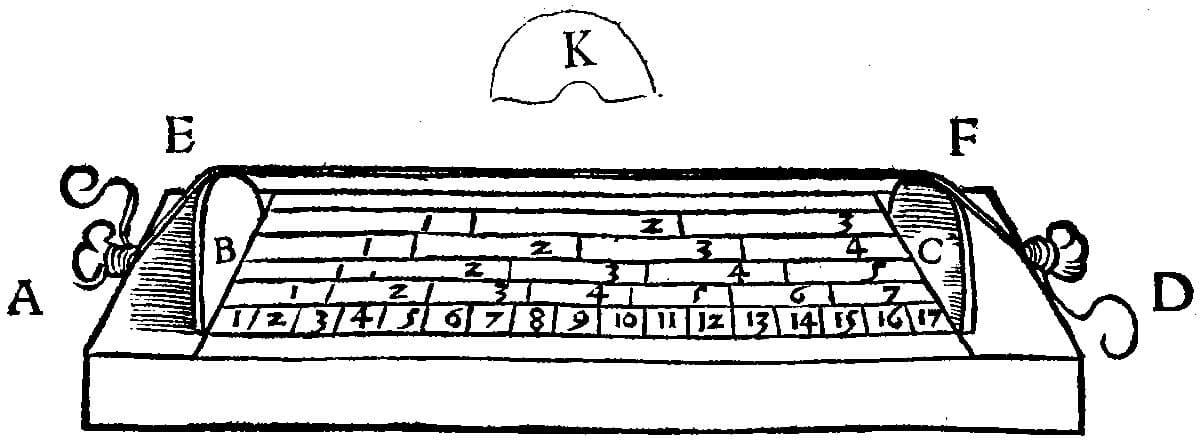
A capo only works because the frets divide the string evenly by pitch. The embedded blueprint places them.
3
3
Read US 7,279
Read US 7,279
Ashborn notes that the use of the capo tasto "(the clamp used on the handle of a guitar to determine the vibrating length of the strings to set the instrument for playing in difficult keys), as heretofore made, is attended with great difficulty", so much so "that many performers have abandoned the use of it."
The second part of his invention combines with the capo tasto, "or plate for pressing the strings onto any particular fret of the handle, a metal or other strap attached thereto and passing down on each side of the handle, and an eccentric roller journaled to the said strap and acting against the under surface of the handle, so that the said plate may, with one hand only, be drawn down onto the strings, and adjusted or liberated therefrom by simply turning the said roller", the whole being pushed back onto the head beyond the last fret, where it does not interfere with the strings.
The first part winds the strings on spindles whose part below the head is enlarged — "from three to four times the diameter of the spindle on which the strings are wound" — driven by catgut from pegs of smaller diameter, "thereby increasing the leverage of the pins to overcome the tension of the strings" without the metal of a geared head.
4
4
Tune, clamp and measure
Tune, clamp and measure
Fit new strings to a cigar-box or acoustic guitar and tune it. Put the capo at the second, third and fifth frets in turn and measure each open string's pitch with a tuner app, checking the notebook's semitone steps.
Loosen the capo until one string buzzes and note which: the thickest strings need the most force. Hook the spring scale under a single string just behind a fret and pull it down 1 mm to feel the force the capo supplies for all six.
Benötigte Werkzeuge:
 Gitarrenkapodaster (Triggerbauweise, universal)
 Zigarrenkistengitarren-Bausatz
 Federkraftmesser
 Digitaler Messschieber 6 Zoll
 Gitarrensaitensatz (Akustik, Phosphorbronze)
5
5
A capo that buzzes or detunes
A capo that buzzes or detunes
Capo troubleshooting.
Flow
Loading...
6
6
History and honest limits
History and honest limits
**James Ashborn** of Walcottville, Connecticut, received US 7,279, dated 16 April 1850, for improvements in the guitar head and the capo tasto.
**Honest limits.** String tensions and the pressing geometry in the notebook are examples; real capo force depends on the pad, the action and the string gauges.
Benötigte Werkzeuge
5- Platzhalter
- Platzhalter
- Platzhalter
- Platzhalter
Verwandte Blueprints
Diese Blueprints teilen Wissen — Techniken, Materialien oder Prinzipien


CC0 Gemeinfrei
Dieser Blueprint ist unter CC0 veröffentlicht. Sie dürfen dieses Werk für jeden Zweck frei kopieren, ändern, verbreiten und verwenden, ohne um Erlaubnis zu fragen.
Unterstützen Sie den Maker, indem Sie Produkte über seinen Blueprint kaufen, wo er eine Maker-Provision von Anbietern festgelegt, verdient. Oder erstellen Sie eine neue Iteration dieses Blueprints und verbinden Sie ihn in Ihrem eigenen Blueprint, um Einnahmen zu teilen.