KUNST
SCHÖNHEIT & WELLNESS
HANDWERK
KULTUR & GESCHICHTE
UNTERHALTUNG
UMFELD
ESSEN & GETRÄNKE
REVERSE ENGINEERING
WISSENSCHAFTEN
SPORT
TECHNOLOGIE
WEARABLES
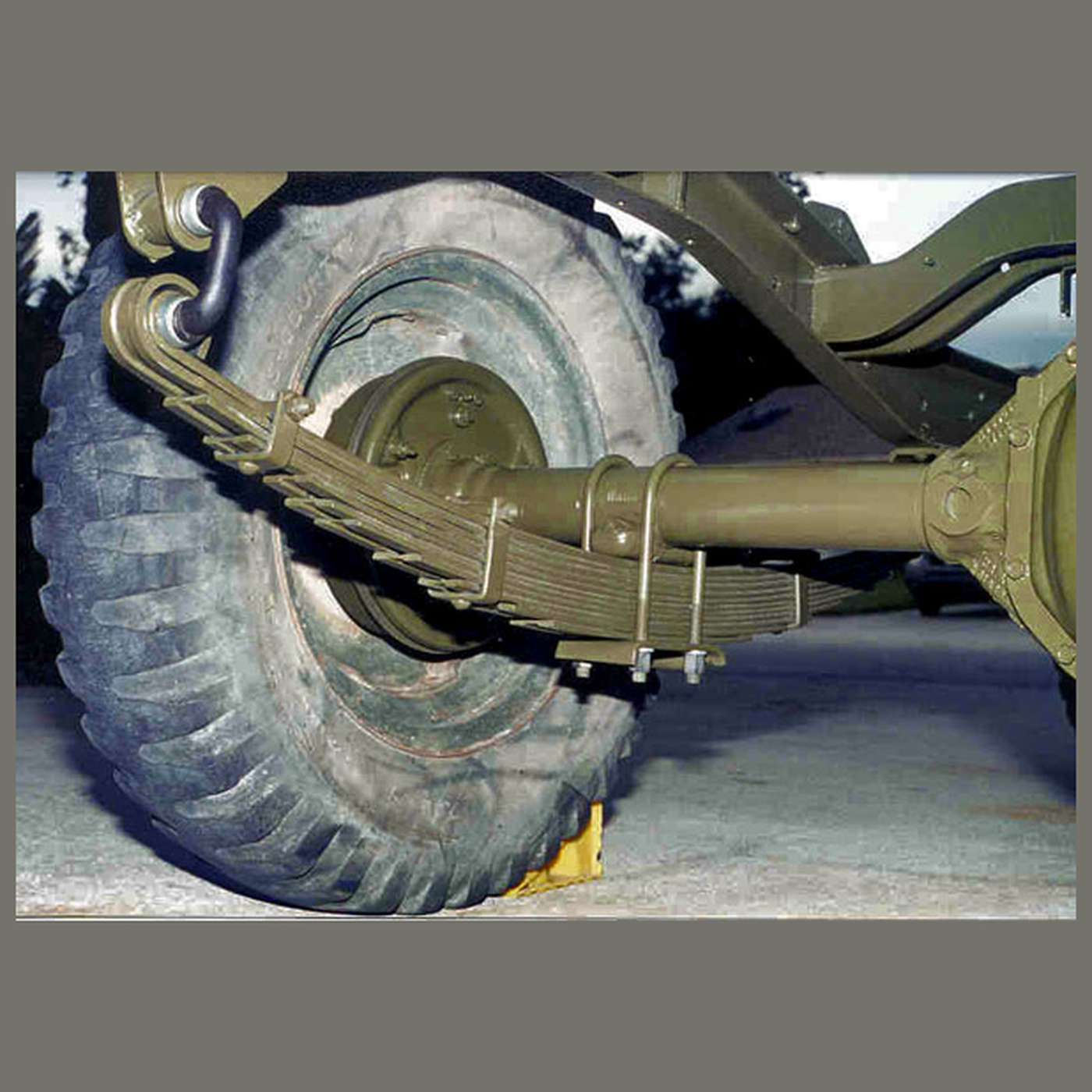

The Leaf Spring: A Beam That Carries the Load and Locates the Axle
Stack strips of spring steel, longest on top and each shorter one below, clamp them at the middle to an axle and hang the ends from the body: that is the leaf spring. It is the carriage spring of the early 1800s — Obadiah Elliott's elliptic spring of 1804 let coaches do away with the heavy perch that held the axles together — and it is still under most lorries and many pick-ups.
It does three jobs at once: it carries the load, it locates the axle so no other links are needed, and the leaves rubbing on each other damp the motion a little.
This rung works out a leaf spring's rate and the ride frequency it gives, and builds one from spring-steel strip to measure.
Anfänger
About 3 hours
Anweisungen
1
1
Rate and ride frequency
Rate and ride frequency
Jupyter-Notebook wird geladen …
2
2
Build a small leaf spring and measure it
Build a small leaf spring and measure it
Cut four strips of spring-steel strip: 300, 240, 180 and 120 mm long. Stack them centred, longest on top, and clamp them together at the middle with a bolt through a small hole (or a clamp). Bend a small eye at each end of the top leaf, or hook it over two dowels set 300 mm apart on a board.
Hang weights from the centre in steps and measure the sag with the steel rule. The slope of load against sag is the rate. Compare with the notebook's formula for your strip's width and thickness (measure them with calipers).
Now remove the two shortest leaves and repeat: the rate falls — and the top leaf now bends into a sharper curve at the centre, where it would crack first.
Materialien für diesen Schritt:
 Federstahlband1 Set
 Maschinenschrauben2 Stück
 Hartholzdübel1 Set
 Sperrholzplatte1 Blatt
Benötigte Werkzeuge:
 Schraubstock
 Digitaler Messschieber 6 Zoll
 Lineal
 Federkraftmesser
 Lederarbeitshandschuhe
3
3
History and context
History and context
Laminated carriage springs developed through the eighteenth century; **Obadiah Elliott's elliptic spring of 1804** (a British patent) let coaches be built without the perch, and the semi-elliptic form went on to railway wagons and motor vehicles. No patent number is asserted here.
**Honest limits.** A leaf spring is heavy for the energy it stores. The friction between leaves damps small bumps poorly and large ones harshly, and changes as the leaves rust. And because the spring also locates the axle, the axle can wind up under hard acceleration and braking.
Materialien
4- 1 SetPlatzhalter
- 2 StückPlatzhalter
- 1 SetPlatzhalter
- 1 BlattPlatzhalter
Benötigte Werkzeuge
5- Platzhalter
- Platzhalter
- Platzhalter
- Platzhalter
- Platzhalter
Dieser Bauplan stellt her
Verwandte Blueprints
Diese Blueprints teilen Wissen — Techniken, Materialien oder Prinzipien
Spring Rate: The One Number a Spring Is
von Emma
Mechanik
45
0
0
0
0
0

Spring Fatigue: It Is the Swing That Breaks It
von Emma
Metallbearbeitung
36
0
0
0
0
0
Balance: A Tiny Eccentricity Becomes an Enormous Force
von Martin
Maschinenbau
43
0
0
0
0
0
Building a Wooden Cart Wheel — Hub, Spokes, and Felloes
von Woody
Holzbearbeitung
81
0
0
0
2
0
Ackermann Steering: The Inner Wheel Turns Further
von Martin
Mechanik
31
0
0
0
0
0
CC0 Gemeinfrei
Dieser Blueprint ist unter CC0 veröffentlicht. Sie dürfen dieses Werk für jeden Zweck frei kopieren, ändern, verbreiten und verwenden, ohne um Erlaubnis zu fragen.
Unterstützen Sie den Maker, indem Sie Produkte über seinen Blueprint kaufen, wo er eine Maker-Provision von Anbietern festgelegt, verdient. Oder erstellen Sie eine neue Iteration dieses Blueprints und verbinden Sie ihn in Ihrem eigenen Blueprint, um Einnahmen zu teilen.