KUNST
SCHÖNHEIT & WELLNESS
HANDWERK
KULTUR & GESCHICHTE
UNTERHALTUNG
UMFELD
ESSEN & GETRÄNKE
REVERSE ENGINEERING
WISSENSCHAFTEN
SPORT
TECHNOLOGIE
WEARABLES
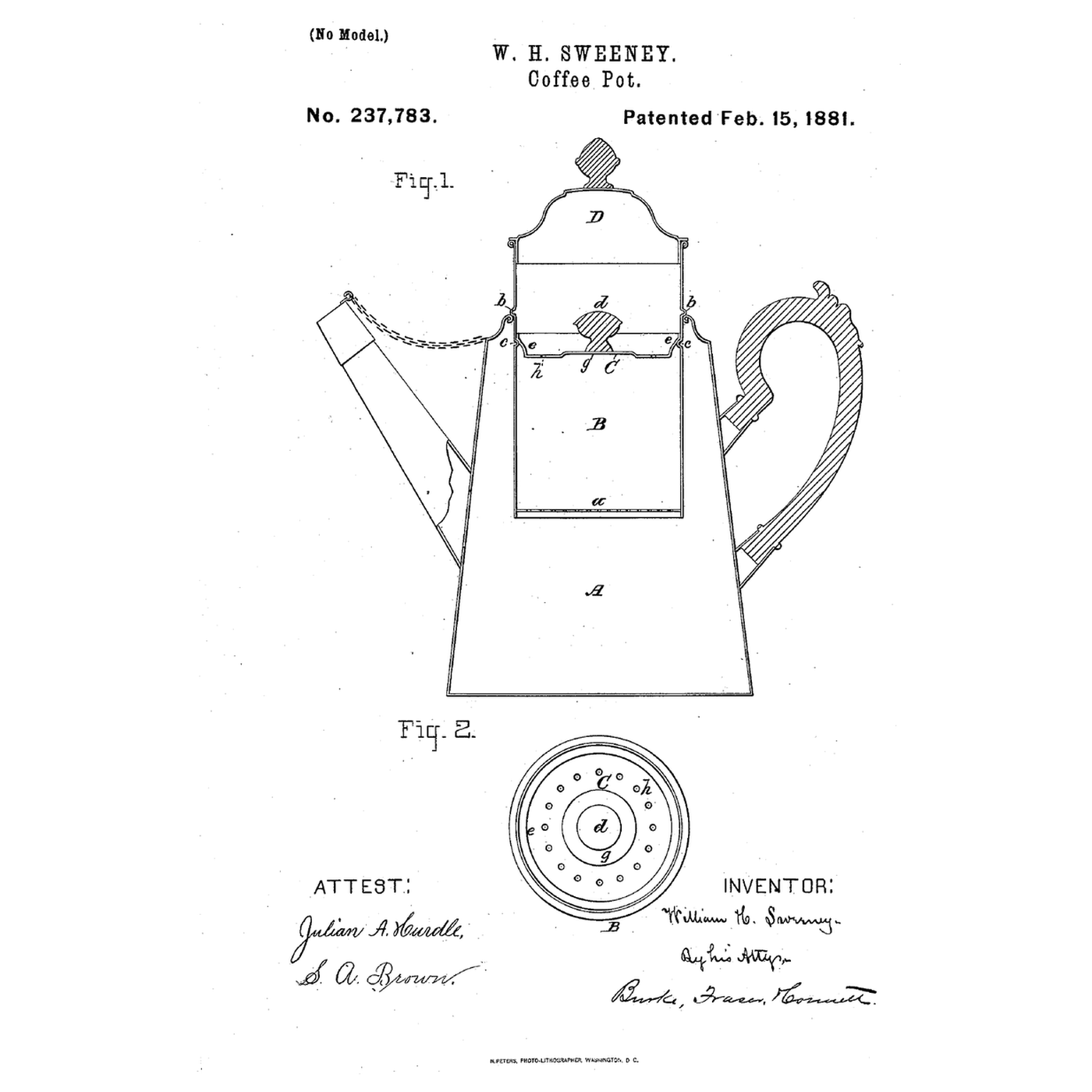


The Ring-Distributor Drip Pot: Holes in a Trough, Water Everywhere at Once
Drip coffee is made by pouring hot water over ground coffee in a filter. Pour it in one spot and it tunnels through, making coffee that is bitter and weak at the same time.
William H. Sweeney of New York received US 237,783, dated 15 February 1881 (filed 26 May 1880), for a coffee-pot whose filter carries a distributing plate with "the perforations arranged in a circle concentric with the axis of the pot, and in a depressed concentric trough", so the water will "flow around and distribute itself evenly as it passes through the perforations."
This rung computes how uneven wetting skews the brew, then brews with and without a distributor and looks at the spent bed.
Anfänger
About 1 hour
Anweisungen
1
1
Wetted share and brew ratio
Wetted share and brew ratio
Jupyter-Notebook wird geladen …
2
2
Spreading water through holes
Spreading water through holes
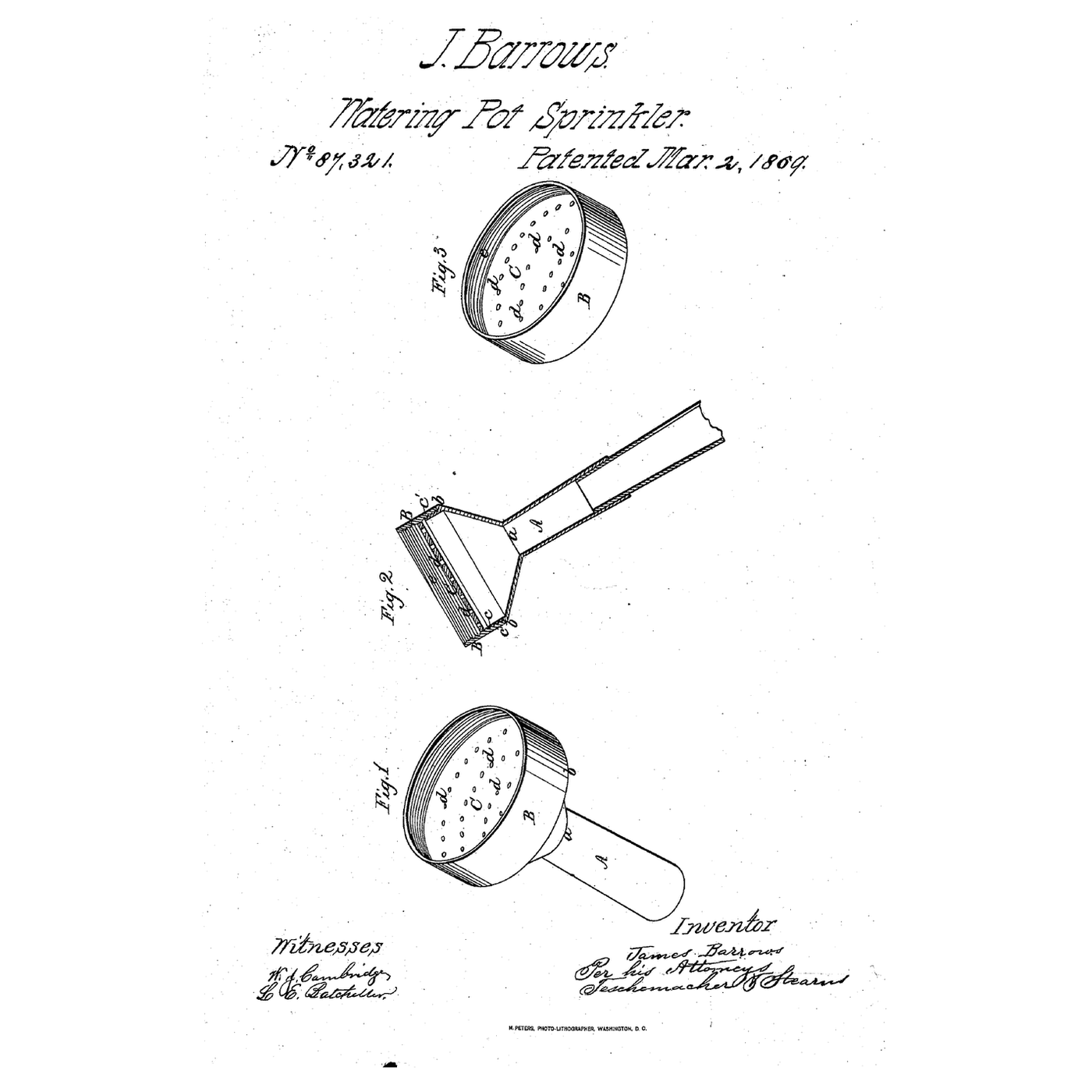
The embedded blueprint is an 1869 watering-can rose; Sweeney's plate spreads water through a ring of holes for the same reason.
3
3
Read US 237,783
Read US 237,783
"This invention relates to that class of coffee-pots in which the ground coffee is placed in a filter in the pot and boiling water is poured over it. The water percolates through the mass of coffee and eventually falls into the pot through the foraminous bottom of the filter."
Earlier distributing plates were meant "to prevent the force of the water, when poured in, from washing through the finer particles or dust of the coffee and rendering it 'muddy.'" But "In a pot where a concave distributing-disk is employed the stream of water is apt to pass through at the center, and where a flat or level plate is used it is apt to pass through at the point where the stream impinges."
"The trough-like character of the depression h causes the water, when poured in, to flow around and distribute itself evenly as it passes through the perforations."
4
4
One spot against a ring
One spot against a ring
Brew two cups the same way, 20 g of ground coffee in a paper filter and 320 g of water just off the boil. For the first, pour in a thin stream onto one spot. For the second, pour onto a small plate with holes in a ring (a jar lid pierced round its edge works) set on the coffee.
Time how long each takes to drain, taste them side by side, and look at the spent grounds: a crater or a flat bed. Compare with the notebook's picture.
Materialien für diesen Schritt:
 Gemahlener Kaffee40 g
 Kaffeefilter / Filterpapier2 Stück
 Wasser1 Stück
Benötigte Werkzeuge:
 Filterkaffeekanne
 Wasserkocher aus Glas
 Digitale Küchenwaage
 Stoppuhr
 Teetasse mit Untertasse - Porzellan
5
5
Drip coffee that is bitter, weak or slow
Drip coffee that is bitter, weak or slow
Drip coffee troubleshooting.
Flow
Loading...
6
6
History and honest limits
History and honest limits
**William H. Sweeney** of New York, a subject of the Queen of Great Britain, filed US 237,783 on 26 May 1880; it is dated 15 February 1881.
**Honest limits.** The notebook splits the bed into wetted and dry parts; real flow spreads sideways in the grounds, and extraction depends on grind and temperature too. Amounts and fractions are examples. Your times, taste and the spent bed are the measurement.
Materialien
3- Platzhalter
- 2 StückPlatzhalter
- 1 StückPlatzhalter
Benötigte Werkzeuge
5- Platzhalter
- Platzhalter
- Platzhalter
- Platzhalter
- Platzhalter
Verwandte Blueprints
Diese Blueprints teilen Wissen — Techniken, Materialien oder Prinzipien



CC0 Gemeinfrei
Dieser Blueprint ist unter CC0 veröffentlicht. Sie dürfen dieses Werk für jeden Zweck frei kopieren, ändern, verbreiten und verwenden, ohne um Erlaubnis zu fragen.
Unterstützen Sie den Maker, indem Sie Produkte über seinen Blueprint kaufen, wo er eine Maker-Provision von Anbietern festgelegt, verdient. Oder erstellen Sie eine neue Iteration dieses Blueprints und verbinden Sie ihn in Ihrem eigenen Blueprint, um Einnahmen zu teilen.