
Zusammenarbeit
KUNST
SCHÖNHEIT & WELLNESS
HANDWERK
KULTUR & GESCHICHTE
UNTERHALTUNG
UMFELD
ESSEN & GETRÄNKE
REVERSE ENGINEERING
WISSENSCHAFTEN
SPORT
TECHNOLOGIE
WEARABLES
Tube-Track Pedal Saw Table: Any Portable Saw Clamped Upside Down on a Carriage Rolling Inside Slotted Tubes (Tomlinson & Bearden, 1931)
Forge

Erstellt von

Forge

13. November 2026NO
0
0
0
0
0

Tube-Track Pedal Saw Table: Any Portable Saw Clamped Upside Down on a Carriage Rolling Inside Slotted Tubes (Tomlinson & Bearden, 1931)

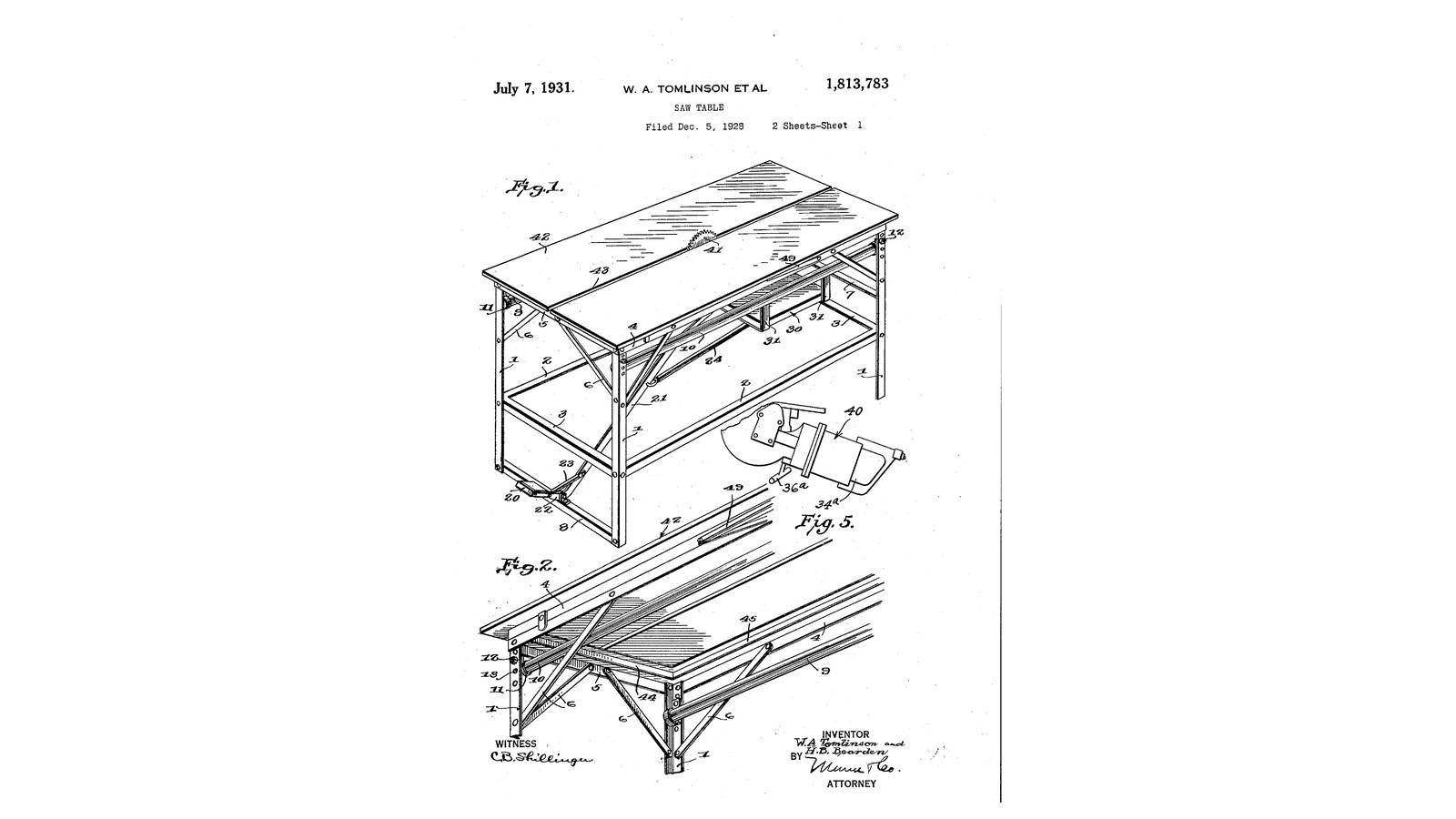
William A. Tomlinson and Howell B. Bearden of Phoenix, Arizona, received US 1,813,783, dated 7 July 1931, for a table that turns any portable power saw into a table saw. The saw is clamped upside down on a carriage, its blade through the slot of a top hinged at the rear. The carriage rolls on ball-bearing rollers inside two steel tubes slotted along their undersides. A pedal pushes it forward through the work, leaving both hands free, and a spring brings it back. With the pedal left alone it works as a fixed saw, and the saw unbolts for hand use. The patent gives no sizes; every size here is ours.
Erfahren
About 4 days

Anweisungen

1

Pedal, link and travel

Jupyter-Notebook wird geladen …
2

Read US 1,813,783

"By using the pedal in the manner above set forth both hands of the operator will be free for manipulating the work, which is especially desirable when pattern work is to be sawed."
3

Angle-iron frame

Bolt a frame of steel angle 900 x 500 mm, 850 high: four corner legs 1, side and end bars 2, 3 halfway up and 4, 5 at the top, flat-bar diagonal braces 6 at the top corners, a cross bar 7 between the rear legs above the middle bars, and a cross bar 8 between the front legs at the bottom. Drill a vertical row of 9 mm holes 13, 25 mm apart, near the top of each leg, for the track hangers.

Materialien für diesen Schritt:

Winkelstahl aus BaustahlWinkelstahl aus Baustahl6 Stück
Baustahl-FlachstahlBaustahl-Flachstahl1 Stück
Sechskantschrauben-SortimentSechskantschrauben-Sortiment40 Stück
SechskantmutterSechskantmutter40 Stück
UnterlegscheibeUnterlegscheibe40 Stück

Benötigte Werkzeuge:

Bügelsäge (Metallsäge)Bügelsäge (Metallsäge)
WinkelschleiferWinkelschleifer
StandbohrmaschineStandbohrmaschine
BohrersatzBohrersatz
KörnerKörner
KombinationswinkelKombinationswinkel
Bandmaß (Rollmeter)Bandmaß (Rollmeter)
RollgabelschlüsselRollgabelschlüssel
SchutzbrilleSchutzbrille
4

Slotted tube tracks

Cut two 900 mm lengths of 42 mm steel tube 9, 10 and cut a 10 mm slot 14 along the underside of each, stopping 20 mm short of the ends; file the slot's edges smooth. Bolt a flat-bar hanger 11 to each end of each tube and hang the tubes along the frame's sides from the legs with bolts 12 through the row of holes, at the height that suits your saw. Put a short coil spring 39 in each end of each tube as a buffer.

Materialien für diesen Schritt:

Rundrohr aus FlussstahlRundrohr aus Flussstahl2 Stück
Baustahl-FlachstahlBaustahl-Flachstahl1 Stück
Coil SpringCoil Spring4 Stück
Sechskantschrauben-SortimentSechskantschrauben-Sortiment8 Stück
SechskantmutterSechskantmutter8 Stück

Benötigte Werkzeuge:

Bügelsäge (Metallsäge)Bügelsäge (Metallsäge)
WinkelschleiferWinkelschleifer
FeilensatzFeilensatz
SchraubstockSchraubstock
StandbohrmaschineStandbohrmaschine
BohrersatzBohrersatz
RollgabelschlüsselRollgabelschlüssel
Digitaler Messschieber 6 ZollDigitaler Messschieber 6 Zoll
SchutzbrilleSchutzbrille
5

Carriage and rollers

Cut the carriage 30 from 5 mm steel plate, as wide as between the tubes. At each corner bolt an upright flat-bar standard 31 that reaches up through a tube's slot, and on its top a short bar 33 across inside the tube carrying a 22 mm ball bearing 32 at each end on an M8 bolt with a lock nut. Slide the rollers into the tubes from the ends, the standards hanging down through the slots, and bolt them to the carriage.

Materialien für diesen Schritt:

BaustahlplatteBaustahlplatte1 Stück
Baustahl-FlachstahlBaustahl-Flachstahl1 Stück
KugellagerKugellager8 Stück
Sechskantschrauben-SortimentSechskantschrauben-Sortiment16 Stück
Sicherungsmutter mit KunststoffeinsatzSicherungsmutter mit Kunststoffeinsatz8 Stück
UnterlegscheibeUnterlegscheibe16 Stück

Benötigte Werkzeuge:

Bügelsäge (Metallsäge)Bügelsäge (Metallsäge)
WinkelschleiferWinkelschleifer
StandbohrmaschineStandbohrmaschine
BohrersatzBohrersatz
FeilensatzFeilensatz
SchraubstockSchraubstock
RollgabelschlüsselRollgabelschlüssel
6

Pedal and springs

Pivot a lever 21 of steel flat bar on the front bottom cross bar 8, with an arm 22 to the side carrying the pedal 20 and a brace 23 from arm to lever. Join the lever's top to the carriage's front with a flat-bar link 24. Hook a return spring 25a from the rear cross bar 7 to the lever partway up.

Materialien für diesen Schritt:

Baustahl-FlachstahlBaustahl-Flachstahl2 Stück
Rundstahl aus BaustahlRundstahl aus Baustahl1 Stück
ZugfederZugfeder1 Stück
Sechskantschrauben-SortimentSechskantschrauben-Sortiment4 Stück
Sicherungsmutter mit KunststoffeinsatzSicherungsmutter mit Kunststoffeinsatz4 Stück

Benötigte Werkzeuge:

Bügelsäge (Metallsäge)Bügelsäge (Metallsäge)
StandbohrmaschineStandbohrmaschine
BohrersatzBohrersatz
SchraubstockSchraubstock
RollgabelschlüsselRollgabelschlüssel
7

Mount the saw and the top

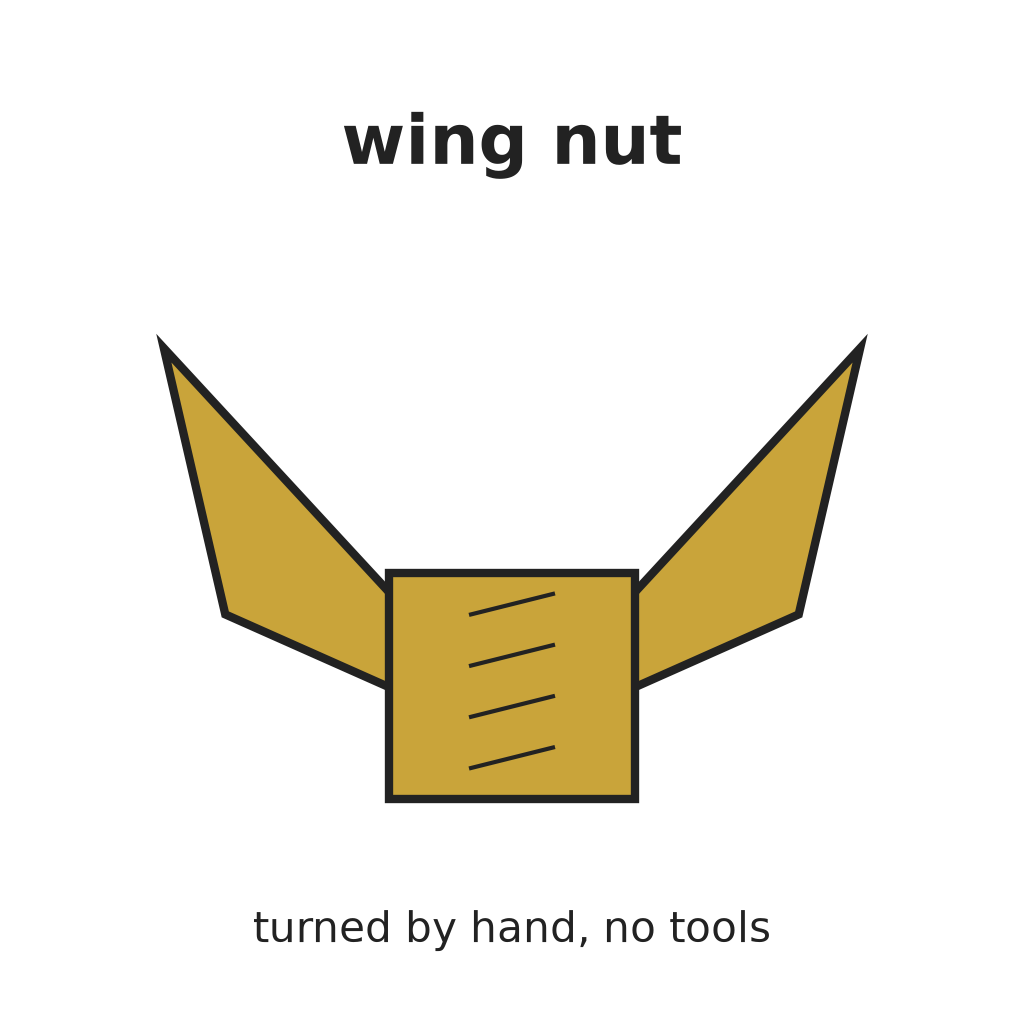
Turn the circular saw upside down on the carriage and bolt it by its base plate with bolts and wing nuts, so it lifts off for hand use; his T-bolt 34 and hook bolts 36 gripped the saw's handles, which modern saws do not suit. Make the top 42 of plywood on a steel angle frame 44, slotted along the blade's path, and hinge its rear edge to the frame so it swings up to reach the saw. Fit a catch 47 to lock it down and a folding flat-bar brace 49 to prop it up.

Materialien für diesen Schritt:

HandkreissägeHandkreissäge1 Stück
Sechskantschrauben-SortimentSechskantschrauben-Sortiment4 Stück
HandflügelmutterHandflügelmutter4 Stück
SperrholzplatteSperrholzplatte1 Stück
Winkelstahl aus BaustahlWinkelstahl aus Baustahl1 Stück
ScharnierScharnier2 Stück
Haken und ÖseHaken und Öse1 Stück
Baustahl-FlachstahlBaustahl-Flachstahl1 Stück
HolzschraubenHolzschrauben16 Stück

Benötigte Werkzeuge:

StichsägeStichsäge
AkkubohrschrauberAkkubohrschrauber
BohrersatzBohrersatz
Bügelsäge (Metallsäge)Bügelsäge (Metallsäge)
RollgabelschlüsselRollgabelschlüssel
KombinationswinkelKombinationswinkel
8

Cut

Lock the top down. Set the saw's depth so the blade stands 10 mm above the board. Place the board on the top in front of the blade, start the saw and press the pedal: the carriage rolls the running blade through it while both hands hold the work. Let the pedal up and the spring returns it. For ripping, leave the carriage still and feed the board.

Benötigte Werkzeuge:

SchutzbrilleSchutzbrille
Gehörschutz (Kapselgehörschutz, SNR 30 dB)Gehörschutz (Kapselgehörschutz, SNR 30 dB)
9

Troubleshooting

Tube-track saw table troubleshooting.

Flow

Loading...
10

History and honest limits

**William A. Tomlinson** and **Howell B. Bearden** of Phoenix, Arizona, US 1,813,783, dated 7 July 1931, filed 5 December 1928. They claimed a top with a slot, "laterally spaced longitudinally extending tubular tracks" below it, "slotted longitudinally on their lower faces", and a saw carriage with upstanding roller-carrying hangers in the tracks, their shanks through the slots. Their saw is held by its handles; ours by its base plate. Their frame is angle iron, as ours. They give no sizes; every size here is ours.

Materialien

18

Benötigte Werkzeuge

15

Dieser Bauplan stellt her

CC0 Gemeinfrei

Dieser Blueprint ist unter CC0 veröffentlicht. Sie dürfen dieses Werk für jeden Zweck frei kopieren, ändern, verbreiten und verwenden, ohne um Erlaubnis zu fragen.

Unterstützen Sie den Maker, indem Sie Produkte über seinen Blueprint kaufen, wo er eine Maker-Provision von Anbietern festgelegt, verdient. Oder erstellen Sie eine neue Iteration dieses Blueprints und verbinden Sie ihn in Ihrem eigenen Blueprint, um Einnahmen zu teilen.

Diskussion

(0)

Anmelden um an der Diskussion teilzunehmen

Kommentare werden geladen...