Zusammenarbeit
KUNST
SCHÖNHEIT & WELLNESS
HANDWERK
KULTUR & GESCHICHTE
UNTERHALTUNG
UMFELD
ESSEN & GETRÄNKE
REVERSE ENGINEERING
WISSENSCHAFTEN
SPORT
TECHNOLOGIE
WEARABLES


Wicker Harvesting Baskets: the Round Willow Cob (Hasluck, 1903)
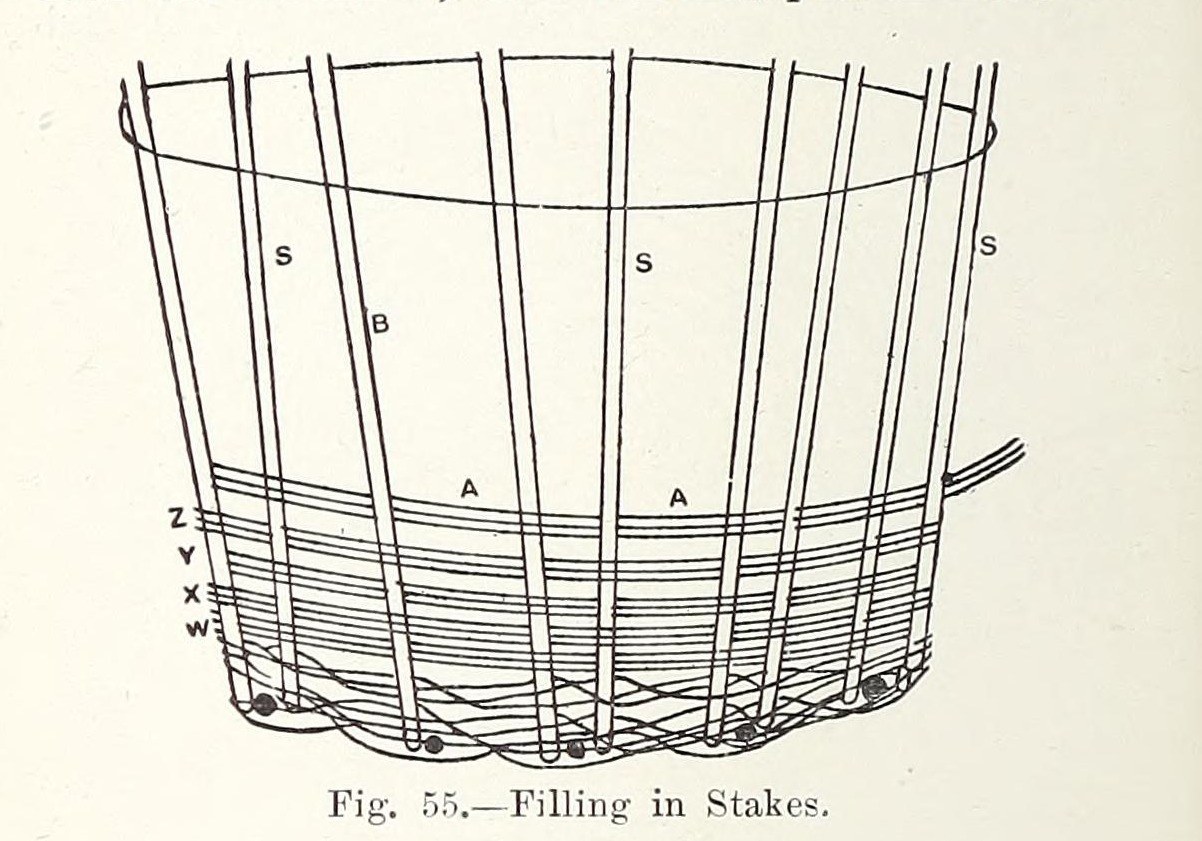
The basket-maker's round 'cob': a crowned round bottom 8 in across, flaring sides slewed to 11 in across at 11 in deep, a laid border and a rope-wrapped bow handle across the top.
Variable: slewed (eight and a half pairs of stakes) or the better randed white cob (nine pairs).
Source: Paul N. Hasluck, Basket Work of All Kinds (1903), pp. 48-54. Picture: Fig. 55 of the book.
Fortgeschritten
Unknown
Anweisungen
1
1
Lay the slarth
Lay the slarth
Cut four sticks about 11 in long and shave them along the middle so one pair crosses the other. Lay them under your feet (Fig. 52) and tie them with two rods, one of whose butts forms a half stick, so the bottom has four and a half sticks. Work the tie-rods round to open the sticks into nine parts (Figs. 53-54), keeping a crown in the bottom.
Materialien für diesen Schritt:
 Dickere Weidenruten4 11 in
 Weidenrute2 tie-rods
Benötigte Werkzeuge:
 Einhand-Gartenschere
 Flaches Holzbrett
 Wasser
2
2
Slew and pair the bottom
Slew and pair the bottom
Fill in by working two rods together (slewing), adding a rod now and then, until the bottom is 7 1/2 in across; then pair off with two pointed rods to 8 in. Push the ends in, pick the bottom and cut the sticks off with the shears.
Materialien für diesen Schritt:
Weidenrute1 slewing, pairingBenötigte Werkzeuge:
Einhand-Gartenschere Schere (groß)
3
3
Stake and upset
Stake and upset
Push in eight and a half pairs of stakes, one each side of eight sticks and one by the ninth. Prick them up and gather them in a hoop several times larger than the bottom, since the cob needs a 3 in spring at the border. Drive them level with the iron. Upset with the tops of four rods (7 to 9 in of tip cut off), each in front of three stakes and behind the fourth; after one round drop to three rods, each in front of two and behind the third, and piece the butts.
Materialien für diesen Schritt:
 Weidenstecklinge17 8 1/2 pairsWeidenrute7 upsetting
Benötigte Werkzeuge:
Einhand-Gartenschere Hammer
 Durchziehnadel
4
4
Slew the sides
Slew the sides
Pin the bottom to the board with the small bodkin or weight it, and fill in the stakes with a three-rod slew (Fig. 55), adding a butt inside as each top finishes outside. Let the sides spring gradually to 11 in across at 11 in deep; a round of white rods halfway up brightens it. Level with a two- or one-rod slew and pair off with two rods.
Materialien für diesen Schritt:
Weidenrute1 slewingBenötigte Werkzeuge:
DurchziehnadelHammer5
5
Border and bow handle
Border and bow handle
Push two pointed sticks down the slewing at opposite sides to keep the handle place. Lay down five stakes and border as for a square basket (Fig. 56), finishing by cramming. Wet the two sticks with the sponge and pull them out; point, bend and push in a stick for the bow handle and wrap it with twisted rods as for the square basket.
Materialien für diesen Schritt:
Dickere Weidenruten1 bowWeidenrute4 handle wrapBenötigte Werkzeuge:
 SchwammEinhand-GartenschereDickere Weidenruten
Materialien
3- 1 bowPlatzhalter
- 4 handle wrapPlatzhalter
- 17 8 1/2 pairsPlatzhalter
Materialien verbundener Blueprints

Dieser Bauplan stellt her

CC0 Gemeinfrei
Dieser Blueprint ist unter CC0 veröffentlicht. Sie dürfen dieses Werk für jeden Zweck frei kopieren, ändern, verbreiten und verwenden, ohne um Erlaubnis zu fragen.
Unterstützen Sie den Maker, indem Sie Produkte über seinen Blueprint kaufen, wo er eine Maker-Provision von Anbietern festgelegt, verdient. Oder erstellen Sie eine neue Iteration dieses Blueprints und verbinden Sie ihn in Ihrem eigenen Blueprint, um Einnahmen zu teilen.