ART
BEAUTY & WELLNESS
CRAFT
CULTURE & HISTORY
ENTERTAINMENT
ENVIRONMENT
FOOD & DRINKS
REVERSE ENGINEERING
SCIENCES
SPORTS
TECHNOLOGY
WEARABLES
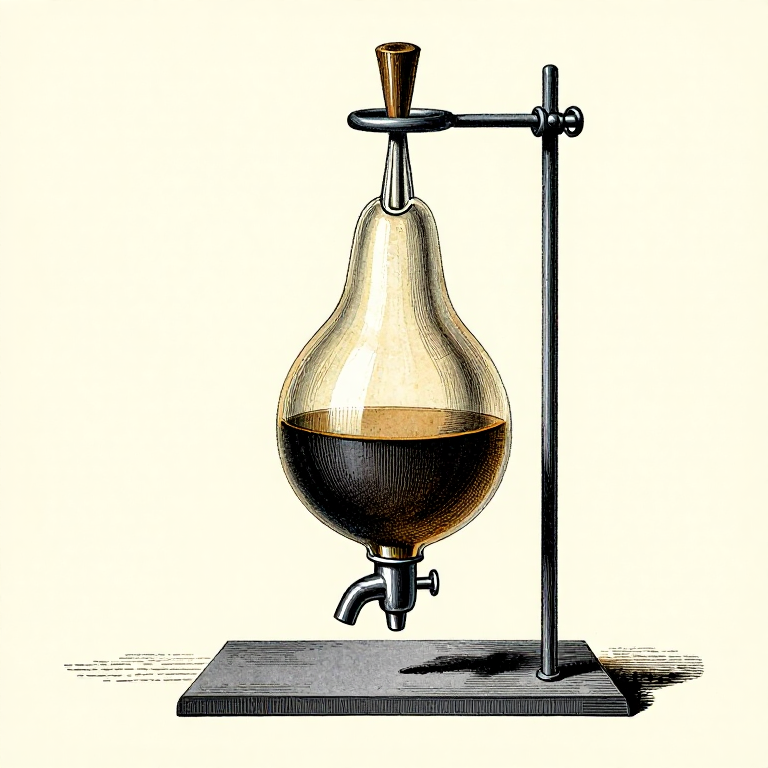


Extraction: Three Small Shakes Beat One Big One
Shake a solution with a solvent that does not mix with it, and the dissolved substance divides between the two layers in a fixed ratio. Run off the layer you want and the separation is done.
It is the fastest purification in the laboratory, it needs one piece of glassware, and there are two things about it worth knowing in advance: **splitting the solvent into several portions extracts more than using it all at once**, and **an acid or a base can have its partition coefficient changed by orders of magnitude with a few drops of reagent**.
It is hazard-gated because separating funnels build pressure, and because the solvents that do this job well are flammable and harmful to breathe.
Advanced
4 hours
Instructions
1
1
Using a separating funnel without an accident
Using a separating funnel without an accident
**Check the tap and the stopper before putting anything in.** A funnel with a loose tap empties itself down the front of whoever is holding it.
**Never fill more than about two thirds.** There must be room for the layers to move when it is shaken.
**Support the stopper with one hand and the tap with the other.** Invert, and **open the tap immediately** to release pressure, pointing the stem away from everyone. Then close, shake gently for a few seconds, and vent again. Repeat with progressively more vigorous shaking.
**Pressure is the real hazard.** A volatile solvent warmed by the hand, or a carbonate wash releasing carbon dioxide, builds pressure fast enough to blow the stopper out and spray the contents. Venting every few seconds at the start is not optional.
**Stand it in a ring to settle**, and take the stopper OUT before opening the tap — otherwise nothing flows and a partial vacuum forms.
**Run the lower layer out through the tap; pour the upper layer out of the top.** Running the upper layer through the tap drags it through the residue of the lower one.
Gloves, eye protection, good ventilation, no flames anywhere near.
Materials for this step:
 Ethanol - Lab Grade, 95%1 piece
Tools needed:
 Separating Funnel
 Chemical-Resistant Gloves
 Clear Safety Glasses
 Full-Face Respirator
2
2
The partition coefficient, and why three portions
The partition coefficient, and why three portions
Loading Jupyter Notebook...
Tools needed:
 Desktop Computer
3
3
Which layer is which, and what to do about emulsions
Which layer is which, and what to do about emulsions
**Identify the layers before running anything off.** Density decides it: ether, hexane, ethyl acetate and toluene float on water; dichloromethane and chloroform sink. A concentrated salt solution is denser than many solvents that would normally sink in pure water, so adding salt can swap the order.
**When in doubt, test.** Add a few drops of water to the layer in question. If they mix in, it is the aqueous layer; if they form a bead, it is not. Five seconds, and it prevents throwing the product away.
**Keep every layer until the product is in hand.** This is the rule that saves preparations. A layer that turns out to have been the wrong one is recoverable only if it is still in a flask.
**Emulsions** — a cloudy layer that will not separate — come from shaking too violently, from surfactant-like impurities, or from solvents of similar density. The remedies, in order:
*Wait.* Many separate on standing.
*Add brine.* Saturated salt solution raises the aqueous density and drags dissolved solvent out of it. The standard fix.
*Swirl gently rather than shaking.*
*Filter through a plug of glass wool or celite.*
*Add a little more of one solvent* to change the density difference.
Prevention is better: **swirl and invert rather than shaking hard.** Extraction needs contact, not violence.
Materials for this step:
Ethanol - Lab Grade, 95%1 piece Magnesium Sulfate (Epsom Salt)1 piece
Tools needed:
Separating Funnel Erlenmeyer FlaskChemical-Resistant Gloves
4
4
Washing, and the order of operations
Washing, and the order of operations
**An extraction takes the product out; a wash takes impurities away from it.** Same funnel, opposite intent, and the layer you keep is the other one.
A standard work-up sequence, and each step has a reason:
**Water wash** — removes water-soluble salts and any remaining polar reagent.
**Dilute acid wash** — removes basic impurities by ionising them into the water. Only if the product is not itself basic.
**Dilute bicarbonate wash** — removes acids. It fizzes, so vent constantly; a stoppered funnel of bicarbonate and acid builds pressure very fast.
**Brine wash** — a saturated salt solution pulls dissolved water out of the organic layer, so the drying agent afterwards has much less to do.
**Dry over a drying agent**, which is the next rung.
**Then remove the solvent.**
Two habits worth keeping: **label every flask as it is filled**, because four unlabelled layers on a bench is a preparation lost; and **check the pH of the aqueous layer** after an acid or base wash, to confirm the wash actually did what was intended rather than being neutralised by the product.
Materials for this step:
Magnesium Sulfate (Epsom Salt)1 pieceTools needed:
Separating FunnelErlenmeyer FlaskChemical-Resistant GlovesMaterials
2- 2 piecesPlaceholder
- Placeholder
Tools Required
6- Placeholder
- Placeholder
- Placeholder
- Placeholder
- Placeholder
- Placeholder
Related Blueprints
These blueprints share knowledge with this one — techniques, materials, or principles that connect them in the learning graph.



CC0 Public Domain
This blueprint is released under CC0. You are free to copy, modify, distribute, and use this work for any purpose, without asking permission.
Support the Maker by purchasing products through their Blueprint where they earn a Maker Commission set by Vendors, or create a new iteration of this Blueprint and include it as a connection in your own Blueprint to share revenue.