ART
BEAUTY & WELLNESS
CRAFT
CULTURE & HISTORY
ENTERTAINMENT
ENVIRONMENT
FOOD & DRINKS
REVERSE ENGINEERING
SCIENCES
SPORTS
TECHNOLOGY
WEARABLES


The Spring-Clamp Bootjack: The Heel Closes the Clamps on the Toe
A bootjack cut out to take the whole foot makes the wearer tip the toe forward to get the heel in, and then the toe lifts as the foot comes out.
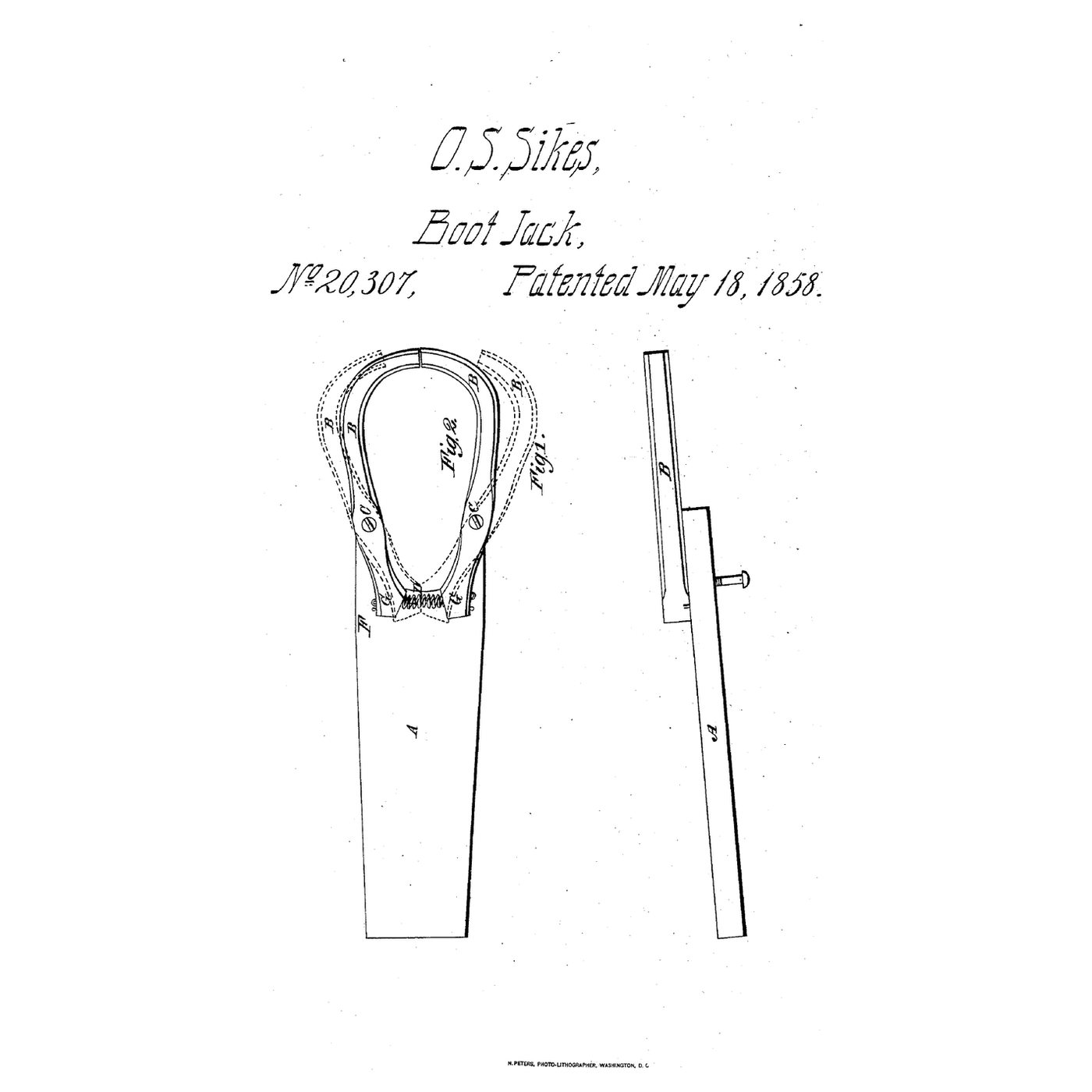
Orson S. Sikes of Suffield, Connecticut, received US 20,307, dated 18 May 1858, for a boot-jack with clamps fixed to it "so that as the foot or heel portion of the boot is brought back into the jack the heel portion of the clamps open against pins or stops, and cramps the heel of the boot, while at the same time the toe portion of the clamps close over the toe of the boot, and thus holds the boot while it is being drawn off." A spring keeps the clamps open until the heel arrives.
This rung works out how the heel's push becomes grip on the toe, then bends the clamps from flat bar and compares the jack with a plain one.
Intermediate
About 3 hours
Instructions
1
1
Clamp lever ratio
Clamp lever ratio
Loading Jupyter Notebook...
2
2
The jack before it
The jack before it
The embedded blueprint holds the toe with a shaft worked by the hand. Sikes's clamps are closed by the heel itself, leaving both hands free.
3
3
Read US 20,307
Read US 20,307
"A is the jack as ordinarily constructed. B, B, are the clamps, C, C, are the screws, by which they are secured to the jack. D is a spring secured in or to the heel end of the clamps to keep the clamps open in readiness for use. F are pins or stops placed at suitable distance apart for the heel portion of the clamps to rest against and the heel of the boot being firmly compressed therein, and the toe of the boot is held down by the toe portion of the clamps G."
4
4
Build the jack and take a boot off
Build the jack and take a boot off
**Jack.** Saw a board 45 × 15 cm from hardwood board and screw a block under it 15 cm from one end so that end stands up off the floor.
**Clamps.** Cut two 40 cm lengths of 20 × 3 mm mild steel flat bar. Heat and bend each in the vice into half of a boot-shaped loop: a short heel end, a curve round the side of the foot, and a toe end that turns in over the toe. Drill each for a pivot screw about a third of the way from its heel end.
**Fit.** Screw the clamps onto the raised end of the board with washers, loose enough to swing, so their heel ends meet at the back and their toe ends are open. Drive two nails as the stops the heel ends rest against. Fit a small compression spring between the heel ends so they stand open.
**Test.** Wearing a rubber boot, slide the heel back into the clamps and check that the toe ends close over the toe. Time taking the boot off, and compare with a plain boot jack.
Materials for this step:
 Hardwood Board1 piece
 Hardwood Block1 piece
 Mild Steel Flat Bar0.8 meter
 Wood Screws6 pieces
 Flat Washer4 pieces
 Nails2 pieces
 Compression Spring Assortment1 piece
Tools needed:
 Hand Saw
 Hacksaw
 Propane Torch
 Bench Vise
 Hammer
 Cordless Drill
 Drill Bit Set
 Files (Hand File)
 Screwdriver Set
 Stopwatch
 Rubber Boots
 Boot Jack
 Leather Work Gloves
 Clear Safety Glasses
5
5
Clamps that stay open, pinch or lift off
Clamps that stay open, pinch or lift off
Spring-clamp bootjack troubleshooting.
Flow
Loading...
6
6
History and honest limits
History and honest limits
**Orson S. Sikes** of Suffield, Hartford County, Connecticut, received US 20,307, dated 18 May 1858. He claimed the arrangement of the clamps, spring and pins, and pointed to the ease of taking a boot off "in a natural manner".
**Honest limits.** Bent flat bar, wood screws and a compression spring stand in for his clamps, screws and spring. The notebook treats each clamp as a straight lever; its force and lengths are examples. Your times are the result.
Materials
7- 1 piecePlaceholder
- 1 piecePlaceholder
- 0.8 meterPlaceholder
- 6 piecesPlaceholder
- 4 piecesPlaceholder
- 2 piecesPlaceholder
- Placeholder
Tools Required
14- Placeholder
- Placeholder
- Placeholder
- Placeholder
- Placeholder
- Cordless Drill3% commissionMagento Legacy Storeships internationallyPlaceholder
- Placeholder
- Placeholder
- Placeholder
- Placeholder
- Placeholder
- Placeholder
- Placeholder
- Placeholder
This blueprint makes
Related Blueprints
These blueprints share knowledge with this one — techniques, materials, or principles that connect them in the learning graph.



CC0 Public Domain
This blueprint is released under CC0. You are free to copy, modify, distribute, and use this work for any purpose, without asking permission.
Support the Maker by purchasing products through their Blueprint where they earn a Maker Commission set by Vendors, or create a new iteration of this Blueprint and include it as a connection in your own Blueprint to share revenue.