ARTE
BELLEZA Y BIENESTAR
ARTESANÍA
CULTURA E HISTORIA
ENTRETENIMIENTO
MEDIO AMBIENTE
COMIDA Y BEBIDAS
INGENIERÍA INVERSA
CIENCIAS
DEPORTES
TECNOLOGÍA
TECNOLOGÍA VESTIBLE
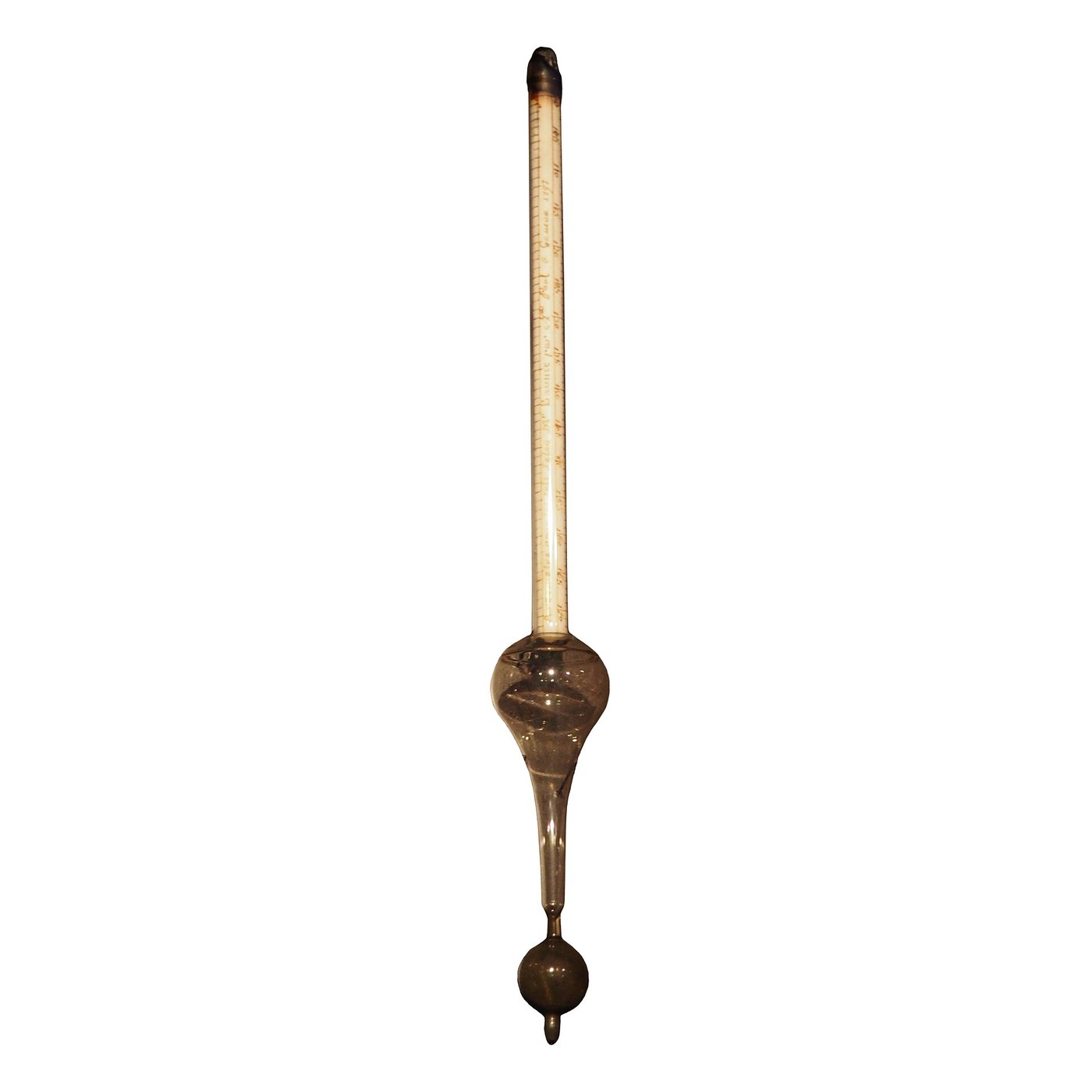


Glass Hydrometer: Blown, Weighted with Shot, Calibrated in Known Liquids
A hydrometer is a glass float with a thin stem: it sinks deeper in light liquids and rides higher in dense ones, so a scale on the stem reads specific gravity. Baumé fixed his scale at two points, pure water and 15 % brine (Ure, 1839); here the scale is marked in sugar solutions of known strength, giving degrees Brix, and in liquids weighed for their specific gravity.
The picture: an old glass hydrometer with a paper scale inside its stem and a ballast bulb below.
Avanzado
A day
Instrucciones
1
1
Blow the float
Blow the float
On a tube, blow an elongated bulb, then a small second bulb below it for ballast, and draw the tube above into a thin, even stem.
Materiales para este paso:
 Kit de tubos de vidrio1 pieza
Herramientas necesarias:
 Soplete de vidriero de mesa
 Gafas de seguridad
 Guantes resistentes al calor
2
2
Ballast and scale paper
Ballast and scale paper
Drop small lead shot into the lower bulb until the float stands upright in water with most of the stem out. Slide a paper strip into the stem.
Materiales para este paso:
 Lingote de plomo50 g
 Papel1 pieza
Herramientas necesarias:
 Balanza de platillos
3
3
Seal the top
Seal the top
Heat the top of the stem and draw it closed. Check that it floats upright and does not leak.
Herramientas necesarias:
Soplete de vidriero de mesaGafas de seguridad4
4
Mark the water point
Mark the water point
Float it in water at room temperature in the cylinder and mark where the surface cuts the stem: specific gravity 1.000 and 0 °Brix.
Materiales para este paso:
 Agua1 litro
Herramientas necesarias:
 Probeta graduada
 Termómetro
 Punta de trazar de diamante
5
5
Mark the other points
Mark the other points
Make sugar solutions by weight (see the notebook) and salt brines; float the hydrometer in each and mark the stem. Weigh 100 mL of each liquid to write its specific gravity beside the mark. Copy the marks onto the paper strip in ink and reseal if you opened it.
Materiales para este paso:
 Azúcar blanco0.3 kg
 Sal0.3 kgAgua2 litros
 Tinta ferrogálica2 ml
Herramientas necesarias:
Balanza de platillosProbeta graduada Pluma de ave
6
6
Calibration liquids
Calibration liquids
Cargando el cuaderno de Jupyter…
7
7
Limits
Limits
Ure's two-point Baumé principle and the Brix definition are sourced; the bulb form, shot ballast and weighing method are ours. Read at the temperature you calibrated at; this hydrometer has no potential-alcohol scale.
Materiales
7- 1 piezaMarcador de posición
- 50 gMarcador de posición
- 1 piezaMarcador de posición
- 3 litrosMarcador de posición
- 0.3 kgMarcador de posición
- 0.3 kgMarcador de posición
- Marcador de posición
Herramientas requeridas
8- Marcador de posición
- Marcador de posición
- Marcador de posición
- Marcador de posición
- Marcador de posición
- Marcador de posición
- Marcador de posición
- Marcador de posición
Este plano hace
Blueprints relacionados
Estos blueprints comparten conocimiento — técnicas, materiales o principios

CC0 Dominio público
Este Blueprint se publica bajo CC0. Eres libre de copiar, modificar, distribuir y usar este trabajo para cualquier propósito, sin pedir permiso.
Apoya al Maker comprando productos a través de su Blueprint, donde gana una Comisión del Maker establecida por los vendedores, o crea una nueva iteración de este Blueprint e inclúyela como conexión en tu propio Blueprint para compartir ingresos.