Colaboración
ARTE
BELLEZA Y BIENESTAR
ARTESANÍA
CULTURA E HISTORIA
ENTRETENIMIENTO
MEDIO AMBIENTE
COMIDA Y BEBIDAS
INGENIERÍA INVERSA
CIENCIAS
DEPORTES
TECNOLOGÍA
TECNOLOGÍA VESTIBLE
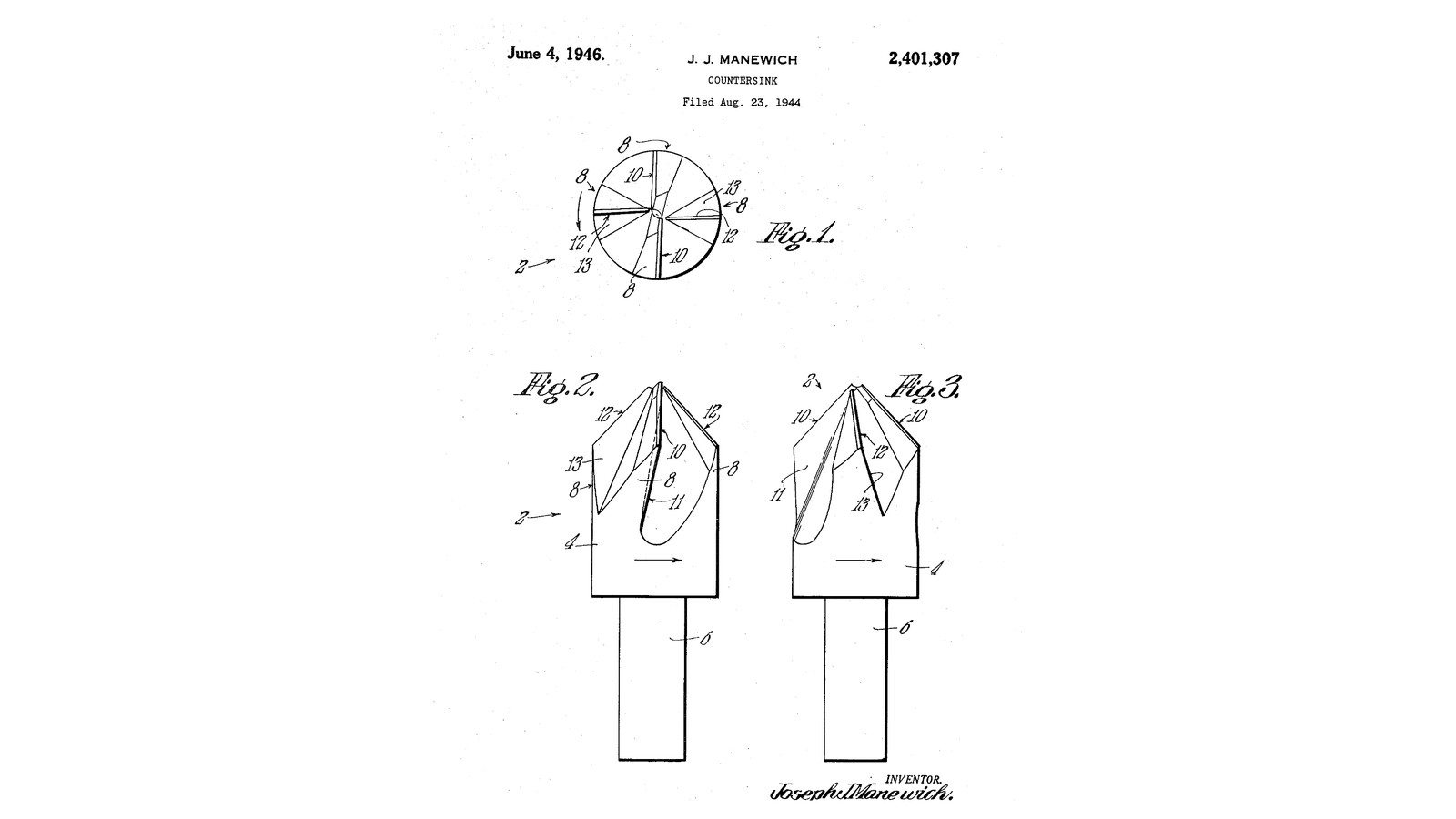


Four-Edge Chatterless Countersinks: Two Pairs of Edges Set Off the Centre Lines, One Raked Each Way (Manewich, 1946)
Joseph J. Manewich of Longmeadow, Massachusetts, received US 2,401,307, dated 4 June 1946, for a countersink that does not chatter. Four teeth are gashed in the cone. The inner ends of one pair of edges sit just ahead of a line through the centre, with their faces raked back. The other pair sit just behind a line at right angles, raked forwards. The edges keep changing how they meet the work as the tool goes in, and each steadies the one opposite, so it can run faster and leaves round, smooth countersinks.
We make a set of three in tool steel. The patent gives no sizes or angles; ours are stated.
Avanzado
About 1 day
Instrucciones
1
1
Why the edges are set off the centre lines
Why the edges are set off the centre lines
Cargando el cuaderno de Jupyter…
2
2
Read US 2,401,307
Read US 2,401,307
"It has been found that the countersink tool by reason of its novel construction and arrangement may be operated at a higher speed than may those of the prior art while at the same time objectionable chatter is eliminated."
3
3
Turn the blanks
Turn the blanks
From octagonal tool steel turn three blanks: a 90 degree cone to a point, 12, 16 and 20 mm across, a short body 4 and an 8 mm shank 6 50 mm long with three filed flats. Heat each to a cherry red and let it cool slowly in the air.
Materiales para este paso:
 Barra octogonal de acero para herramientas2 piezas
Herramientas necesarias:
 Torno de metal
 Plato de torno de 3 mordazas
 Herramienta de corte para torno
 Gubia de tronzar
 Transportador de ángulos
 Calibre digital de 6 pulgadas
 Juego de limas
 Fragua
 Tenazas de fragua
 Gafas de seguridad
4
4
Mark and gash the four teeth 8
Mark and gash the four teeth 8
Blue the cone and scribe two diameters across its end at right angles. Mark the positive pair's edges 10 parallel to the first diameter, 0.5 mm ahead of it in the direction of turning, and the negative pair's edges 12 parallel to the second, 0.5 mm behind it. File or grind a gash 11 ahead of each edge, down the cone: for the edges 10 the face raked back about 8 degrees (positive), for the edges 12 raked forward about 5 degrees (negative). Give each edge a little clearance behind it.
Herramientas necesarias:
 Juego de limas de aguja
 Mordaza de máquinaJuego de limas
 Esmeril de bancoTransportador de ángulos
5
5
Harden and temper
Harden and temper
Heat each head to a cherry red, until a magnet no longer sticks, and quench it point first in water, moving it about. Rub it bright with a stone, heat the shank gently 20 mm behind the head, and quench again as soon as a light straw colour reaches the cutting edges.
Herramientas necesarias:
FraguaTenazas de fragua Imán pequeño
 Cubo de temple
 Agua
 Piedra de afilar
 Guantes de soldadorGafas de seguridad
6
6
Hone and test
Hone and test
Hone all four edges lightly with the stone. Countersink holes in hardwood and in a scrap of aluminium at a higher speed than usual: the cone should be round and smooth, with no chatter marks.
Herramientas necesarias:
Piedra de afilar Taladro inalámbrico
 Juego de brocas
 Tabla de madera duraGafas de seguridad
7
7
Troubleshooting
Troubleshooting
Four-edge countersink troubleshooting.
Flow
Loading...
8
8
History and honest limits
History and honest limits
**Joseph J. Manewich** of Longmeadow, Massachusetts, US 2,401,307, dated 4 June 1946, filed 23 August 1944. He claimed cutting edges in two pairs, "the innermost portions of the cutting edges of one pair thereof disposed adjacent said longitudinal axis and forwardly" of a plane through it, and those of the other pair "rearwardly" of another plane at right angles. He calls the first positive edges with positive rake and the second negative with negative rake. He gives no sizes, offsets or angles; ours are stated, with the house hardening.
Materiales
1- Marcador de posición
Herramientas requeridas
21- Marcador de posición
- Marcador de posición
- Marcador de posición
- Marcador de posición
- Marcador de posición
- Marcador de posición
- Marcador de posición
- Marcador de posición
- Marcador de posición
- Marcador de posición
- Marcador de posición
- Marcador de posición
- Marcador de posición
- Marcador de posición
- Marcador de posición
- Marcador de posición
- Marcador de posición
- Marcador de posición
- 1 vendor sell this, none ship to you yetMarcador de posición
- Marcador de posición
- Marcador de posición
Este plano hace

Blueprints relacionados
Estos blueprints comparten conocimiento — técnicas, materiales o principios
CC0 Dominio público
Este Blueprint se publica bajo CC0. Eres libre de copiar, modificar, distribuir y usar este trabajo para cualquier propósito, sin pedir permiso.
Apoya al Maker comprando productos a través de su Blueprint, donde gana una Comisión del Maker establecida por los vendedores, o crea una nueva iteración de este Blueprint e inclúyela como conexión en tu propio Blueprint para compartir ingresos.