ARTE
BELLEZA Y BIENESTAR
ARTESANÍA
CULTURA E HISTORIA
ENTRETENIMIENTO
MEDIO AMBIENTE
COMIDA Y BEBIDAS
INGENIERÍA INVERSA
CIENCIAS
DEPORTES
TECNOLOGÍA
TECNOLOGÍA VESTIBLE
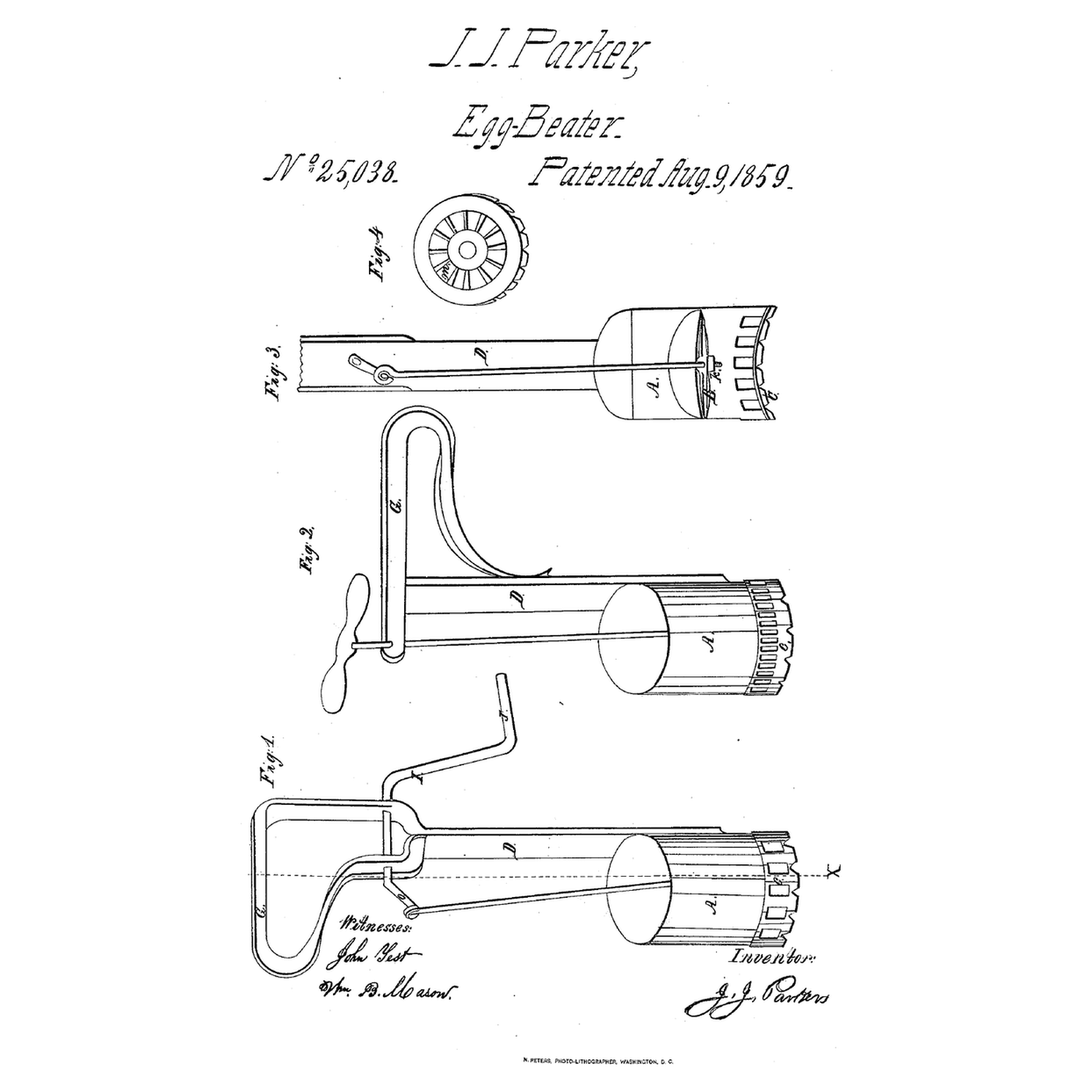


Piston-Pump Egg Beater: Pump the Eggs Through a Grate
A whisk stirs the eggs; it does not force them through anything.
J. J. Parker of Marietta, Ohio, received US 25,038, dated 9 August 1859, for an egg beater and churn combined: a tin tube with square openings at its lower end and a piston inside, worked up and down "in the manner of a pump" by a crank, which "draws the eggs in and out through the grate bars until they are completely torn in pieces or made perfectly fine and frothy"; a band turned round the tube's foot closes the openings to vary the agitation.
This rung works out the jet speed at each band setting, then prints the tube, band and piston, fits the crank, and times a beating at two settings.
Intermedio
About 3 hours, plus printing
Instrucciones
1
1
Jet speed at each setting
Jet speed at each setting
Cargando el cuaderno de Jupyter…
2
2
The churning it also does
The churning it also does
The embedded blueprint churns cream to butter. Parker's pump-tube does the same when worked longer in cream.
3
3
Read US 25,038
Read US 25,038
"At the lower end of the tube is a band of about one half an inch in width loosely fitted with openings one fourth of an inch square and corresponding exactly with the openings in the tube and of the same size, so that by turning the band around either way the openings are closed or made smaller at pleasure, so as to produce more or less agitation in the eggs or cream. This band has a bottom with grate like bars cut or made in it."
4
4
Print the tube, band and piston
Print the tube, band and piston
Print the tube, the band with its grate and the piston disk. Print in PETG at 0.2 mm layers, 30 % infill, 4 walls.
Materiales para este paso:
 Filamento PETG1 pieza
Herramientas necesarias:
 Impresora 3D de filamento (FDM)
5
5
Print the tube
6
6
Print the band
7
7
Print the piston
Print the piston
The piston, printed as step 4 describes.
8
8
Pack the piston
Pack the piston
Cut a leather disk 2 mm larger than the piston. Clamp it between the printed disk and a washer on an M3 rod end with a nut, so its edge seals the tube.
Materiales para este paso:
 Cuero1 pieza
 Arandela plana1 pieza
 Tuerca hexagonal1 pieza
 Tornillos de máquina1 pieza
Herramientas necesarias:
 Cúter de precisión
 Llave inglesa ajustable
 Calibre digital de 6 pulgadas
9
9
Post and crank
Post and crank
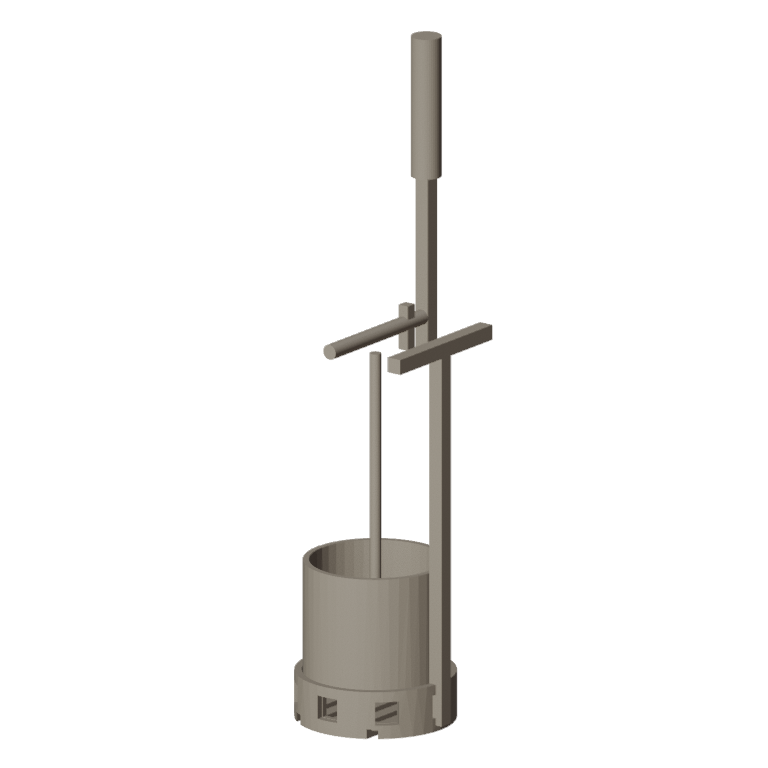
Epoxy a 4 mm wire post up the tube's side, bent at its top into bearings 100 mm above the tube. Bend a crank shaft of 3 mm wire with a 22 mm crank one end and a handle the other, and link the crank to the rod with a wire pitman.
Materiales para este paso:
 Redondo de acero dulce1 pieza
 Alambre de acero inoxidable1 pieza
 Epoxi de dos componentes1 pieza
Herramientas necesarias:
 Tornillo de banco
 Alicates de punta redonda
 Alicates de boca plana
 Sierra para metales
 Gafas de seguridad transparentes
10
10
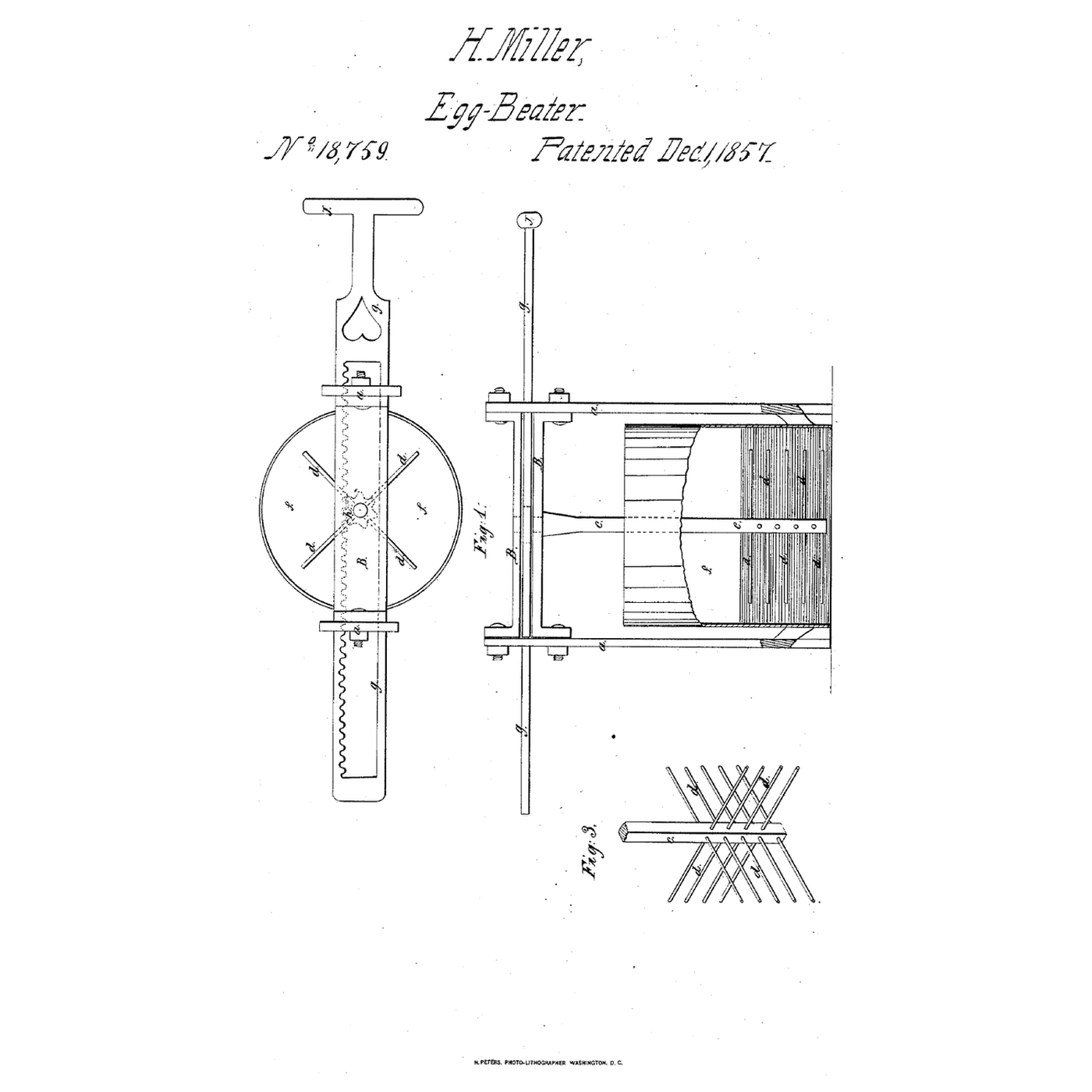
The patent drawing
The patent drawing
US 25,038 drawing sheet, public domain (expired patent).
11
11
Beat at two settings
Beat at two settings
Stand the beater in a bowl with two eggs and a spoon of sugar. Crank twice a second with the band fully open and time to a fine froth; repeat with the band half closed.
Materiales para este paso:
 Huevo4 piezas
 Azúcar granulado1 pieza
Herramientas necesarias:
 Bol grande de acero inoxidable
 Cronómetro
12
12
A pump that leaks past, sticks or splashes
A pump that leaks past, sticks or splashes
Piston-pump egg beater troubleshooting.
Flow
Loading...
13
13
History and honest limits
History and honest limits
**J. J. Parker** of Marietta, Ohio, received US 25,038, dated 9 August 1859. His smaller machine's tube is one and a half inches across and one and five eighths deep; the crank shaft is No. 7 wire with a seven-eighths-inch crank; the piston is two oval pieces of thin metal with leather between, its edges forced out by pressing them together. It may also be worked by a handle on the rod instead of a crank.
**Honest limits.** FDM prints hold food in their layer lines, so wash well and replace when worn. Printed PETG stands in for tin. The notebook treats the flow as steady. Your times are the result.
Materiales
10- 1 piezaMarcador de posición
- 1 piezaMarcador de posición
- 1 piezaMarcador de posición
- 1 piezaMarcador de posición
- 1 piezaMarcador de posición
- 1 piezaMarcador de posición
- 1 piezaMarcador de posición
- 1 piezaMarcador de posición
- 4 piezasMarcador de posición
- 1 piezaMarcador de posición
Herramientas requeridas
11- Marcador de posición
- Marcador de posición
- Marcador de posición
- Marcador de posición
- Marcador de posición
- Marcador de posición
- Marcador de posición
- Marcador de posición
- Marcador de posición
- Marcador de posición
- Marcador de posición
Archivos de diseño
3Este plano hace
Blueprints relacionados
Estos blueprints comparten conocimiento — técnicas, materiales o principios



CC0 Dominio público
Este Blueprint se publica bajo CC0. Eres libre de copiar, modificar, distribuir y usar este trabajo para cualquier propósito, sin pedir permiso.
Apoya al Maker comprando productos a través de su Blueprint, donde gana una Comisión del Maker establecida por los vendedores, o crea una nueva iteración de este Blueprint e inclúyela como conexión en tu propio Blueprint para compartir ingresos.