ARTE
BELLEZA Y BIENESTAR
ARTESANÍA
CULTURA E HISTORIA
ENTRETENIMIENTO
MEDIO AMBIENTE
COMIDA Y BEBIDAS
INGENIERÍA INVERSA
CIENCIAS
DEPORTES
TECNOLOGÍA
TECNOLOGÍA VESTIBLE

Rotary-and-Vibrating Dasher Churn: Turn to Churn, Lift and Plunge to Gather
Nash wanted to switch from churning to gathering "without changing the connection of the machinery."
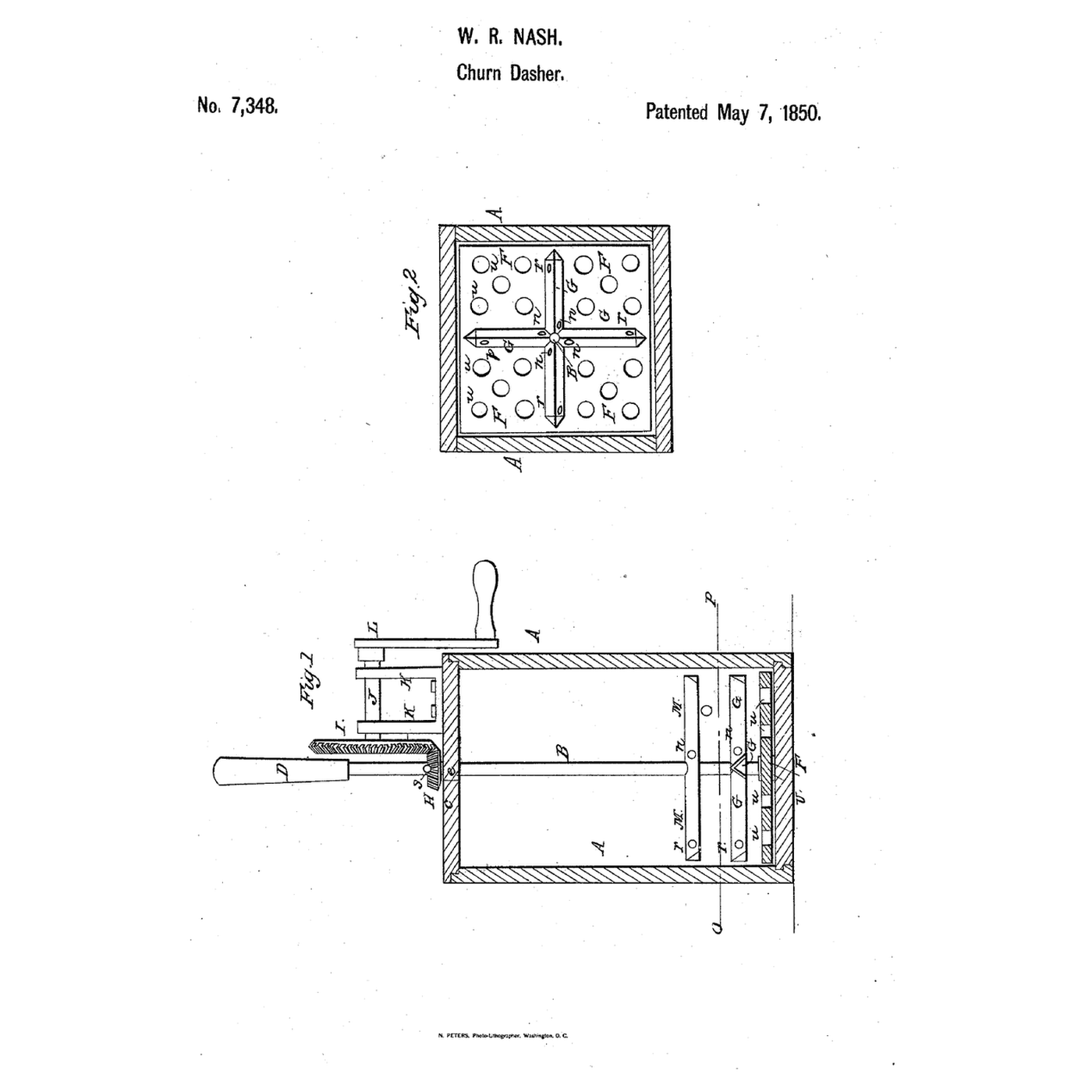
William R. Nash of Bridgeport, Connecticut, received US 7,348, dated 7 May 1850, for working rotary and vertical churn-dashers on one shaft. A rotary dasher of four radial hollow prismatic arms, each with a hole in its forward side near the shaft and an aperture in its rear side near its end, turns above a perforated vibrating dasher held between collars. The pinion on the lid drives the shaft by a pin in a notch, "but the shaft being free to slide vertically upward," the handle on top can work the vibrating dasher up and down.
This rung looks at the hollow arms, then prints both dashers and the notched pinion, fits them in a box, and makes butter.
Intermedio
About 4 hours, plus printing
Instrucciones
1
1
Air through the arms
Air through the arms
Cargando el cuaderno de Jupyter…
2
2
Rotary and reciprocating dashers on one spindle before it
Rotary and reciprocating dashers on one spindle before it
The embedded blueprint works both dashers at once from one crank. Nash uses them one after the other: rotary to churn, vibrating to gather.
3
3
Read US 7,348
Read US 7,348
"The nature of this invention consists, principally in so arranging and combining in the same churn and upon one shaft, a horizontal rotary dasher and a vertically vibrating dasher, that while the rotary dasher is operated for the purpose of agitating the cream, the vibrating dasher remains at rest; and that when the butter is produced, the vibrating dasher may be operated for the purpose of gathering or consolidating the butter."
4
4
Print the parts
Print the parts
Print the rotary dasher with its four hollow triangular arms, the perforated vibrating dasher, the notched pinion and the crank arm. Print in PETG at 0.2 mm layers, 30 % infill, 4 walls; wash before first use.
Materiales para este paso:
 Filamento PETG1 pieza
Herramientas necesarias:
 Impresora 3D de filamento (FDM)
5
5
Print the rotary dasher
Print the rotary dasher
The rotary dasher, printed as step 4 describes.
6
6
Print the vibrating dasher
Print the vibrating dasher
The vibrating dasher, printed as step 4 describes.
7
7
Print the notched pinion
Print the notched pinion
The notched pinion, printed as step 4 describes.
8
8
Print the crank arm
Print the crank arm
The crank arm, printed as step 4 describes.
9
9
Shaft and dashers
Shaft and dashers
Use a 12 mm hardwood dowel as the shaft, squared where the rotary dasher sits. Glue two collars of short dowel on it either side of the vibrating dasher so it is carried up and down but turns freely, and glue the rotary dasher 30 mm above. Drill a cross hole for a steel pin just above where the pinion will sit, and fit a handle on top.
Materiales para este paso:
 Espigas de madera dura1 pieza
 Redondo de acero dulce1 pieza
 Cola de carpintero1 pieza
Herramientas necesarias:
 Serrucho
 Taladro inalámbrico
 Juego de brocas
 Sierra para metales
10
10
Lid, pinion and crank
Lid, pinion and crank
Take a food-safe square box about 170 mm each way and cut a two-part plywood lid, one part removable. Seat the pinion on the lid round the shaft, the pin lying in its notch. Mount a crown wheel on a short crank shaft between two posts on the lid so its pegs mesh the pinion, as his gear wheel I, and fit the crank arm.
Materiales para este paso:
 Recipiente de almacenaje de grado alimentario1 pieza
 Tablero contrachapado1 pieza
 Tabla de pino1 piezaEspigas de madera dura1 pieza
 Tornillo para madera n.º 8 x 1"1 pieza
Herramientas necesarias:
 Segueta (sierra de marquetería)Taladro inalámbrico
 Juego de destornilladores
11
11
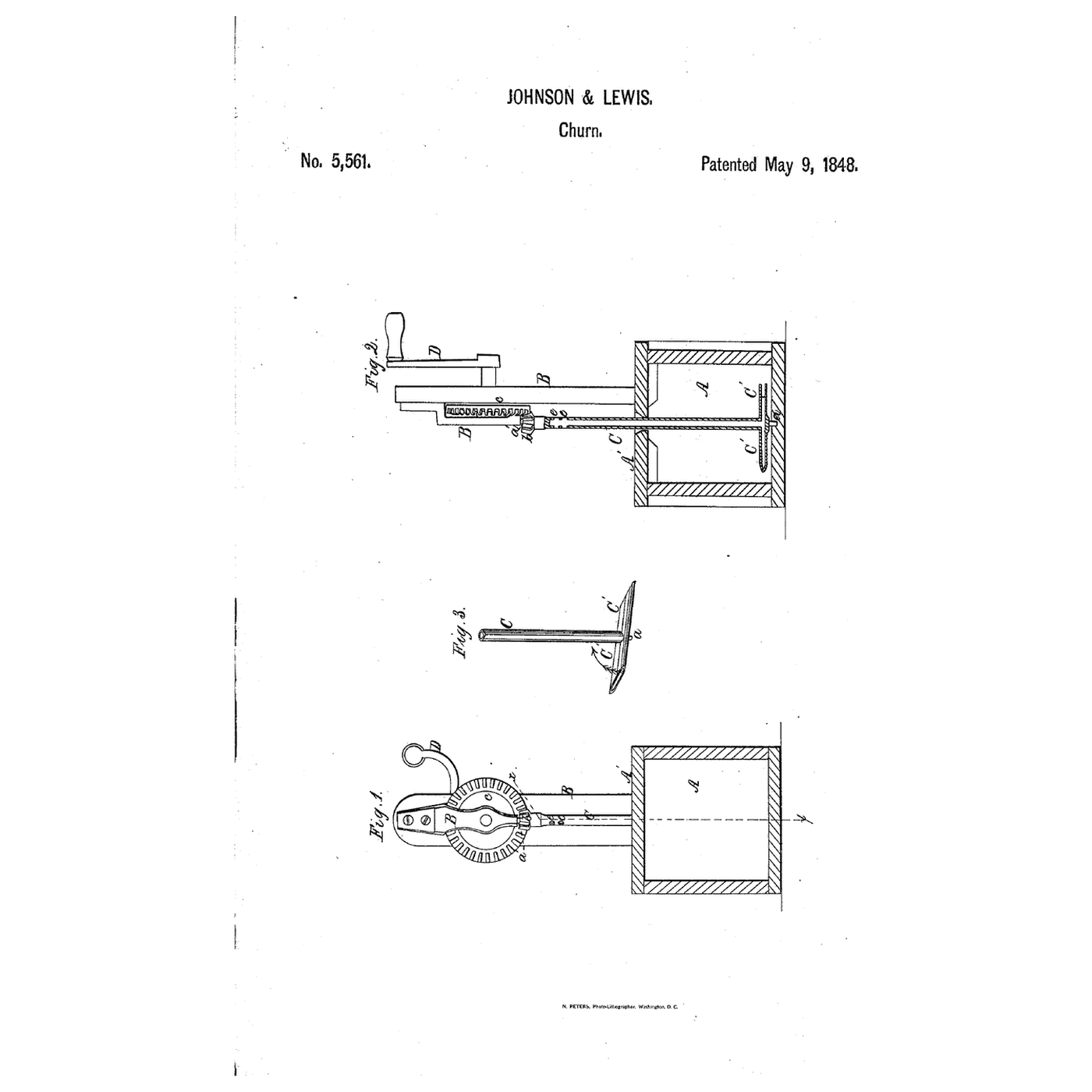
The patent drawing
The patent drawing
US 7,348 drawing sheet, public domain (expired patent).
12
12
Churn by crank, gather by hand
Churn by crank, gather by hand
Let the heavy cream stand until it reaches about 15 °C, checked with the thermometer. Pour in 1.5 litres. Turn the crank; time until the butter comes. Then work the handle up and down, so the vibrating dasher gathers the butter while the gearing rests. Pour off the buttermilk, add cold water, churn a little and pour off again until it runs clear; work in a pinch of salt and weigh the butter.
Materiales para este paso:
 Crema de leche espesa1500 ml
 Sal marina gruesa1 pieza
 Agua1 pieza
Herramientas necesarias:
 Termómetro de sonda permanente
 Cronómetro
 Báscula digital de cocina
 Bol grande de acero inoxidable
13
13
A pin that jumps, a dasher that turns
A pin that jumps, a dasher that turns
Rotary-and-vibrating dasher troubleshooting.
Flow
Loading...
14
14
History and honest limits
History and honest limits
**William R. Nash** of Bridgeport, Fairfield County, Connecticut, received US 7,348, dated 7 May 1850. His lid was in two parts so one could be removed "without disturbing" the other; "one or more additional rotary dashers, may be attached to the vertical shaft." He claimed the application of the shaft to give a vertical reciprocating movement to the vibrating dasher and a rotary one to the others, so either can be used.
**Honest limits.** A pegged crown wheel and pinion stand in for his gear wheel and pinion; a food-safe box and printed dashers for his. FDM prints hold food in their layer lines, so wash well and replace when worn. Your times and weights are the result.
Materiales
11- 1 piezaMarcador de posición
- 1 piezaMarcador de posición
- 1 piezaMarcador de posición
- 1 piezaMarcador de posición
- Marcador de posición
- 1 piezaMarcador de posición
- 1 piezaMarcador de posición
- Marcador de posición
- 1500 mlMarcador de posición
- 1 piezaMarcador de posición
- 1 piezaMarcador de posición
Herramientas requeridas
11- Marcador de posición
- Marcador de posición
- 1 vendor sell this, none ship to you yetMarcador de posición
- Marcador de posición
- Marcador de posición
- Marcador de posición
- Marcador de posición
- Marcador de posición
- Marcador de posición
- Marcador de posición
- Marcador de posición
Archivos de diseño
4Este plano hace
Blueprints relacionados
Estos blueprints comparten conocimiento — técnicas, materiales o principios
Double-Motion Dasher Churn: One Crank Spins One Dasher and Plunges the Other
por Emma
COMIDA Y BEBIDAS
29
0
0
0
0
0
Whirl-Frame Air Dasher Churn: Free Wheels Spun by the Milk Inside a Revolving Frame
por Martin
COMIDA Y BEBIDAS
32
0
0
0
0
0
Hollow-Arm Air Churn: A Spinning Dasher That Breathes Air Into the Cream
por Emma
COMIDA Y BEBIDAS
29
0
0
0
0
0
CC0 Dominio público
Este Blueprint se publica bajo CC0. Eres libre de copiar, modificar, distribuir y usar este trabajo para cualquier propósito, sin pedir permiso.
Apoya al Maker comprando productos a través de su Blueprint, donde gana una Comisión del Maker establecida por los vendedores, o crea una nueva iteración de este Blueprint e inclúyela como conexión en tu propio Blueprint para compartir ingresos.