Colaboración
ARTE
BELLEZA Y BIENESTAR
ARTESANÍA
CULTURA E HISTORIA
ENTRETENIMIENTO
MEDIO AMBIENTE
COMIDA Y BEBIDAS
INGENIERÍA INVERSA
CIENCIAS
DEPORTES
TECNOLOGÍA
TECNOLOGÍA VESTIBLE
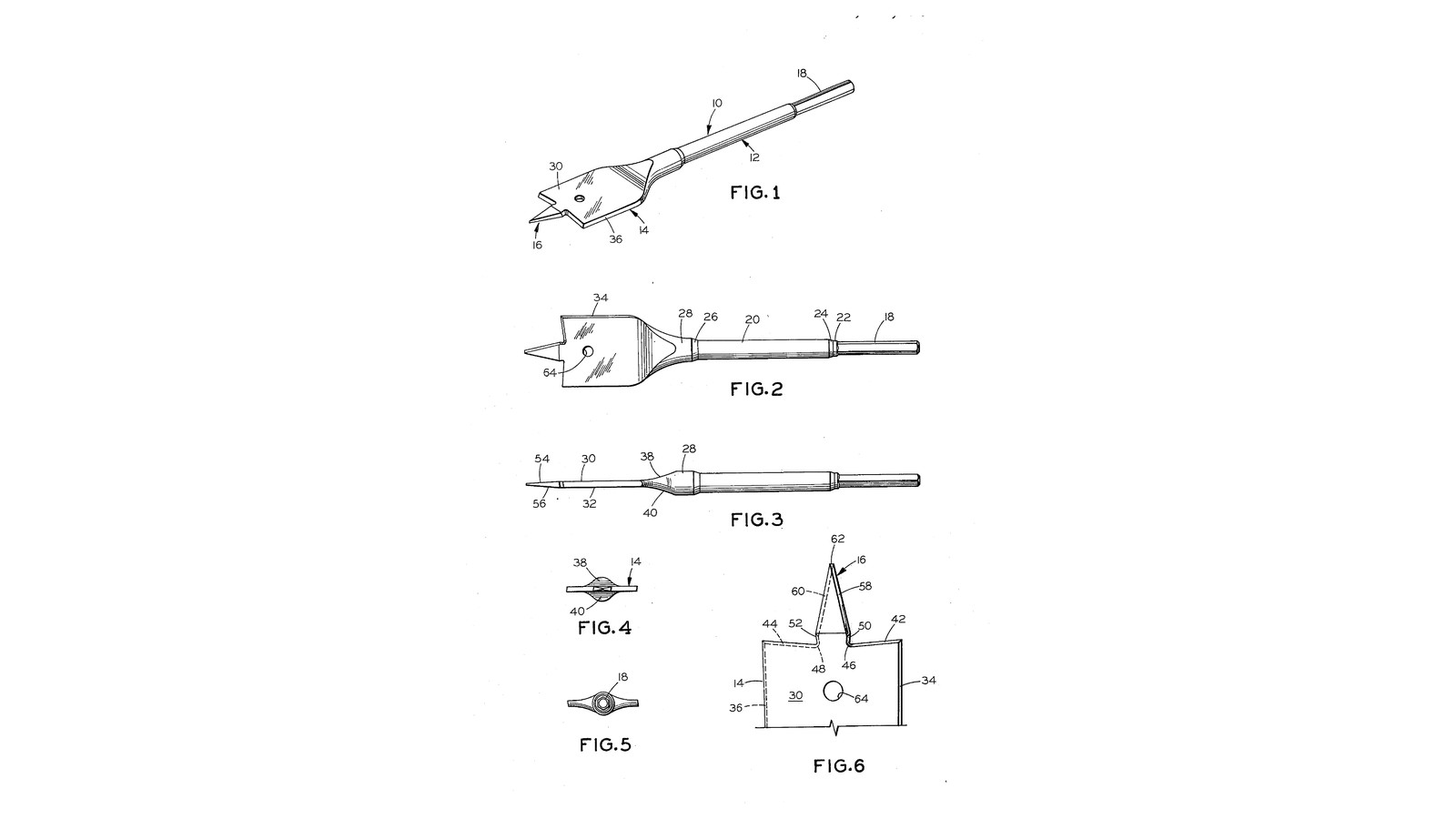


Diamond-Point Spade Bits: A Thinned, Wide-Angled Point Does More of the Cutting (Southall, 1975)
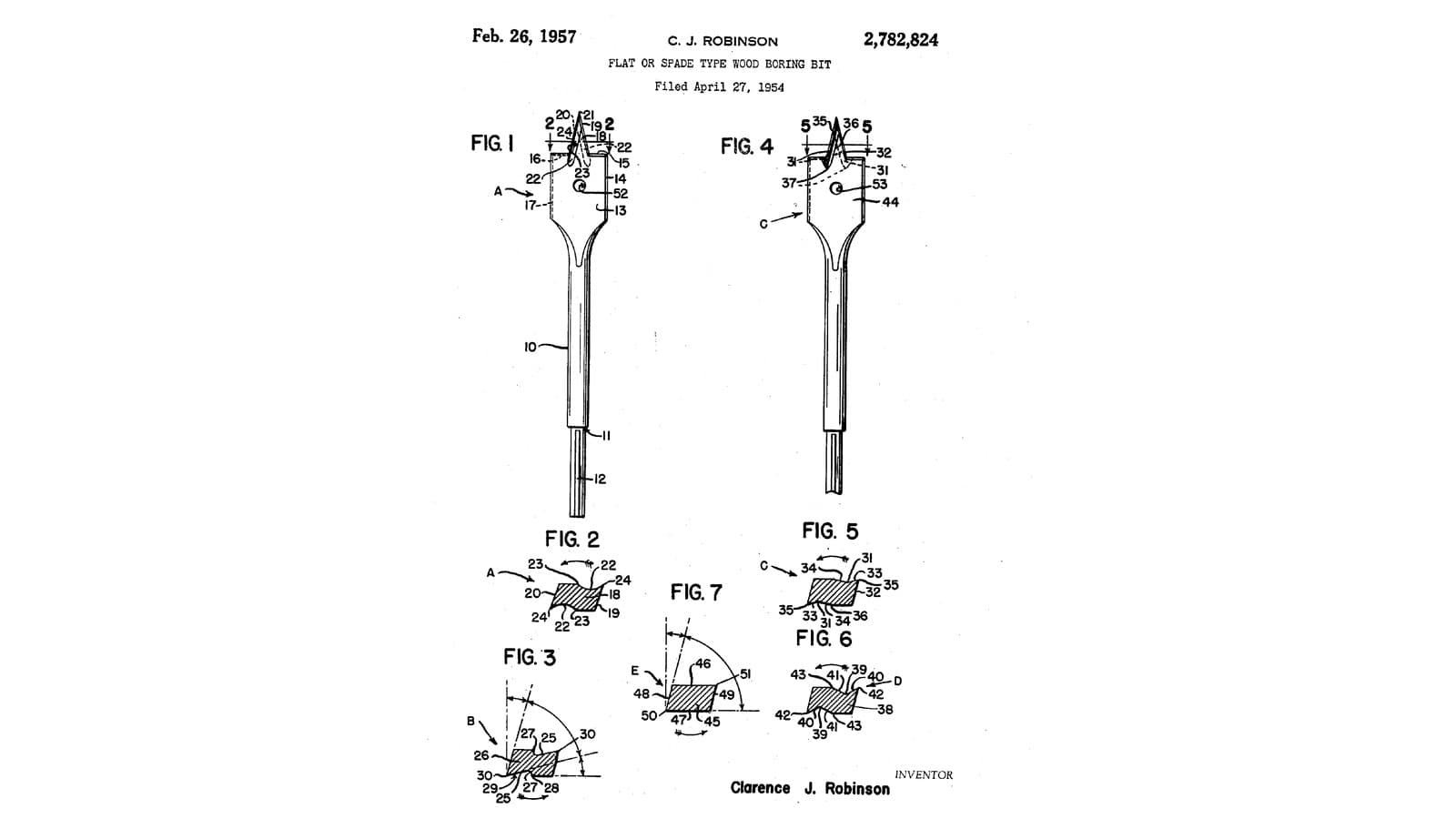
William Southall of Moonah, Australia, invented this spade bit. US 3,920,350, dated 18 November 1975 and assigned to The Stanley Works, was granted after his death. The point is diamond-shaped in section. It flares out slightly where it leaves the blade, then closes at a large angle, and its faces are ground thinner towards the tip. So it cuts more and the blade's edges less. The cutting edges lean forward towards the outside and are bevelled opposite ways. The corners at the root of the point are undercut, because sharp corners there cut poorly.
His figures are for a one-inch bit; we forge 5/8, 3/4 and 1 inch bits with his point and angles.
Intermedio
About 1 day
Instrucciones
1
1
His one-inch figures
His one-inch figures
Cargando el cuaderno de Jupyter…
2
2
Read US 3,920,350
Read US 3,920,350
"As a result of the fact that the point 16 is provided with a relatively large point angle, the point 16 is caused to perform more of the cutting function as compared to that performed by the cutting surfaces 42 and 44 of the blade 14."
3
3
Forge the blades
Forge the blades
Cut three 170 mm lengths of 10 mm octagonal tool steel. Heat 50 mm of one end to a bright orange in the forge and flatten it on the anvil to about 3 mm thick, centred on the bar. Hammer across it with the peen to spread it wider than the bit, about 2 mm over its size: 18, 22 and 27 mm. Draw the neck down smoothly where the blade meets the bar and keep the blade in line with it. Reheat as soon as the colour fades to red. Finally heat each one to a cherry red and let it cool slowly in the air, to soften it for filing.
Materiales para este paso:
 Barra octogonal de acero para herramientas3 piezas
Herramientas necesarias:
 Sierra para metales
 Tornillo de banco
 Fragua
 Yunque
 Martillo de forja
 Tenazas de fragua
 Guantes de soldador
 Gafas de seguridad
4
4
Print the grinding template
Print the grinding template
Full-size A4 template: the outlines of the 5/8, 3/4 and 1 inch bits with Southall's point, forward-leaning cutting edges and tapered sides, and the hanging hole. Print at 100 %; its 50 mm bar must measure 50 mm.
5
5
Grind the outline
Grind the outline
Glue each bit's outline from the template on its blade, centred on the bar. Grind to the lines on the bench grinder, dipping the steel in water often: the two sides parallel, the shoulders square across, the point in the middle. Grind the blade's two faces flat and parallel to 2.5 mm. Grind three flats on the end of the shank, a third of the way round from each other, 20 mm long, for the chuck's jaws. Drill a 3 mm hole through the blade at the template's circle.
Herramientas necesarias:
 Impresora de inyección de tinta
 Cola
 Esmeril de banco
 Cubo de temple
 Agua
 Juego de limasTornillo de banco
 Calibre digital de 6 pulgadasGafas de seguridad
6
6
Grind Southall's bevels and point
Grind Southall's bevels and point
Bevel each side of the blade about 2 degrees, one side from the top face and the other from the bottom face. Bevel the two cutting edges about 10 degrees behind the edge, again opposite ways, so each cuts as the bit turns. Bevel the point's converging edges about 10 degrees the same opposite ways, giving the point its diamond section. Grind the point's top and bottom faces thinner towards the tip until they meet there at about 8 degrees. Round the two corners where the point meets the cutting edges with the edge of a needle file.
Herramientas necesarias:
Esmeril de bancoCubo de templeAgua Juego de limas de agujaTornillo de bancoCalibre digital de 6 pulgadas
7
7
Harden and temper
Harden and temper
Heat the blade and the neck evenly to a cherry red, until a magnet no longer sticks to it, and quench it straight down in water, moving it up and down. Rub the faces bright with a stone. Heat the shank gently 30 mm behind the blade and watch the colours run down; quench again as soon as a dark straw colour reaches the shoulders and the point. Do the other two.
Herramientas necesarias:
FraguaTenazas de fragua Imán pequeñoCubo de templeAgua
 Piedra de afilarGuantes de soldadorGafas de seguridad
8
8
Sharpen and test
Sharpen and test
Hone the cutting edges on the shoulders and the point with the stone, keeping their angles, and take the burr off. Chuck a bit by its flats and bore a scrap of hardwood: it should start on the point without wandering, cut two clean shavings from the shoulders and leave a round hole of its own size; check it with the caliper.
Herramientas necesarias:
Piedra de afilar Taladro inalámbrico
 Tabla de madera duraCalibre digital de 6 pulgadasGafas de seguridad
9
9
Troubleshooting
Troubleshooting
Spade bit troubleshooting.
Flow
Loading...
10
10
History and honest limits
History and honest limits
**William Southall**, deceased, late of Moonah, Australia, by Dorothy I. Southall, administratrix, assignor to The Stanley Works, US 3,920,350, dated 18 November 1975, filed 11 February 1974. He claimed a point "having side edges diverging towards said side edges of said blade and a pair of faces converging to the tip", giving "a generally rhomboidal transverse cross section", with the blade's leading edges inclined towards the point and at opposite angles. His figures are for a one-inch bit and are approximate; we use his point and angles on all three sizes. His shank is round with a hexagonal end; ours is octagonal tool steel with three ground flats. He gives no heat treatment; the hardening is our house practice.
Materiales
1- Marcador de posición
Herramientas requeridas
20- Marcador de posición
- Marcador de posición
- Marcador de posición
- Marcador de posición
- Marcador de posición
- Marcador de posición
- Marcador de posición
- Marcador de posición
- Marcador de posición
- Marcador de posición
- Marcador de posición
- Marcador de posición
- Marcador de posición
- Marcador de posición
- Marcador de posición
- Marcador de posición
- Marcador de posición
- Marcador de posición
- 1 vendor sell this, none ship to you yetMarcador de posición
- Marcador de posición
Archivos de diseño
1Este plano hace

Blueprints relacionados
Estos blueprints comparten conocimiento — técnicas, materiales o principios
CC0 Dominio público
Este Blueprint se publica bajo CC0. Eres libre de copiar, modificar, distribuir y usar este trabajo para cualquier propósito, sin pedir permiso.
Apoya al Maker comprando productos a través de su Blueprint, donde gana una Comisión del Maker establecida por los vendedores, o crea una nueva iteración de este Blueprint e inclúyela como conexión en tu propio Blueprint para compartir ingresos.