Colaboración
ARTE
BELLEZA Y BIENESTAR
ARTESANÍA
CULTURA E HISTORIA
ENTRETENIMIENTO
MEDIO AMBIENTE
COMIDA Y BEBIDAS
INGENIERÍA INVERSA
CIENCIAS
DEPORTES
TECNOLOGÍA
TECNOLOGÍA VESTIBLE
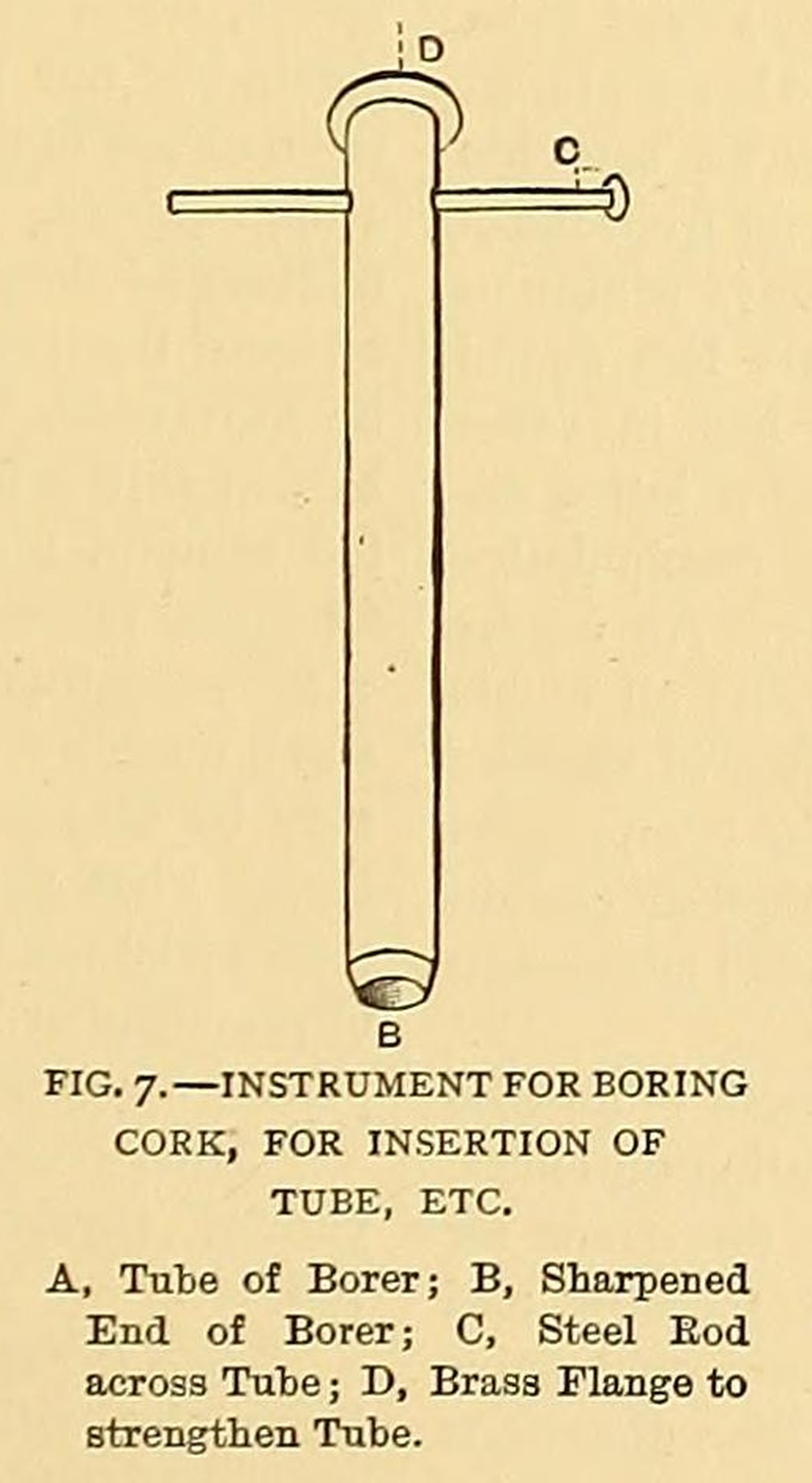


Cork Borer from Brass Tube: Edge Filed Like Two Gouges Back to Back, Steel Wire Handle (Soward, Amateur Work, 1881)
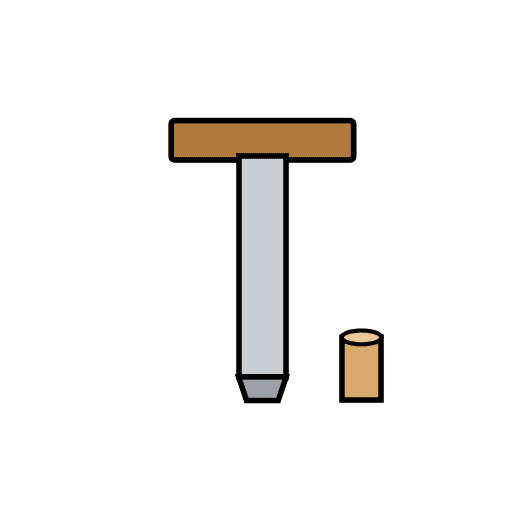
Alfred Soward's laboratory cork-borer from Amateur Work (1881): about 4 in. of brass tube the size of the hole, one end filed on the outside to a ring-shaped cutting edge, a brass flange on the other end to strengthen it, and a steel wire pushed through a cross hole as a handle. Turned like a gimlet, it cuts a clean, centred hole for a glass tube.
Principiante
An hour
Instrucciones
1
1
Read Soward
Read Soward
"This latter instrument is simply a piece of brass tube about 4 in. long, and of a diameter suited to the hole required."
2
2
Cut the tube
Cut the tube
Cut about 4 in. (100 mm) of brass tube whose outside diameter matches the hole you need (he takes 3/8 in., about 10 mm, for a glass tube). Square both ends.
Materiales para este paso:
 Tubo de latón1 pieza
Herramientas necesarias:
 Tornillo de banco
 Sierra para metales
 Limas (lima de mano)
3
3
File the cutting edge
File the cutting edge
File one end on the outside only, all round, to a thin cutting edge: like two gouges put together with their hollow sides facing (B in his fig. 7). Leave the bore untouched.
Herramientas necesarias:
Tornillo de bancoLimas (lima de mano) Limas de aguja
4
4
Fit the flange
Fit the flange
Fit a small brass ring or flange round the other end to strengthen it (D in fig. 7). Ours: cut it from brass sheet and soft-solder it on.
Materiales para este paso:
 Lámina de latón1 pieza
 Alambre de soldadura1 pieza
 Fundente1 pieza
Herramientas necesarias:
 Tijeras de chapa
 Taladro de columna
 Juego de brocas
 Soldador de estaño
5
5
Cross hole and handle
Cross hole and handle
Below the flange, drill a hole straight across the tube for a piece of steel wire. Push the wire through so it stands at right angles to the tube as a handle (C in fig. 7, drawn with a head on one end).
Materiales para este paso:
 Alambre de acero1 pieza
Herramientas necesarias:
Taladro de columnaJuego de brocasLimas (lima de mano)6
6
Troubleshooting
Troubleshooting
Cork borer troubleshooting.
Flow
Loading...
7
7
History and honest limits
History and honest limits
From Alfred W. Soward, "Filters: Their Construction and Maintenance" I, **Amateur Work, Illustrated**, vol. I (1881), pp. 131-133 and fig. 7 (checked on the archive.org scan amateurworkillus11881lond). To use it, hold the cork's small end against a wall or the bench edge, press on the centre of the large end and turn like a gimlet, giving the cork a quarter turn left after each quarter turn of the borer right. A bought set of four then cost 1s. He does not say how the flange is fixed: soft solder, the metric figures and the tools are ours.
Materiales
5- 1 piezaMarcador de posición
- 1 piezaMarcador de posición
- 1 piezaMarcador de posición
- 1 piezaMarcador de posición
- 1 piezaMarcador de posición
Herramientas requeridas
8- Marcador de posición
- Marcador de posición
- Marcador de posición
- Marcador de posición
- Marcador de posición
- Marcador de posición
- Marcador de posición
- 2 vendors sell this, none ship to you yetMarcador de posición
Este plano hace
Blueprints relacionados
Estos blueprints comparten conocimiento — técnicas, materiales o principios

CC0 Dominio público
Este Blueprint se publica bajo CC0. Eres libre de copiar, modificar, distribuir y usar este trabajo para cualquier propósito, sin pedir permiso.
Apoya al Maker comprando productos a través de su Blueprint, donde gana una Comisión del Maker establecida por los vendedores, o crea una nueva iteración de este Blueprint e inclúyela como conexión en tu propio Blueprint para compartir ingresos.