Colaboración
ARTE
BELLEZA Y BIENESTAR
ARTESANÍA
CULTURA E HISTORIA
ENTRETENIMIENTO
MEDIO AMBIENTE
COMIDA Y BEBIDAS
INGENIERÍA INVERSA
CIENCIAS
DEPORTES
TECNOLOGÍA
TECNOLOGÍA VESTIBLE
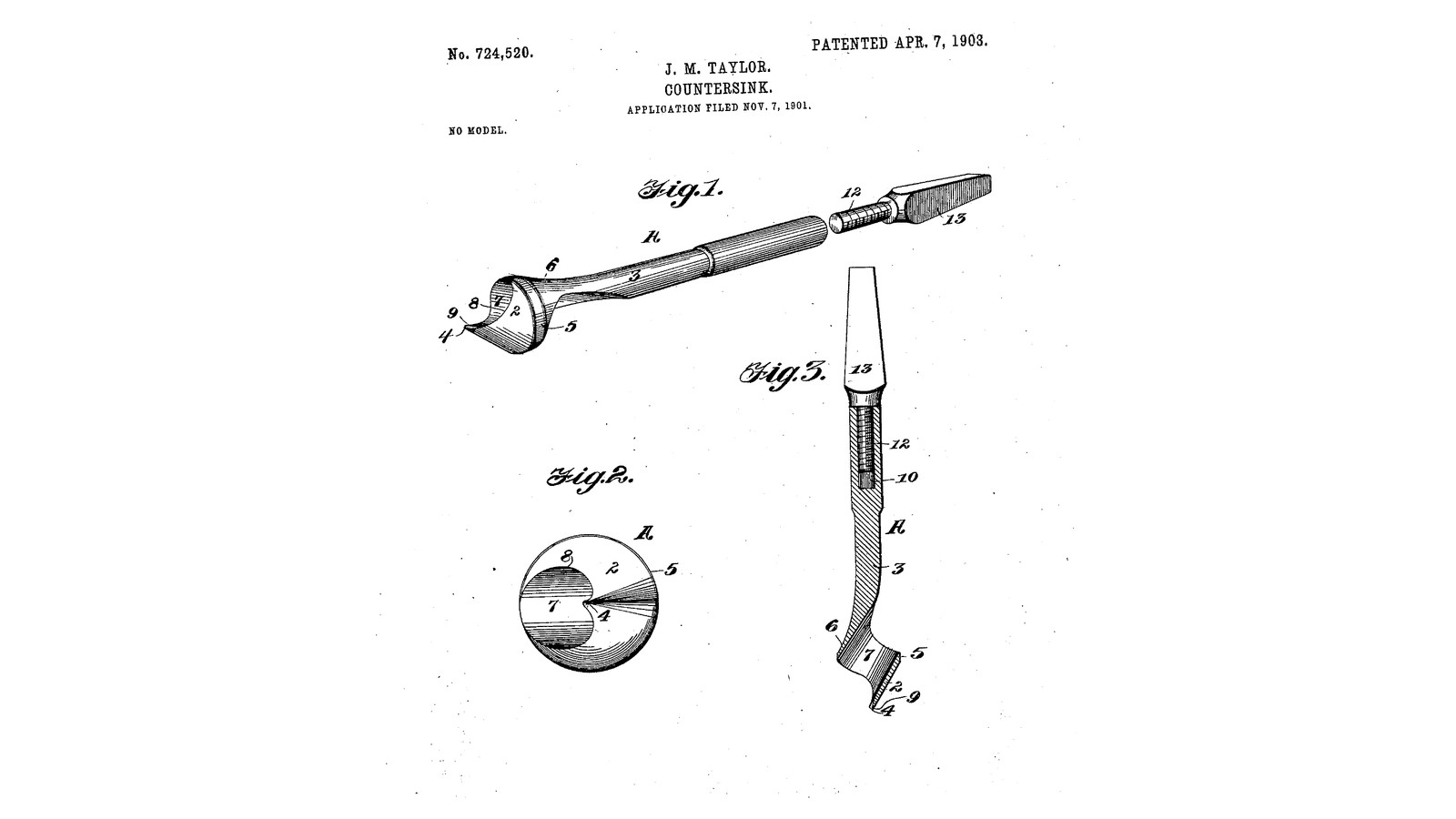


Cross-Hole Countersinks: A Slanting Hole Through the Cone Makes One Spiral Shearing Lip (Taylor, 1903)
John M. Taylor of Hartford, Connecticut, received US 724,520, dated 7 April 1903, for a countersink that shears wood smoothly. Its conical head has a hole drilled through it at a slant that crosses the axis and reaches the point. One edge of that hole is the cutting lip, a spiral curve from the point out to the rim, and the chips go straight out through the hole to the back. A short band behind the cone guides it.
We turn a set of three from tool steel and harden them. The patent gives no sizes; every size here is ours.
Intermedio
About 1 day
Instrucciones
1
1
Where the slanting hole must go
Where the slanting hole must go
Cargando el cuaderno de Jupyter…
2
2
Read US 724,520
Read US 724,520
"One of the outer edges of the wall of the opening forms a cutting-lip 8, which is of spiral formation, whereby it is effective to make a shear cut, and terminates in a shoulder 9, forming an entering or cutting point 4 at the apex of the conical head 2."
3
3
Turn the blanks
Turn the blanks
From octagonal tool steel big enough for each head, turn three blanks: a 90 degree cone 2 to a sharp point, 12, 16 and 20 mm across at its base; a band 5 2 mm long at that diameter as the guide; a truncated cone 6 down to an 8 mm shank 50 mm long. File three flats on each shank's end for the chuck. Heat each to a cherry red and let it cool slowly in the air, to soften it for drilling.
Materiales para este paso:
 Barra octogonal de acero para herramientas2 piezas
Herramientas necesarias:
 Torno de metal
 Plato de torno de 3 mordazas
 Herramienta de corte para torno
 Gubia de tronzar
 Transportador de ángulos
 Calibre digital de 6 pulgadas
 Juego de limas
 Fragua
 Tenazas de fragua
 Gafas de seguridad
4
4
Drill the slanting opening 7
Drill the slanting opening 7
Hold a blank in the machine vice tilted so the drill meets the cone's side at 35 degrees to the tool's axis, aimed to cross the axis just behind the point (the notebook gives how far). Drill through with a drill 0.45 of the head across: 5.5, 7 and 9 mm, so the hole breaks out through the point on one side and out of the back cone on the other. Open the back of the hole a little larger, so it tapers towards the shank.
Herramientas necesarias:
 Taladro de columna
 Mordaza de máquinaTransportador de ángulos
 Juego de brocasCalibre digital de 6 pulgadas
5
5
File the lip 8
File the lip 8
With a round needle file, clean the hole's edge on the side that leads as the countersink turns, leaving it sharp from the point to the band: that is the spiral cutting lip. File a little relief on the cone just behind it, and leave the shoulder 9 at the point.
Herramientas necesarias:
 Juego de limas de agujaMordaza de máquina
 Esmeril de banco
6
6
Harden and temper
Harden and temper
Heat each head to a cherry red, until a magnet no longer sticks, and quench it point first in water, moving it about. Rub it bright with a stone, heat the shank gently 20 mm behind the head, and quench again as soon as a light straw colour reaches the cutting lip.
Herramientas necesarias:
FraguaTenazas de fragua Imán pequeño
 Cubo de temple
 Agua
 Piedra de afilar
 Guantes de soldadorGafas de seguridad
7
7
Hone and test
Hone and test
Hone the lip lightly with the stone. Drill a few screw holes in hardwood and countersink them in the drill: the cone should cut a smooth bell without chatter and the chips should come out of the hole at the back.
Herramientas necesarias:
Piedra de afilar Taladro inalámbricoJuego de brocas
 Tabla de madera duraGafas de seguridad
8
8
Troubleshooting
Troubleshooting
Countersink troubleshooting.
Flow
Loading...
9
9
History and honest limits
History and honest limits
**John M. Taylor** of Hartford, Connecticut, US 724,520, dated 7 April 1903, filed 7 November 1901. He claimed "a countersink having a cone-shaped head provided with an opening crossing diagonally to the axis within the length of the tool and intersecting the apex of the cone, said opening having a curved edge forming a cutting-lip", and a two-part shank for brace or chuck. We make one-piece shanks for a chuck. He gives no sizes, angle or steel; our 90 degree cones, sizes and the house hardening are ours.
Materiales
1- Marcador de posición
Herramientas requeridas
22- Marcador de posición
- Marcador de posición
- Marcador de posición
- Marcador de posición
- Marcador de posición
- Marcador de posición
- Marcador de posición
- Marcador de posición
- Marcador de posición
- Marcador de posición
- Marcador de posición
- Marcador de posición
- Marcador de posición
- Marcador de posición
- Marcador de posición
- Marcador de posición
- Marcador de posición
- Marcador de posición
- Marcador de posición
- Marcador de posición
- 1 vendor sell this, none ship to you yetMarcador de posición
- Marcador de posición
Este plano hace

Blueprints relacionados
Estos blueprints comparten conocimiento — técnicas, materiales o principios
CC0 Dominio público
Este Blueprint se publica bajo CC0. Eres libre de copiar, modificar, distribuir y usar este trabajo para cualquier propósito, sin pedir permiso.
Apoya al Maker comprando productos a través de su Blueprint, donde gana una Comisión del Maker establecida por los vendedores, o crea una nueva iteración de este Blueprint e inclúyela como conexión en tu propio Blueprint para compartir ingresos.