ARTE
BELLEZA Y BIENESTAR
ARTESANÍA
CULTURA E HISTORIA
ENTRETENIMIENTO
MEDIO AMBIENTE
COMIDA Y BEBIDAS
INGENIERÍA INVERSA
CIENCIAS
DEPORTES
TECNOLOGÍA
TECNOLOGÍA VESTIBLE



The Spring-Wedge Bootjack: Press the Wedge and the Platform Clamps the Heel
An open bootjack holds the heel only while the boot is pulled against it, and a tight boot slips out.
Franklin J. French of Whitingham, Vermont, received US 13,002, dated 5 June 1855, for "a new and useful Machine for Holding Boots to be Drawn Off, which I call Spring Boot-jack": a platform in two sections of wood, about fourteen inches long, hinged together on an iron hinge and closed by a spiral spring, raised on a cleat to the height of a heel. A wooden wedge on a steel spring is pressed down between the sections at the far end, which opens them there and "closes the other end around a boot at the heel", section B acting as a lever to clamp it.
This rung works out the wedge and the lever, with a work check, then builds the jack from pine to his dimensions and draws off a boot with it.
Intermedio
About 4 hours
Instrucciones
1
1
Wedge and lever
Wedge and lever
Cargando el cuaderno de Jupyter…
2
2
A lever bootjack before it
A lever bootjack before it
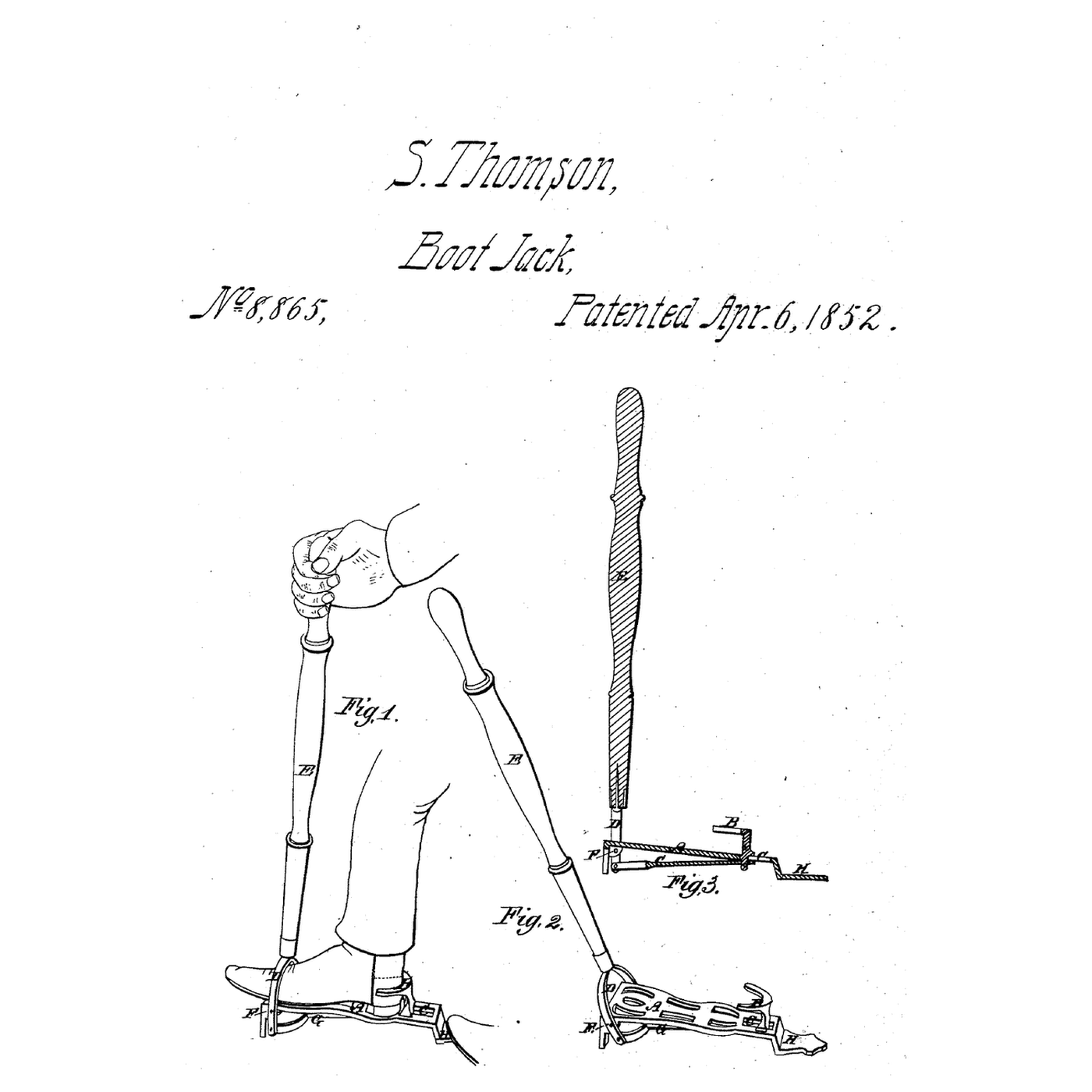
The embedded blueprint holds the heel with a lever and stirrup. French clamps it between two platform sections, closed by a wedge on a spring.
3
3
Read US 13,002
Read US 13,002
"Letters A and B represent the platform or inclined plane in two sections about fourteen inches long and seven-eighths of an inch thick made of wood straight on the edges except about four inches at one end, which end is shaped out on a circle to receive the heel of a boot, the part B of the platform acting as a lever so as to clamp or clasp the heel of the boot when the spring wedge D is pressed down, hereafter described."
"This wedge is to pass in between the two sections of the platforms A, and B, at o, o, there being a small notch cut off the corners of these two sections at o, o, to allow the wedge to enter. As this wedge is pressed down or in between these two sections it opens them and closes the other end around a boot at the heel."
4
4
Build the jack and draw off a boot
Build the jack and draw off a boot
**Sections.** Saw two strips of 22 mm pine (his seven-eighths of an inch) about 36 cm long (fourteen inches), straight-edged, and shape a semicircle in the facing edges of one end to take a heel. Cut small notches off the facing corners at the other end, as o o.
**Hinge and spring.** Near the heel end, under where the cleat will go, join the sections with a 75 mm strip of flat bar as the hinge, let into both and screwed through holes elongated so the sections can move apart, as French's iron hinge through the cleat G. Put a spiral spring of steel wire between them near the heel end so it closes the jack ready for use.
**Cleat.** Screw a hardwood cleat about 11 cm long under the heel end to raise it to a heel's height, and a thin cleat F under section A that supports the end of section B.
**Spring wedge.** Carve a wooden wedge about 45 mm long and 30 mm deep (his 1 3/4 and 1 1/4 inches), screw it to the end of a strip of spring steel about 20 cm long, and screw the strip's other end to section A so the wedge stands over the notches.
**Test.** Set the boot's heel in the opening, stand on the platform with the other foot so it presses the wedge, and draw the foot out of the boot.
Materiales para este paso:
 Tabla de pino1 pieza
 Bloque de madera dura1 pieza
 Pletina de acero dulce0.1 metro
 Tornillos para madera12 piezas
 Alambre de acero para muelles0.3 metro
 Fleje de acero para muelles0.25 metro
Herramientas necesarias:
 Serrucho
 Escofina
 Juego de formones para madera
 Taladro inalámbrico
 Juego de brocas
 Sierra para metales
 Tornillo de banco
 Martillo
 Alicates de punta redonda
 Juego de destornilladores
 Transportador de ángulos
 Botas de cuero
5
5
A jack that slips, sticks or will not open
A jack that slips, sticks or will not open
Spring-wedge bootjack troubleshooting.
Flow
Loading...
6
6
History and honest limits
History and honest limits
**Franklin J. French** of Whitingham, Windham County, Vermont, received US 13,002, dated 5 June 1855. His iron hinge was about three inches long, five-eighths of an inch wide and three-sixteenths thick, with holes that let a screw be shifted to alter the size; the spiral spring E of iron wire was about two inches long after bending; the wedge D was about 1 1/8 inch thick; the steel spring C was about eight inches long, 1 1/8 wide and 1/16 thick. His claim is the spring wedge D in combination with the lever B and spring E.
**Honest limits.** Pine, flat bar and bought spring steel stand in for his wood and iron. The notebook treats the wedge as frictionless; its push, angles and lengths are examples. Your drawn-off boot is the result.
Materiales
6- 1 piezaMarcador de posición
- 1 piezaMarcador de posición
- 0.1 metroMarcador de posición
- 12 piezasMarcador de posición
- 0.3 metroMarcador de posición
- 0.25 metroMarcador de posición
Herramientas requeridas
12- Marcador de posición
- Marcador de posición
- Marcador de posición
- 1 vendor sell this, none ship to you yetMarcador de posición
- Marcador de posición
- Marcador de posición
- Marcador de posición
- Marcador de posición
- Marcador de posición
- Marcador de posición
- Marcador de posición
- Marcador de posición
Este plano hace
Blueprints relacionados
Estos blueprints comparten conocimiento — técnicas, materiales o principios


CC0 Dominio público
Este Blueprint se publica bajo CC0. Eres libre de copiar, modificar, distribuir y usar este trabajo para cualquier propósito, sin pedir permiso.
Apoya al Maker comprando productos a través de su Blueprint, donde gana una Comisión del Maker establecida por los vendedores, o crea una nueva iteración de este Blueprint e inclúyela como conexión en tu propio Blueprint para compartir ingresos.