

Smelting Wootz Crucible Steel — The Indian Secret Behind Damascus Blades
Wootz steel is the original high-carbon crucible steel, first produced in southern India around 300 BCE. The name derives from the Kannada word 'ukku' (meaning steel), filtered through the English colonial term 'wootz'. It was exported from Indian ports across the medieval world — reaching Damascus, where Syrian bladesmiths forged it into swords with distinctive watered patterns. The blades' legendary sharpness and flexibility made 'Damascus steel' famous, but the raw material always came from India.
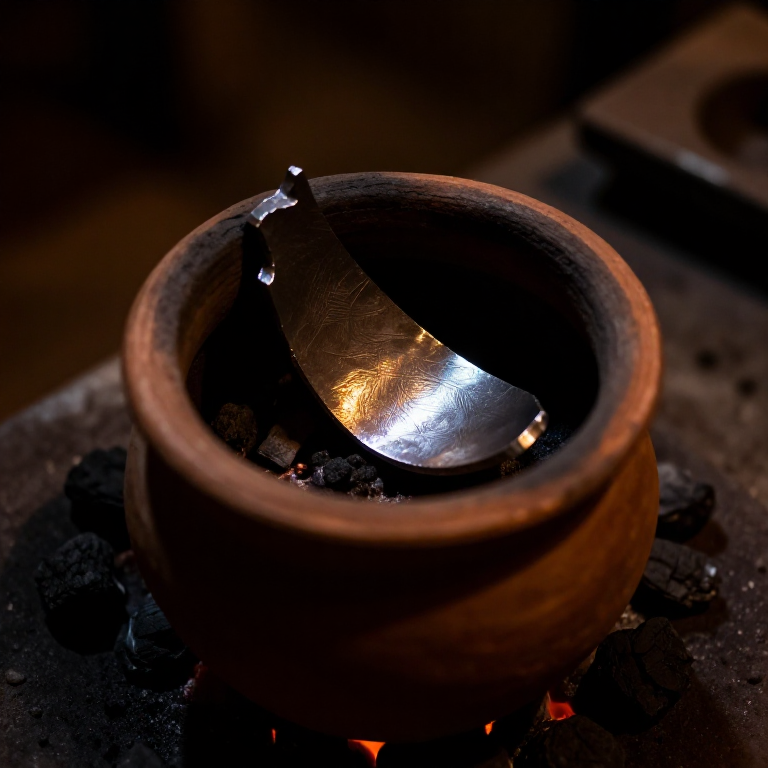
The secret of wootz is the crucible process: iron, carbon (from plant material), and trace elements are sealed together in a small clay crucible and heated until the iron melts and absorbs the carbon uniformly. When the crucible cools very slowly, iron carbide (cementite) precipitates in characteristic bands and clusters within the steel matrix, creating the visible watered pattern and producing a blade that is simultaneously hard (from cementite) and tough (from the softer iron matrix between the carbide bands).
The knowledge of wootz production was lost by the mid-18th century as European Bessemer and open-hearth steel replaced traditional methods. Despite decades of metallurgical research, modern scientists have not fully replicated the original process — the specific Indian ores, crucible clay compositions, plant carbon sources, and multi-day cooling protocols that created the finest wootz remain partly unknown. This blueprint documents the best-understood reconstruction of the ancient process.
Instrucciones
Prepare the crucible clay
Prepare the crucible clay
The crucible must survive temperatures above 1500°C for several hours without cracking or contaminating the steel melt. Indian wootz crucibles used a specific clay composition: refractory clay mixed with rice husk ash (which provides silica) and charcoal powder (which creates porosity for thermal shock resistance). The ratio is approximately 60% clay, 20% rice husk ash, and 20% crushed charcoal by volume.
Mix the ingredients thoroughly with enough water to form a workable paste. Shape the crucible as a cylinder approximately 8-10 cm in diameter and 15-20 cm tall, with walls 1.5-2 cm thick and a rounded bottom. The top will be sealed with a clay lid after charging. Allow the crucible to dry slowly in shade for 3-5 days, then pre-fire at low temperature (500°C) to remove all moisture before use.
Materiales para este paso:
 Arcilla refractaria (chamota de alta)2 kg
Prepare the charge: iron and carbon source
Prepare the charge: iron and carbon source
The crucible charge consists of wrought iron (bloomery iron or low-carbon iron) and a carbon source that will dissolve into the iron at high temperature. Traditional Indian smiths used small pieces of wrought iron — often recycled nails, tools, or iron bloom fragments — cut into pieces no larger than 2 cm. Approximately 300-400 grams of iron per crucible.
The carbon source varied by region: dried Cassia auriculata leaves (a leguminous plant) in the Deccan, bamboo charcoal in Sri Lanka, or green wood chips packed around the iron pieces. The carbon content of the finished steel must reach 1.0-2.0% — significantly higher than bloomery iron (0.1-0.3%) but below cast iron (3.5-4.5%). The precise amount of plant material controls the final carbon content. Approximately 20-30 grams of dried leaves or charcoal per crucible produces steel in the optimal 1.2-1.8% carbon range.
Materiales para este paso:
 Limaduras de hierro400 g
 Carbón vegetal30 g
Charge and seal the crucible
Charge and seal the crucible
Layer the iron pieces and plant material alternately inside the crucible: a layer of iron, a layer of leaves or charcoal, and repeat until the crucible is approximately three-quarters full. The layering ensures the carbon source is distributed throughout the iron mass for uniform carburization. Some historical accounts mention adding small quantities of glass or slag as a flux to help the melt flow and absorb impurities.
Seal the crucible with a clay lid, pressing wet clay firmly around the rim joint to create an airtight seal. The seal is critical — oxygen entering during the melt would burn the carbon out of the steel (decarburization), producing ordinary soft iron instead of high-carbon steel. The sealed crucible creates a reducing atmosphere where carbon transfers from the plant material into the iron without oxidation losses.
Build the charcoal wind furnace
Build the charcoal wind furnace
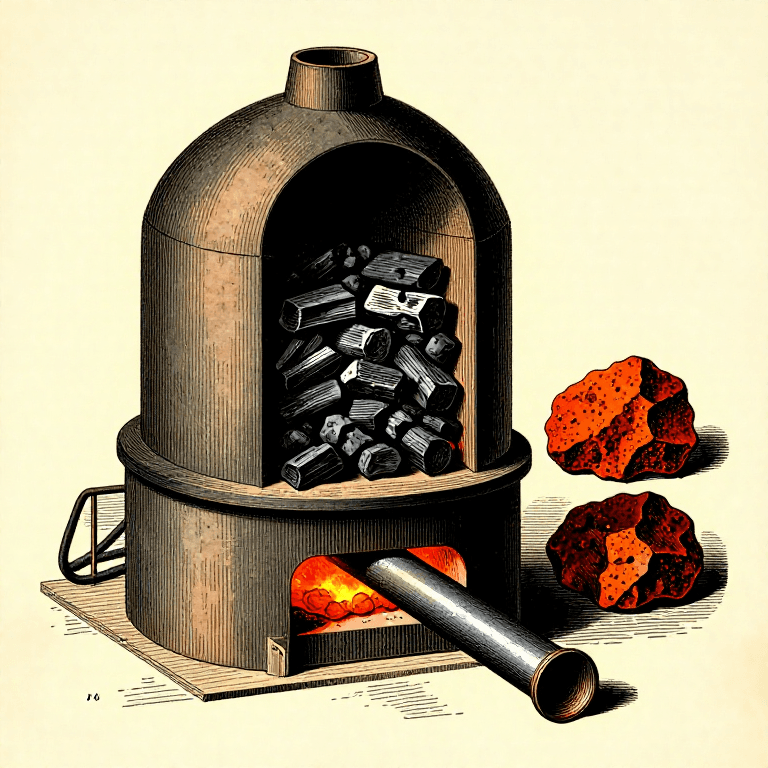
Wootz smelting requires temperatures above 1500°C — higher than a typical blacksmith's forge (1200°C) or a bloomery furnace. Indian smiths used wind furnaces: stone or clay-lined pits oriented to catch prevailing winds, supplemented by bellows during calm periods. The furnace is approximately 50 cm in diameter and 60-80 cm deep, lined with refractory clay.
Pack the furnace tightly with high-quality hardwood charcoal — lump charcoal, not briquettes. The sealed crucible is placed in the center of the charcoal bed, surrounded on all sides by fuel. Fill charcoal above the crucible to the rim of the furnace. The mass of charcoal surrounding the crucible acts as both fuel and insulation, maintaining the extreme temperature needed to melt the iron charge inside.
Materiales para este paso:
Carbón vegetal30 kgHerramientas necesarias:
 Gafas de protección química
 Guantes de nitrilo
Fire the crucible for 4-6 hours
Fire the crucible for 4-6 hours
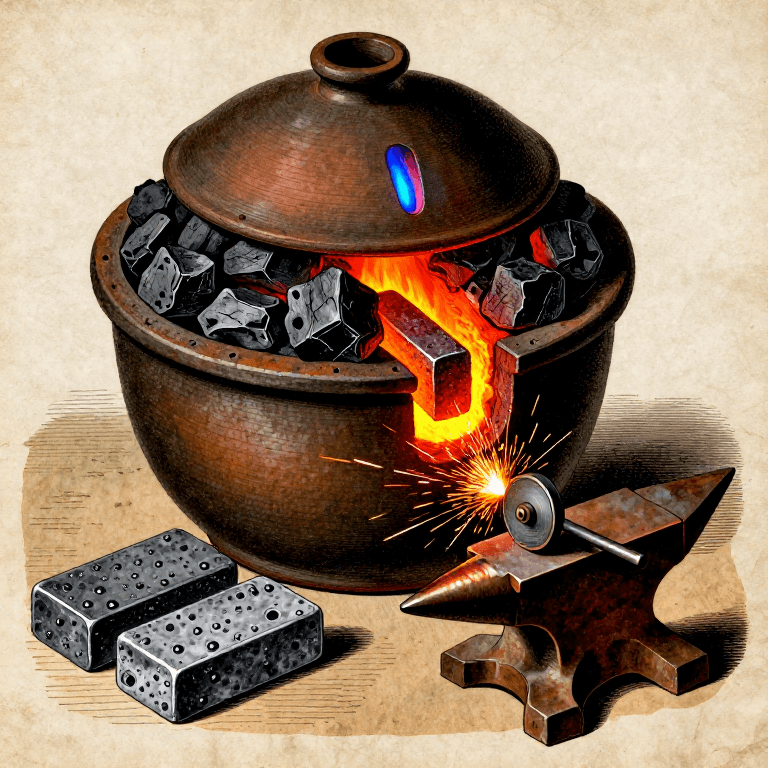
Light the charcoal and use bellows to raise the temperature steadily over 2-3 hours. Once the charcoal bed is fully ignited and glowing white-hot, the crucible interior reaches the melting point of the iron-carbon alloy (approximately 1400-1500°C depending on carbon content). The iron inside melts, dissolving the carbon from the plant material and any trace elements from the crucible walls.
Maintain maximum bellows blast for 2-3 hours at peak temperature. The crucible must remain sealed throughout — any breach will admit oxygen and ruin the melt. Listen for a characteristic bubbling sound from the crucible as CO gas is released from the carbon-iron reaction. When the bubbling stops, the carburization is complete and the iron has fully melted into a homogeneous liquid steel pool.
Herramientas necesarias:
 Fuelle
Cool the crucible extremely slowly
Cool the crucible extremely slowly
This is the step that creates the distinctive wootz microstructure. After the melt is complete, stop adding air and allow the furnace to cool as slowly as possible — ideally over 24-48 hours. The slow cooling allows iron carbide (cementite, Fe₃C) to precipitate from the liquid in large, aligned bands within the softer iron matrix. Rapid cooling produces fine, randomly distributed carbides that lack the watered pattern.
Do not remove the crucible from the furnace — let the entire charcoal bed cool naturally around it. Some historical accounts describe burying the furnace under earth or ash to further slow the cooling rate. The temperature must drop gradually through the critical range of 1100-700°C where the carbide structure forms. This patience — letting nature control the cooling rate rather than forcing it — is what made wootz unique and what makes it difficult to replicate with modern equipment designed for rapid, controlled cooling.
Break the crucible and inspect the ingot
Break the crucible and inspect the ingot
Once completely cool (after 2-3 days), break the clay crucible to reveal the steel ingot — a dense, rounded puck approximately 7-8 cm in diameter and 3-4 cm thick, weighing 300-400 grams. The surface will be rough with crucible slag adhered to it. Clean the surface by grinding on a coarse stone.
A successful wootz ingot has a smooth, dense cross-section when cut or polished, with a faint pattern of lighter and darker bands visible even before etching. The steel should spark bright white when tested on a grinding wheel (indicating high carbon content) and be too hard to file easily. If the surface shows large pores or the metal is soft enough to file, the temperature was too low or the carbon source insufficient — the iron did not fully melt and carburize. This ingot is the raw material that Syrian bladesmiths would forge into Damascus sword blades.
Herramientas necesarias:
 Martillo
 Piedra de moler
Materiales
3- Marcador de posición
- 400 gMarcador de posición
- 30 kgMarcador de posición
Herramientas requeridas
5- Marcador de posición
- Marcador de posición
- Marcador de posición
- Marcador de posición
- Marcador de posición
Materiales de Blueprints conectados

Este plano hace
Blueprints relacionados
Estos blueprints comparten conocimiento — técnicas, materiales o principios


CC0 Dominio público
Este Blueprint se publica bajo CC0. Eres libre de copiar, modificar, distribuir y usar este trabajo para cualquier propósito, sin pedir permiso.
Apoya al Maker comprando productos a través de su Blueprint, donde gana una Comisión del Maker establecida por los vendedores, o crea una nueva iteración de este Blueprint e inclúyela como conexión en tu propio Blueprint para compartir ingresos.