Colaboración
ARTE
BELLEZA Y BIENESTAR
ARTESANÍA
CULTURA E HISTORIA
ENTRETENIMIENTO
MEDIO AMBIENTE
COMIDA Y BEBIDAS
INGENIERÍA INVERSA
CIENCIAS
DEPORTES
TECNOLOGÍA
TECNOLOGÍA VESTIBLE
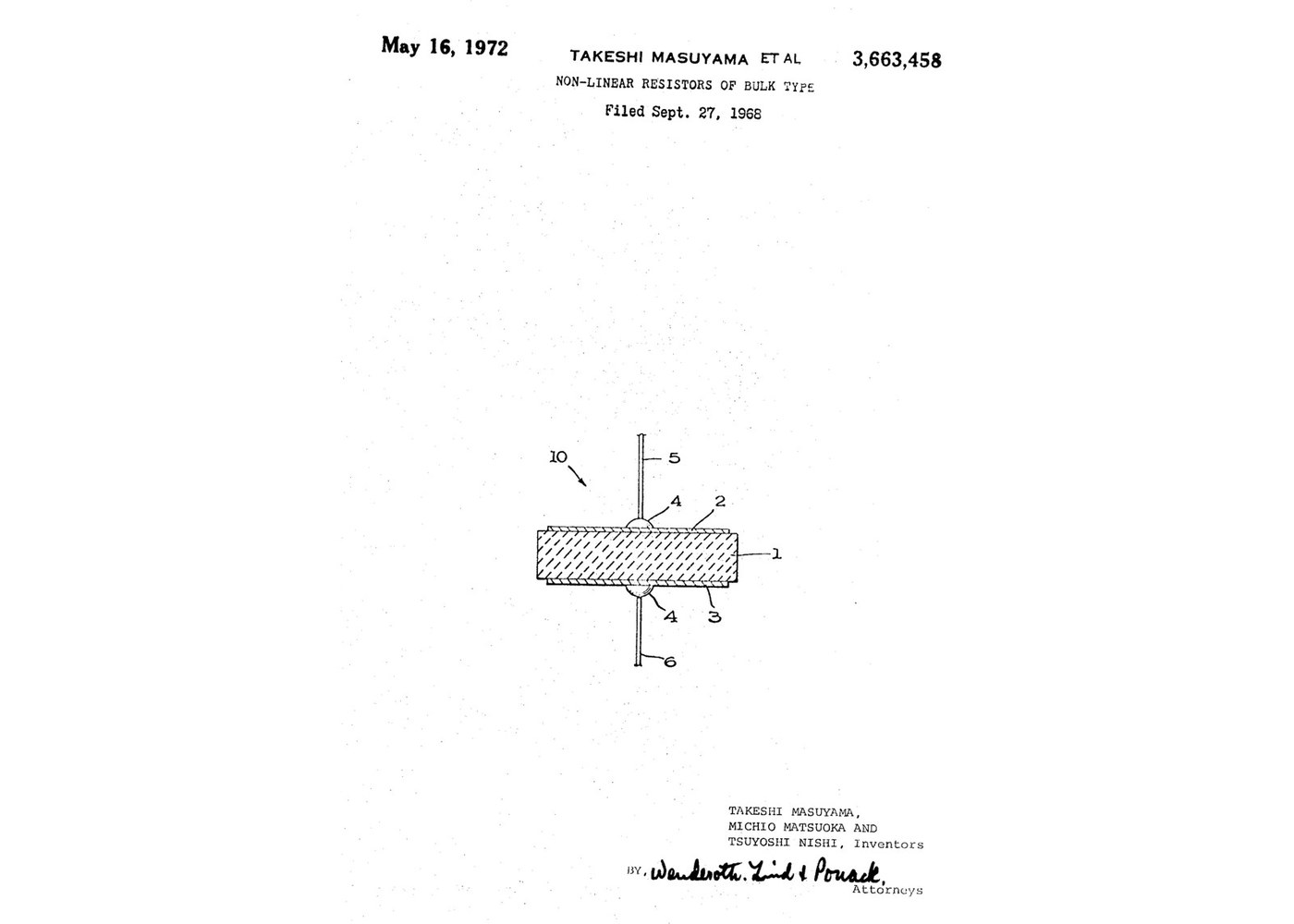


Metal Oxide Varistor: Zinc Oxide with 0.2 % Bismuth Oxide, Sintered Disc (Masuyama 1972)
A non-linear resistor: the current through it rises far faster than the voltage across it. Masuyama, Matsuoka and Nishi made one from zinc oxide with a little bismuth oxide: pressed into a disc, sintered, lapped, and given metal electrodes. With 0.2 mole % bismuth oxide, sintered at 1000 °C and lapped to 1 mm, the disc measured a C-value of 43 at 1 mA and a nonlinearity exponent n of 4.3.
Source: T. Masuyama, M. Matsuoka and T. Nishi (Matsushita), US 3,663,458 (1972), Example 1. Unknown: what the silver paint is. The patent calls the spraying and the paint well known. The spraying is ours, after US Army Corps of Engineers EM 1110-2-3401 (1999). The 10 g batch is our arithmetic. Picture: the patent's drawing.
Avanzado
1 day
Instrucciones
1
1
Weigh 99.8 ZnO to 0.2 Bi2O3 and wet-mill 5 hours
Weigh 99.8 ZnO to 0.2 Bi2O3 and wet-mill 5 hours
Mix zinc oxide and bismuth oxide 99.8 : 0.2 by moles. Ours, for 10 g: 9.887 g zinc oxide and 0.113 g bismuth oxide (our arithmetic). Mill wet for 5 hours, then dry. Unknown: the milling liquid.
Materiales para este paso:
 Óxido de zinc en polvo9.887 g
 Óxido de bismuto0.113 g
Herramientas necesarias:
 Balanza de platillos
 Molino de bolas de hierro
 Horno de secado
2
2
Press discs 13 mm by 2.5 mm
Press discs 13 mm by 2.5 mm
Press the powder in a mould into discs 13 mm across and 2.5 mm thick at 340 kg/cm².
Herramientas necesarias:
 Prensa hidráulica
 Matriz de prensado de discos
 Calibre vernier
3
3
Sinter 1 hour at 1000 °C and furnace-cool
Sinter 1 hour at 1000 °C and furnace-cool
Sinter the discs in air for 1 hour at 1000 °C, then let them cool in the furnace to room temperature (about 15-30 °C). Above 1200 °C the disc loses its nonlinearity.
Herramientas necesarias:
 Horno mufla
4
4
Lap both faces to 1.0 mm
Lap both faces to 1.0 mm
Lap both faces with 600-mesh silicon carbide until the disc is 1.0 mm thick.
Herramientas necesarias:
 Granalla de carburo de silicioCalibre vernier
5
5
Spray aluminium electrodes and attach leads
Spray aluminium electrodes and attach leads
Spray a metallised film of aluminium on both faces. Attach a lead wire to each with conductive silver paint. Ours, after US Army Corps of Engineers EM 1110-2-3401 (1999): wire-arc spray the aluminium from two 3.2 mm wires melted by an 18-40 V DC arc and atomised by compressed air, 15-20 cm from the disc and never at less than 45°, in at least two coats at right angles of 50-75 µm each. Unknown: the paint.
Materiales para este paso:
 Lingote de aluminio1 as 3.2 mm spray wire
 Pintura conductora de plata1 as required
 Alambre de cobre2 piezas
Herramientas necesarias:
Calibre vernier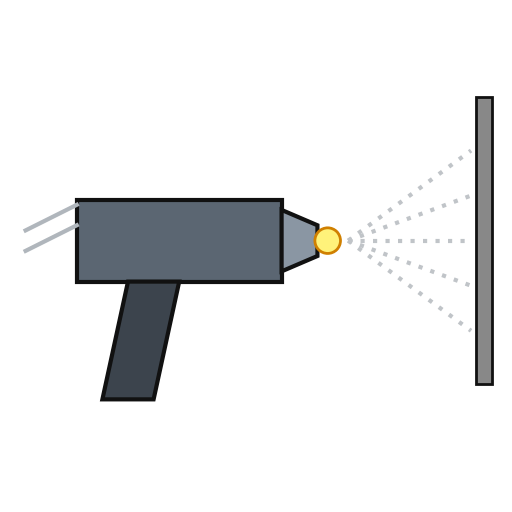 Pistola de proyección por arco eléctrico
 Compresor de aire industrial
Materiales
5- 9.887 gMarcador de posición
- 0.113 gMarcador de posición
- 1 as 3.2 mm spray wireMarcador de posición
- 1 as requiredMarcador de posición
- 2 piezasMarcador de posición
Herramientas requeridas
10- Marcador de posición
- Marcador de posición
- Marcador de posición
- Marcador de posición
- Marcador de posición
- Marcador de posición
- Marcador de posición
- Marcador de posición
- Marcador de posición
- Marcador de posición

Blueprints relacionados
Estos blueprints comparten conocimiento — técnicas, materiales o principios


CC0 Dominio público
Este Blueprint se publica bajo CC0. Eres libre de copiar, modificar, distribuir y usar este trabajo para cualquier propósito, sin pedir permiso.
Apoya al Maker comprando productos a través de su Blueprint, donde gana una Comisión del Maker establecida por los vendedores, o crea una nueva iteración de este Blueprint e inclúyela como conexión en tu propio Blueprint para compartir ingresos.