
Camera Lucida
The camera obscura needs a dark room. The camera lucida does not — and that is the whole point of it. William Hyde Wollaston patented it in 1806 as "An Instrument whereby any person may draw in Perspective", and it works in full daylight on an ordinary table.
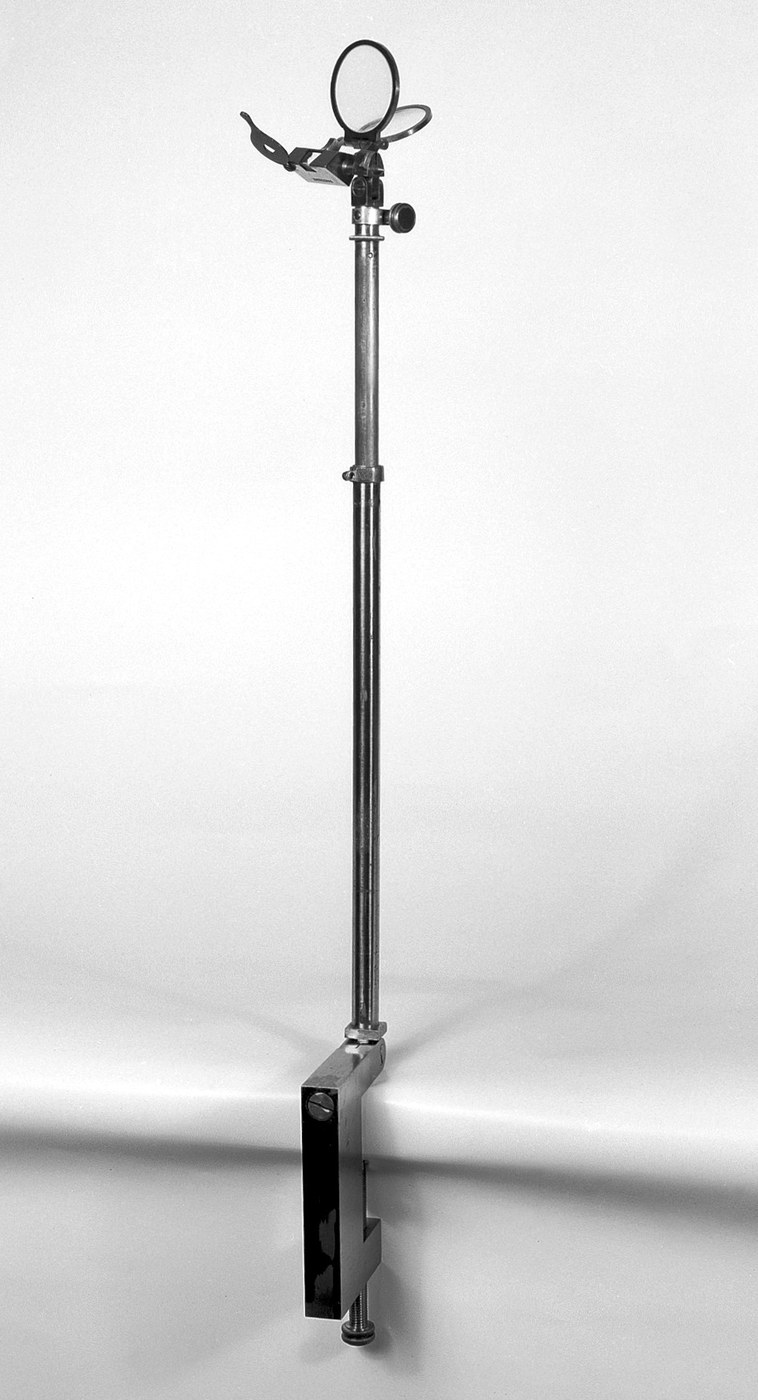
There is no projection. Nothing is cast onto the paper. A four-sided prism sits above the page, and light from the scene bounces twice inside it before reaching your eye — two reflections, so the image arrives the right way up rather than inverted. At the same time your eye receives light directly from the paper below. Your brain superimposes the two. You appear to see the scene lying on the page, with your own pencil moving across it.
It is an optical illusion assembled inside the observer, which is why photographing what you see through one is nearly impossible and why using one takes practice.
Instructions
Understand the prism geometry
Understand the prism geometry
Wollaston's prism is four-sided: one angle of 90°, the opposite angle 135°, and the remaining two 67.5° each. Those angles are what produce two internal reflections and an upright image.
Substitute two mirrors if you have no prism
Substitute two mirrors if you have no prism
A true Wollaston prism is hard to source. Two small first-surface mirrors at a shallow angle reproduce the double reflection and work well enough to learn on.
Materials for this step:
 Flat Mirror (First Surface)2 pieces
Build the stand
Build the stand
Make a stand that holds the optic about 100 mm above the paper on a stiff arm. It must not move at all — any wobble and the superimposed image drifts away from your drawing.
Materials for this step:
 Hardwood Block1 piece
Weight the base heavily
Weight the base heavily
Clamp or weight the base to the table. This is the single biggest determinant of whether the instrument is usable — a light stand is useless.
Set the optic at 45° to the scene
Set the optic at 45° to the scene
Angle the optic so the first surface faces the subject and the second directs light down toward your eye position above the paper.
Find the eye position
Find the eye position
Put your eye so that it is half over the edge of the optic. Half the pupil receives the reflected scene and half sees the paper directly. This half-and-half position is the entire trick and it is fussy to find.
Wait for your eye to merge the two
Wait for your eye to merge the two
Hold still. After a few seconds the scene appears to lie on the paper. If you see two separate things, move your eye a millimetre at a time until they fuse.
Match the brightness
Match the brightness
Adjust the light on your paper until it roughly matches the scene's brightness. If the paper is much brighter the image washes out; if much darker the paper disappears and you cannot see your pencil.
Mark key points first
Mark key points first
Dot the corners and major junctions before drawing any line. If your head shifts, those fixed dots let you re-register the view; a half-drawn contour does not.
Materials for this step:
 Card Stock (Heavy, 50 Sheets)1 sheet
Trace the outline
Trace the outline
Draw the contours you see, moving your head as little as possible. Expect to lose the image repeatedly at first — this is normal and is why the instrument has a reputation for being difficult.
Measure the accuracy
Measure the accuracy
Measure a known dimension in the real scene and the same one in your drawing, and work out the ratio. Repeat for a second dimension. A well-set instrument holds a consistent ratio across the whole drawing — that is what "accurate perspective" means here.
Tools needed:
 Steel Ruler
History & Context
History & Context
Wollaston's patent. William Hyde Wollaston took out British patent 2993 in 1806 for "An Instrument whereby any person may draw in Perspective, or may Copy or Reduce any Print or Drawing". The claim in the title is the sales pitch — any person, no training required — and it is worth noticing that this is a drawing aid marketed at people who could not draw.
Two reflections, not one. A single mirror gives a mirrored image. Wollaston's four-sided prism reflects the light twice on its way through, and two reflections cancel out, so the scene is perceived as in nature, right side up. Meanwhile the eye also receives light directly from the paper, and the two are merged in the perception of the viewer. The instrument does not form an image anywhere — the superimposition happens in the visual system.
Why it beat the camera obscura for fieldwork. No dark room, no box, no projection screen. It folds into a case and works outdoors in daylight. That made it the standard tool for scientific and topographic illustration through the nineteenth century — naturalists, surveyors and travelling draughtsmen used it constantly, and Brunel owned one.
The Hockney–Falco argument. David Hockney and Charles Falco proposed that optical devices of this family were used far earlier and far more widely by painters than art historians accept. The debate has been vigorous and is not settled. The fair statement is that these instruments plainly existed and were plainly used by some artists, while proving that a specific painting was made with one is very hard — the same honest position as with the camera obscura.
Why it is hard, and what that teaches. Most people expect a projected image and get an illusion that collapses when they move. That difficulty is itself the lesson: the camera lucida demonstrates that seeing is an active construction. Two light paths reaching one pupil are assembled by the brain into a single scene that exists nowhere in the physical world.
Materials
3- 2 piecesPlaceholder
- 1 piecePlaceholder
- Placeholder
Tools Required
1- Placeholder
Related blueprints
Other builds that share materials, tools, or techniques with this one.
CC0 Public Domain
This blueprint is released under CC0. You are free to copy, modify, distribute, and use this work for any purpose, without asking permission.
Support the Maker by purchasing products through their Blueprint where they earn a Maker Commission set by Vendors, or create a new iteration of this Blueprint and include it as a connection in your own Blueprint to share revenue.