Collaboration
ART
BEAUTÉ ET BIEN-ÊTRE
ARTISANAT
CULTURE ET HISTOIRE
DIVERTISSEMENT
ENVIRONNEMENT
NOURRITURE ET BOISSONS
INGÉNIERIE INVERSE
SCIENCES
SPORTS
TECHNOLOGIE
TECHNOLOGIE PORTABLE
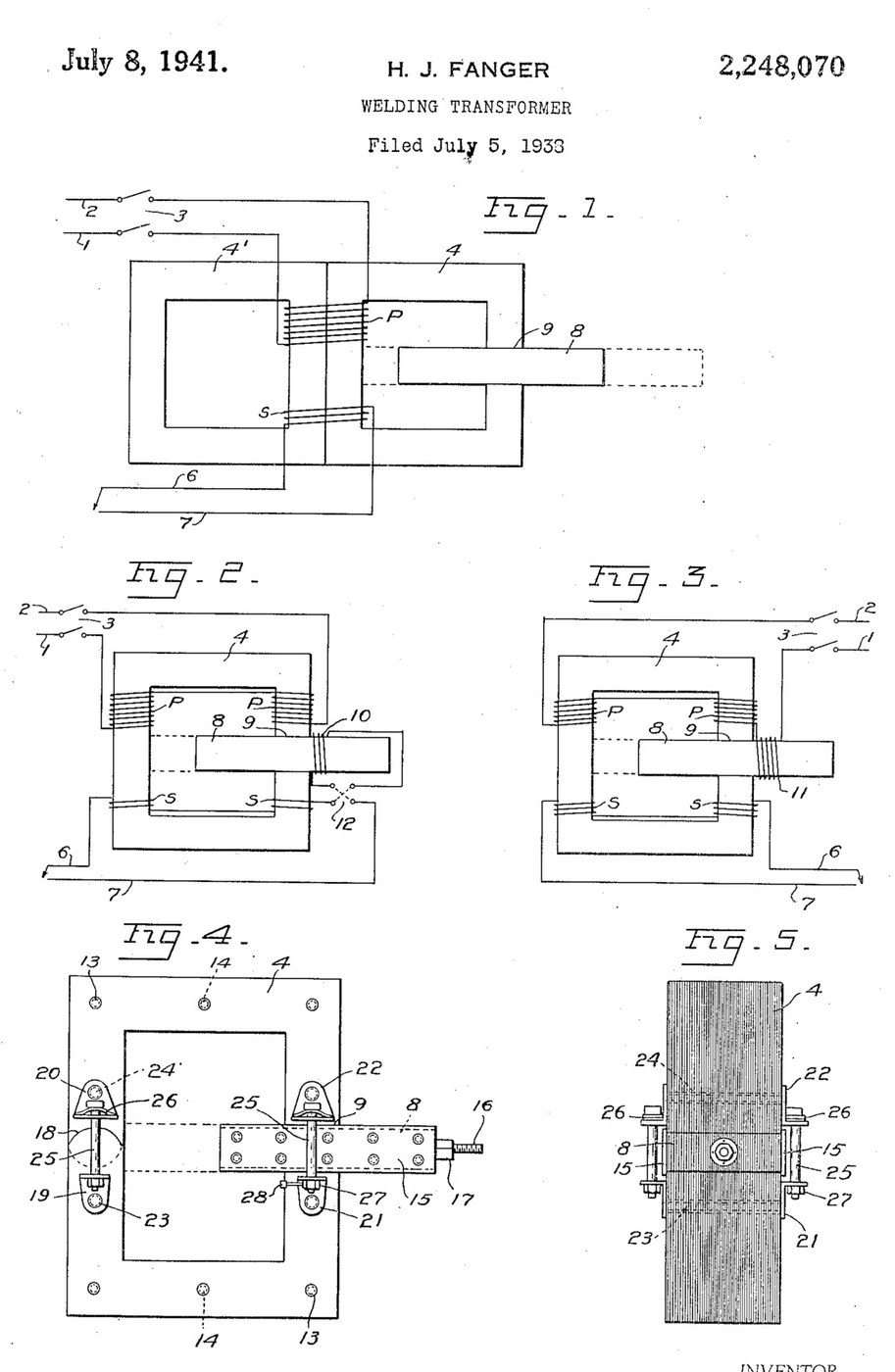


Arc Welder: AC Transformer with a Sliding Shunt Core (Fanger, US 2,248,070)
An AC arc welder is a step-down transformer whose current can be turned up and down. H. J. Fanger (US 2,248,070, 1941) cuts a gap through one leg of a laminated ring core and slides a laminated iron shunt bar through it: pushed in, it carries flux past the secondary and lowers the welding current; pulled out, the current rises.
For arc welding he gives about 60 to 68 volts open circuit, 15 to 200 amps, dropping to 38 or 40 volts at the working arc, with a small coil on the shunt bar in series with the secondary.
Source: H. J. Fanger, "Welding Transformer", US Patent 2,248,070 (filed 1938, granted 1941). Picture: its Figs. 1-5.
Avancé
Unknown
Consignes
1
1
Read Fanger
Read Fanger
"With arc welding, infinite control of the volume of the secondary current, between maximum and minimum is obtained by adjustment of the slidable shunt core without altering the welding characteristics of the current, also better ignition of the arc is had at a given voltage, and greater stability of the arc".
2
2
Stack the core
Stack the core
Build a single rectangular ring core of insulated iron laminations, held together with brass (or insulated) bolts or rivets in insulating tubes (Fig. 4). Cut a gap straight through one leg, accurately machined and finished, and make a circular joint through the opposite leg with the segments staggered to overlap in successive laminations. Core size, lamination iron and thickness are not given (ours: the tools).
Matériaux pour cette étape :
 Métal inconnu1 iron laminations
 Assortiment de boulons à tête hexagonale1 brass bolts
 Isolant inconnu1 insulating tubes
Outils nécessaires :
 Cisaille à tôle
 Perceuse à colonne
 Jeu de forets
 Limes (lime à main)
 Dimensions inconnues
3
3
Make the shunt bar
Make the shunt bar
Make the sliding shunt section of the same laminated iron, a snug fit in the gap with its laminations edge-to-edge with the core's, and long enough to fill the gap at every position. Sheath both sides with a slightly wider plate of Bakelite that overlaps the edges of the gap to guide it. Fit a threaded rod on its outer end, working in a nut fixed to the section (or move it by hand, with calibration marks along one edge).
Matériaux pour cette étape :
Métal inconnu1 shunt laminations Bakélite2 side platesAssortiment de boulons à tête hexagonale1 brass bolts
 Tige filetée1 pièce
 Écrou hexagonal1 pièce
Outils nécessaires :
Perceuse à colonneJeu de foretsLimes (lime à main)4
4
Wind the coils
Wind the coils
Wind the primary and secondary windings on both legs of the core (Fig. 2), in series or in parallel to suit the line voltage and the current wanted. Wind a small auxiliary coil round the shunt bar's path, fixed so the bar slides through it, and connect it in series with the secondary through a reversing switch (some jobs weld better with the current through it one way). Turns and wire sizes are not given.
Matériaux pour cette étape :
 Fil de cuivre1 insulation and size not given
Outils nécessaires :
Dimensions inconnues5
5
Spring the joints
Spring the joints
On both sides of the gap and of the circular joint fit pairs of confronting angle plates, held by brass bolts in insulating sleeves and drawn together by spring bolts whose heads rest on slightly arched spring plates, so the joints close snugly on the sliding bar. A small lever on the gap-joint nut gives a half turn to release the bar for moving. The angle-plate material is not given.
Matériaux pour cette étape :
 Matériau inconnu4 angle platesAssortiment de boulons à tête hexagonale1 brass and spring boltsIsolant inconnu1 sleeves
 Feuillard d'acier à ressort1 arched spring platesÉcrou hexagonal4 pièces
Outils nécessaires :
Perceuse à colonneJeu de forets Clé à molette
6
6
Connect and set
Connect and set
Connect the primary to the line through a line switch, and the secondary leads to the electrode holder and the work. Pull the shunt bar out for more current, push it in for less: Fanger gives about 60-68 volts open circuit and 15-200 amps, dropping to 38-40 volts at the arc.
Matériaux pour cette étape :
 Interrupteur marche/arrêt1 line switch
Outils nécessaires :
Clé à moletteMatériaux
10- 1 shunt laminationsEspace réservé
- 1 brass and spring boltsEspace réservé
- 1 sleevesEspace réservé
- 2 side platesEspace réservé
- 1 pièceEspace réservé
- 5 piècesEspace réservé
- 1 insulation and size not givenEspace réservé
- 4 angle platesEspace réservé
- 1 arched spring platesEspace réservé
- 1 line switchEspace réservé
Ce plan fabrique

CC0 Domaine public
Ce blueprint est publié sous CC0. Vous êtes libre de copier, modifier, distribuer et utiliser ce travail pour tout usage, sans demander la permission.
Soutenez le Maker en achetant des produits via son Blueprint où il perçoit une Commission Maker définie par les Vendeurs, ou créez une nouvelle itération de ce Blueprint et incluez-le comme connexion dans votre propre Blueprint pour partager les revenus.