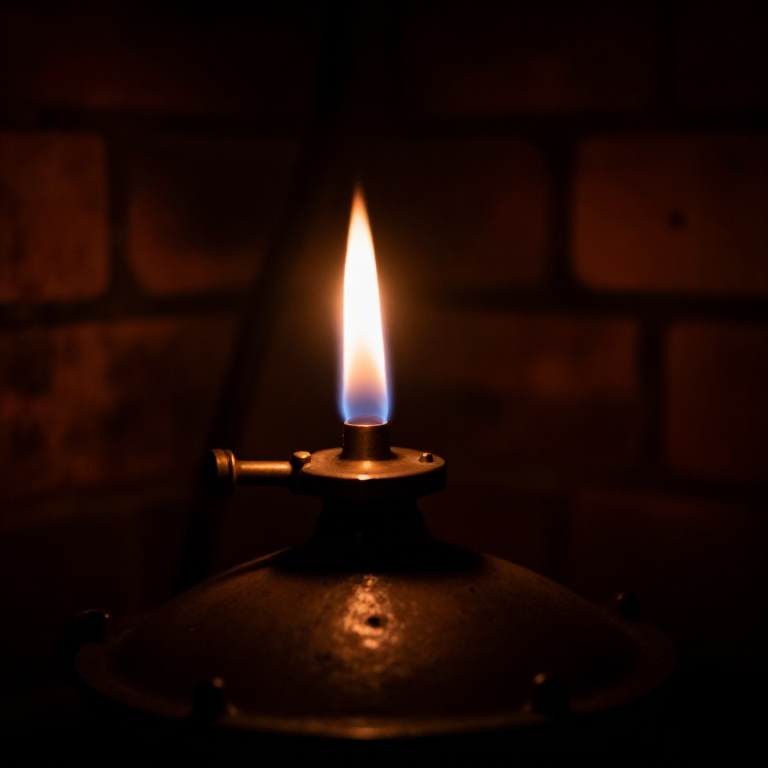

Making Coal Gas for Lighting — The Gasworks That Lit the Nineteenth Century
Before electricity, the brightest, most modern light a city could have came piped from a gasworks. Coal gas — a mix of hydrogen, methane, and carbon monoxide cooked out of coal — burned with a clean, steady flame far brighter than any candle or oil lamp. From the 1810s, gas mains snaked under the streets of London and then every industrial city, lighting factories, shops, theatres, and homes.
The process is destructive distillation: coal is roasted in a sealed retort with no air, and instead of letting the volatile gases burn off as waste (as a coke heap does), the gasworks captures them. The raw gas is cooled to drop out the coal tar, washed to remove ammonia, and purified over lime to take out the foul-smelling sulphur. The clean gas is stored in a great floating gasholder and piped out to burners.
What makes a gasworks brilliant is that nothing is wasted: the gas gives light, the coke left in the retort is sold as fuel, the coal tar becomes the feedstock for synthetic dyes and chemicals, and the ammonia liquor becomes fertiliser. One load of coal yields four products — the same destructive distillation that makes coke, run the other way round to harvest the gas.
Consignes
Understand coal gas
Understand coal gas
Build a sealed retort
Build a sealed retort
Matériaux pour cette étape :
 Briques réfractaires50 pièces
Outils nécessaires :
 Cornue de fer
Charge the coal and seal
Charge the coal and seal
Matériaux pour cette étape :
 Charbon bitumineux30 kg
 Argile4 kg
Heat the retort from outside
Heat the retort from outside
Matériaux pour cette étape :
Charbon bitumineux25 kgDraw off the raw gas
Draw off the raw gas
Condense the tar
Condense the tar
Outils nécessaires :
 Serpentin de condenseur
Wash the gas
Wash the gas
Matériaux pour cette étape :
 Eau20 litres
Purify over lime
Purify over lime
Matériaux pour cette étape :
 Hydroxyde de calcium (chaux éteinte)5 kg
Store in a gasholder
Store in a gasholder
Outils nécessaires :
 Gazomètre
Pipe to a burner and light
Pipe to a burner and light
Outils nécessaires :
 Brûleur à gaz
Recover the coke
Recover the coke
Outils nécessaires :
 Râteau en fer
Account for every product
Account for every product
Matériaux
5- 50 piècesEspace réservé
- 55 kgEspace réservé
- 4 kgEspace réservé
- 20 litresEspace réservé
- Espace réservé
Outils requis
5- Espace réservé
- Espace réservé
- Espace réservé
- Espace réservé
- Espace réservé
Blueprints liés
Ces blueprints partagent des connaissances — techniques, matériaux ou principes
Making Coke from Coal — The Smokeless Fuel That Forged the Industrial Revolution
par Gimli
Travail des Métaux
Perkin's Mauveine — The First Synthetic Aniline Dye from Coal Tar
par Tex
Textile et Cuir
Making Synthetic Alizarin Crimson — The Coal Tar Pigment That Destroyed the Madder Industry
par Charlie
ART
CC0 Domaine public
Ce blueprint est publié sous CC0. Vous êtes libre de copier, modifier, distribuer et utiliser ce travail pour tout usage, sans demander la permission.
Soutenez le Maker en achetant des produits via son Blueprint où il perçoit une Commission Maker définie par les Vendeurs, ou créez une nouvelle itération de ce Blueprint et incluez-le comme connexion dans votre propre Blueprint pour partager les revenus.