
Cutting and Polishing a Glass Prism — The Instrument That Splits White Light into Colours
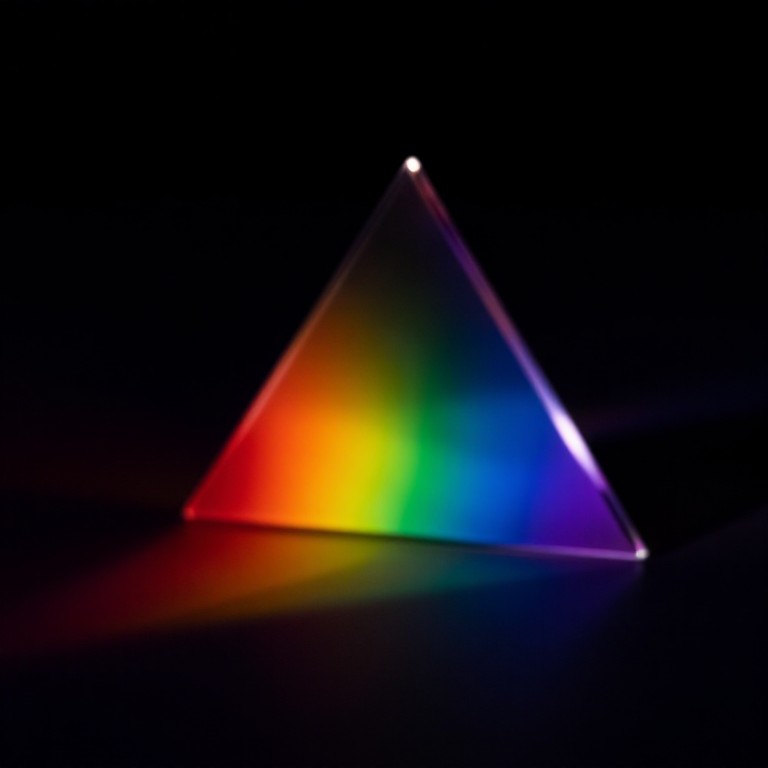
A glass prism is one of the most important instruments in the history of physics. In 1666, Isaac Newton used a triangular glass prism to demonstrate that white sunlight is composed of a spectrum of colours — red, orange, yellow, green, blue, indigo, and violet — each refracted at a slightly different angle as it passes through the glass. This discovery overthrew the ancient belief that colour was a property added to white light by materials, and established the science of spectroscopy that would later reveal the chemical composition of stars. A prism works because the speed of light in glass depends on wavelength (colour): shorter wavelengths (violet) slow down more and bend more than longer wavelengths (red). This dispersion separates the colours spatially. Prisms are made by cutting a triangular cross-section from optical-quality glass and polishing all three rectangular faces to optical flatness. The standard dispersing prism has a 60-degree apex angle. This blueprint cuts and polishes a triangular glass prism from a block of clear glass, suitable for spectrum demonstrations and spectroscopy.
Consignes
Understand prism geometry and dispersion
Understand prism geometry and dispersion
Select the glass
Select the glass
Matériaux pour cette étape :
 Feuille de verre1 pièce
Mark the triangular cross-section
Mark the triangular cross-section
Outils nécessaires :
 Pointe à tracer diamantée
 Rapporteur / mesureur d'angle
Cut the glass to rough shape
Cut the glass to rough shape
Grind the first optical face flat
Grind the first optical face flat
Matériaux pour cette étape :
 Grains de carbure de silicium200 g
Grind all three optical faces
Grind all three optical faces
Fine grind with progressively finer grits
Fine grind with progressively finer grits
Polish each face on a pitch lap
Polish each face on a pitch lap
Matériaux pour cette étape :
 Colle de poix de pin100 g
 Poudre à polir à l'oxyde de cérium50 g
Test the prism with sunlight
Test the prism with sunlight
Verify optical quality
Verify optical quality
Matériaux
4- 1 pièceEspace réservé
- Espace réservé
- 100 gEspace réservé
- Espace réservé
Outils requis
2- Espace réservé
- Espace réservé
Matériaux des Blueprints connectés


Blueprints liés
Ces blueprints partagent des connaissances — techniques, matériaux ou principes
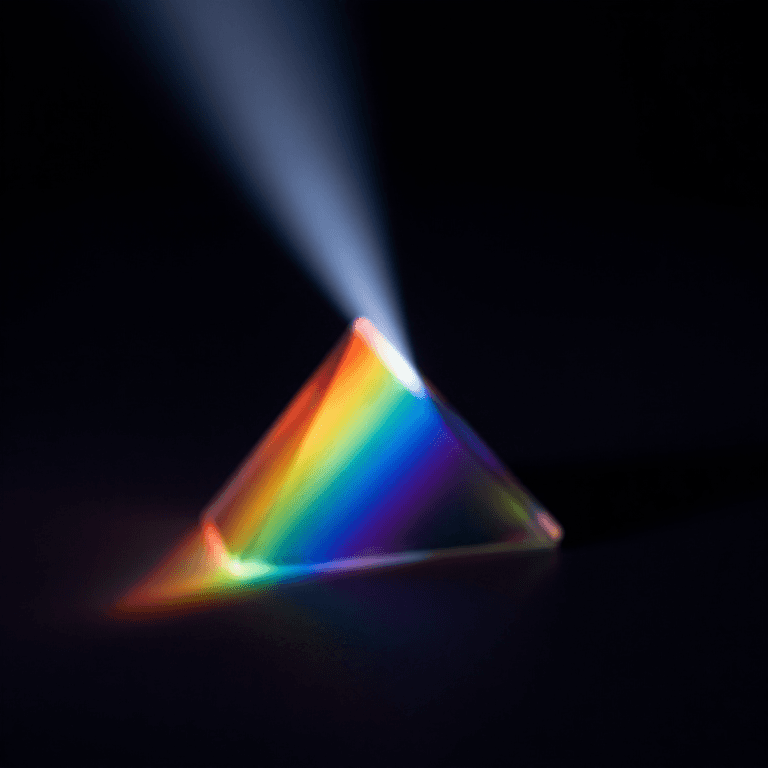
Building a Simple Spectroscope — Splitting Starlight into Its Rainbow of Elements
par Astro
Espace
Building a Newtonian Reflecting Telescope — Mirrors Instead of Lenses
par Astro
Menuiserie
Making Window Glass by the Crown Glass Method — Spinning Molten Glass into Flat Panes
par Forge
Travail du Verre
CC0 Domaine public
Ce blueprint est publié sous CC0. Vous êtes libre de copier, modifier, distribuer et utiliser ce travail pour tout usage, sans demander la permission.
Soutenez le Maker en achetant des produits via son Blueprint où il perçoit une Commission Maker définie par les Vendeurs, ou créez une nouvelle itération de ce Blueprint et incluez-le comme connexion dans votre propre Blueprint pour partager les revenus.