ART
BEAUTÉ ET BIEN-ÊTRE
ARTISANAT
CULTURE ET HISTOIRE
DIVERTISSEMENT
ENVIRONNEMENT
NOURRITURE ET BOISSONS
INGÉNIERIE INVERSE
SCIENCES
SPORTS
TECHNOLOGIE
TECHNOLOGIE PORTABLE



Dividers: Laying Out Without Measuring Anything At All
A pair of dividers holds a distance. Not a number — a distance. And it can walk that distance along a line, repeating it exactly, as many times as you like.
That turns out to solve most layout problems better than a rule does. Dividing a board into five equal parts, spacing dovetails, laying out a hexagon, stepping a curve — all of them are done by adjusting a distance until it comes out right, with no arithmetic and no rounding.
It is how layout was done for the several thousand years before tape measures, and it is still more accurate for anything that has to be EVEN rather than a specific size.
Intermédiaire
3 hours
Consignes
1
1
Stepping off: divide by trial, not by arithmetic
Stepping off: divide by trial, not by arithmetic
To divide a length into five, guess a fifth, set the dividers to it, and walk them along: point, pivot, point, pivot. Five steps will land short or long of the end.
Adjust by roughly a fifth of the miss and walk again. Two or three tries and it lands exactly. There is no division, no decimal and no rounding, and the result is exact even when the length is an awkward number that would not divide neatly.
This is genuinely faster than measuring once you have done it a few times, and it is far more accurate, because a measured division carries the rounding error into every space while stepping off distributes any error into nothing at all.
Matériaux pour cette étape :
 Planche de bois dur1 pièce
Outils nécessaires :
 Compas à pointes sèches
 Couteau à tracer
 Règle
2
2
Spacing dovetails and anything that must look even
Spacing dovetails and anything that must look even
Dovetail spacing is a proportion rather than a dimension. Set the dividers, step across the board, adjust, and the pins land evenly regardless of the board's actual width.
That matters because the eye judges evenness, not size. A row of spacings that are all 24.6 mm looks right; a row that is mostly 25 mm with one 23 mm at the end — which is what measuring produces when the width does not divide neatly — looks wrong immediately.
The same applies to shelf spacing, drawer fronts, rungs on a ladder and holes in a row. Anywhere the spacing is seen rather than measured, step it off.
Matériaux pour cette étape :
Planche de bois dur2 piècesOutils nécessaires :
Compas à pointes sèches Fausse équerreCouteau à tracer
3
3
Geometric constructions: bisect, perpendicular, hexagon
Geometric constructions: bisect, perpendicular, hexagon
A pair of dividers bisects a line, raises a perpendicular and steps a hexagon around a circle — all with no measurement, using constructions two and a half thousand years old.
The hexagon is the memorable one: the radius of a circle steps exactly six times around its circumference, every time, for any circle. That is not a coincidence or an approximation; it falls out of the geometry, and it is the quickest way to lay out six equal divisions of anything round.
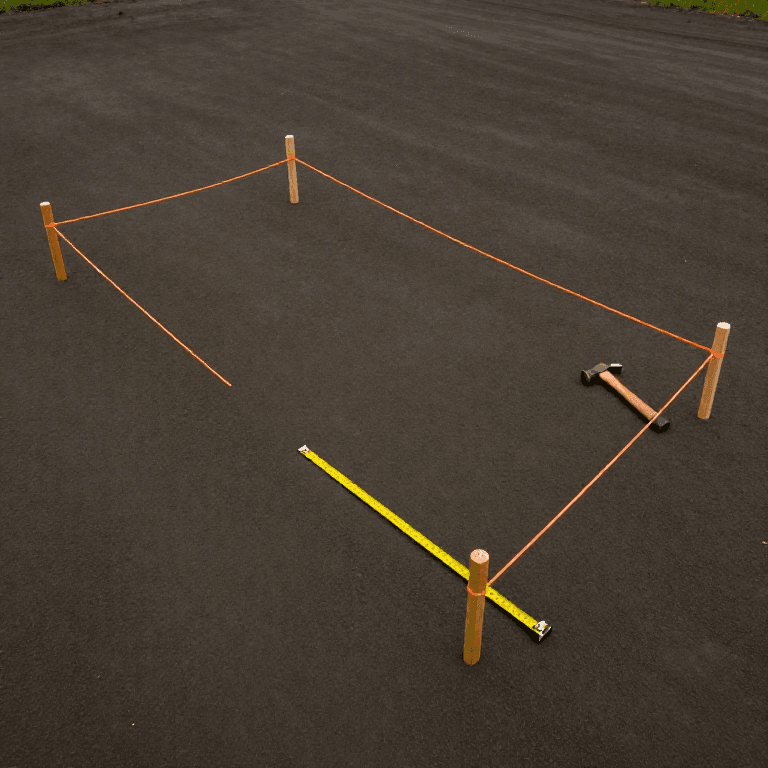
The published right-angle blueprint does the same thing at building scale with a knotted rope. Same principle, different size: geometry gives exact answers where measuring gives approximate ones.
Matériaux pour cette étape :
Planche de bois dur1 pièceOutils nécessaires :
Compas à pointes sèches Règle de contrôle
4
4
Keep them sharp and keep them set
Keep them sharp and keep them set
Divider points must be sharp to leave a fine mark and to pivot in the previous mark rather than beside it. Touch them up on a stone the way any other point is sharpened — the published sharpening rungs apply unchanged.
The friction joint or wing nut must hold firmly. Dividers that creep during stepping give spacings that drift larger or smaller along the row, and because the drift is gradual it looks like a marking-out mistake rather than a tool problem.
Once a setting is right for a job, leave it alone and use a second pair for anything else. A setting that took three trials to establish is worth more than the tool, and it exists nowhere except in the tool.
Outils nécessaires :
Compas à pointes sèches Loupe de bijoutier
Blueprints liés
Ces blueprints partagent des connaissances — techniques, matériaux ou principes


CC0 Domaine public
Ce blueprint est publié sous CC0. Vous êtes libre de copier, modifier, distribuer et utiliser ce travail pour tout usage, sans demander la permission.
Soutenez le Maker en achetant des produits via son Blueprint où il perçoit une Commission Maker définie par les Vendeurs, ou créez une nouvelle itération de ce Blueprint et incluez-le comme connexion dans votre propre Blueprint pour partager les revenus.